
AI Without Governance Is a Business Risk Multiplier
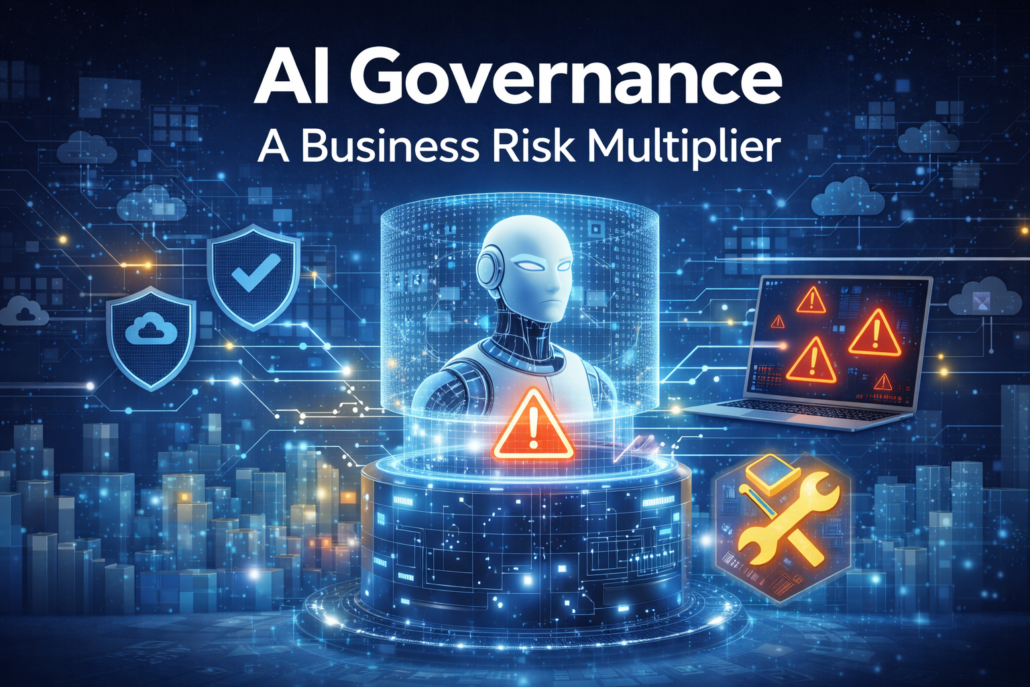
AI governance is becoming one of the most important topics in business today. AI is moving fast—faster than most organizations are prepared for—and the gap between adoption and governance is where real business risk is emerging. Organizations exploring AI in SAP Business One must balance innovation with control to ensure long-term success.
Let’s be clear.
Deploying AI without a plan, without understanding, and without governance is not innovation. It is exposure.
Across industries, companies are moving quickly from curiosity to deployment without putting structure in place. That approach may create short-term momentum, but it does not scale and it introduces avoidable operational and financial risk. As AI adoption accelerates, many companies are discovering that governance alone isn’t enough—true success depends on overall AI in ERP systems readiness.
At the recent SAP Partner Summit in Las Vegas, governance and responsible AI implementation were recurring themes in discussions about the future of ERP and enterprise automation. As AI becomes more deeply embedded in business systems like SAP Business One, structured governance is becoming just as important as the technology itself.
Organizations exploring AI in ERP environments must balance innovation with control to ensure long-term success.
Understanding AI Governance and the Two Types of AI in Business
Generative AI
Generative AI produces content, summaries, and recommendations.
Common use cases include:
- Writing emails and reports
- Summarizing operational data
- Assisting with customer service responses
- Creating documentation and communications
Risks include:
- Inaccurate or misleading outputs
- Data exposure through prompts
- Inconsistent results across users
In most cases, these risks are manageable because a human is reviewing the output before action is taken.
Generative AI is an assistant.
It supports decision-making but typically does not execute actions on its own.
Agentic AI
Agentic AI is fundamentally different.
It does not just assist. It acts.
- Executes workflows
- Makes operational decisions
- Updates systems
- Operates across multiple platforms
- Automates business processes
This is where the risk profile changes significantly.
When AI systems are allowed to act without defined boundaries, organizations introduce operational risk that can scale quickly and quietly across ERP systems, finance, inventory, and customer operations.
Real World AI Governance Failures That Highlight the Risk
These are not theoretical concerns. There are well-documented examples of AI systems creating real business impact when governance is missing.
Air Canada Chatbot Case
An AI chatbot provided incorrect refund guidance to a customer. The airline argued the chatbot was not authoritative. The tribunal disagreed and held the company accountable.
Source: https://www.bccrt.bc.ca (Moffatt v. Air Canada, 2024)
Samsung Data Exposure
Employees used a public AI tool and unintentionally uploaded sensitive internal information, including proprietary code.
Source: https://www.bloomberg.com/news/articles/2023-04-03/samsung-bans-chatgpt-after-sensitive-code-leak
Zillow Automated Decision Losses
Automated home purchasing decisions at scale resulted in more than $500 million in losses due to flawed assumptions and insufficient controls.
Source: https://investors.zillowgroup.com (Zillow shareholder communications, 2021)
Amazon Recruiting System Bias
An AI recruiting tool introduced bias into hiring recommendations and was ultimately shut down.
Source: https://www.reuters.com/article/us-amazon-com-jobs-automation-insight-idUSKCN1MK08G
These outcomes are predictable when AI systems operate without governance, structured data, and human oversight.
Why AI Governance Matters
AI does not understand business context.
It operates on patterns, rules, and data inputs.
If those inputs are flawed, incomplete, or inconsistent, the system will still act—and it will do so at speed and scale.
This is why clean ERP data and structured business processes are foundational to safe AI implementation. Without clean and reliable data, AI automation increases risk instead of improving efficiency.
Human in the Loop (HITL) becomes essential.
For any process that impacts:
- Financial outcomes
- Customer commitments
- Inventory and supply chain
- Compliance and contractual obligations
- ERP transactions and reporting
There must be a defined control point where a person can review, validate, and intervene.
This is not about slowing down innovation.
It is about preventing small issues from becoming large-scale operational failures.
Three AI Governance Non-Negotiables for Implementation
If you are implementing AI in your organization, three areas should never be optional.
1. Define the Use Case Clearly
Be specific about the problem you are solving and how success will be measured.
Avoid broad or undefined AI deployments.
AI should be applied to structured business processes where outcomes can be measured and controlled.
2. Understand the System
Know:
- where your data comes from
- how decisions are made
- how AI interacts with ERP and other systems
- where failure points exist
Organizations that understand their ERP integrations and automation workflows are better positioned to deploy AI safely and effectively.
3. Implement Governance
Establish:
- audit trails
- decision visibility
- escalation paths
- human oversight checkpoints
- system monitoring and reporting
Without governance, AI becomes difficult to manage and nearly impossible to scale responsibly.
AI Strategy for Scalable and Controlled Growth
The companies that will succeed with AI are not the ones that move first.
They are the ones that build structured and controlled systems.
Successful AI organizations focus on:
- controlled automation
- observable decision-making
- measurable outcomes
- scalable infrastructure
- governed ERP environments
AI is a force multiplier.
It amplifies whatever foundation you give it.
Strong structure creates competitive advantage. Weak structure creates operational risk.
Governance alone isn’t enough without clean data for AI in ERP systems.
Final Thought
AI has the potential to transform operations, improve efficiency, and unlock new growth opportunities.
But without governance, it introduces risk just as quickly.
Organizations that build structured AI governance frameworks today will be the ones that scale safely and successfully tomorrow.
If your organization is evaluating AI strategy, governance frameworks, or agentic AI deployment, now is the time to ensure the right structure is in place before scaling further.
You can learn more about how Support One approaches governed automation and AI through CoreFx here:
https://supportone.us/corefunction
Or connect with our team to discuss how to structure AI safely and effectively in your organization.
Jason Sproles
President and CEO
Support One, Inc.
Talk with an expert about how AI can deliver real results in your ERP system.

