
Clean Data for AI in ERP Systems: Why It Matters

Clean Data for AI in ERP Systems Starts With the Right Foundation
Clean data for AI in ERP systems is the foundation of every successful AI initiative. Strong ERP data quality enables artificial intelligence to generate accurate forecasts, automate business processes, and deliver reliable business insights. Companies are investing in artificial intelligence, automation, and machine learning to improve forecasting, streamline operations, and make better business decisions. However, without accurate, consistent, and reliable ERP data, even the most advanced AI tools will produce unreliable results.
As we’ve explored in AI in ERP Systems Readiness and throughout this AI in ERP systems series, successful AI adoption isn’t just about choosing the right technology—it’s about preparing the right data. Organizations that invest in clean ERP data, standardized business processes, and strong governance are far more likely to achieve measurable business value from AI.
Automation doesn’t fix bad data—it exposes it faster.
What Makes ERP Data AI-Ready?
Clean data is more than simply removing duplicate records. For AI to generate reliable insights, ERP data should be:
- Accurate
- Complete
- Consistent
- Current
- Standardized
- Free of unnecessary duplicates
When customer records, inventory items, supplier information, pricing, and financial transactions follow consistent standards, AI can recognize patterns with much greater accuracy.
Think of AI as an expert analyst learning from your ERP system. If the information it receives is inconsistent or incomplete, the recommendations it produces will also be inconsistent.
Organizations that prioritize clean ERP data build a stronger foundation for forecasting, automation, reporting, fraud detection, and strategic decision-making.
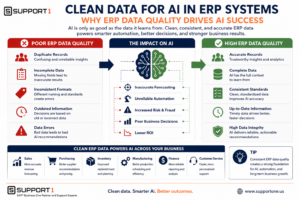
Clean data for AI in ERP systems starts with strong ERP data quality. This infographic compares the impact of poor versus high-quality ERP data on AI accuracy, automation, forecasting, fraud detection, and business performance.
Why Clean Data Matters More Than the AI Itself
AI systems learn from patterns. If your ERP data includes:
- Duplicate vendors
- Inconsistent naming
- Outdated or incomplete records
Then AI outputs will reflect those same issues.
This becomes especially critical in financial workflows like accounts payable, where even small inconsistencies can lead to major downstream problems.
The introduction of Ask AI in SAP Business One FP 2608 makes data quality even more important, because useful AI answers depend on accurate and consistent ERP information.
Why SAP Business One Ask AI Makes Data Quality More Important
The introduction of Ask AI in SAP Business One 10.0 FP 2608 makes ERP data quality even more important.
Ask AI gives users a conversational way to work with SAP Business One information. SAP also supports reusable question templates, including public questions that authorized users can make available to other employees.
This can make ERP information easier to explore, but AI does not magically correct inaccurate business data.
If customer records are duplicated, inventory quantities are wrong, item descriptions are inconsistent, or supplier information is outdated, AI is still working from an unreliable foundation.
The easier it becomes for employees to ask AI questions about ERP information, the more important it becomes that they can trust the information behind the answers.
Ask AI can make SAP Business One data easier to access. Clean data helps make that information worth trusting.
See ASK AI in action in these Two New Videos from SAP
Learn more about conversational ERP and the progression from Ask AI to AI agents in What Is an ERP AI Copilot?
AI-Generated Queries Still Depend on Reliable ERP Data
FP 2608 also introduces another important capability: AI can help users create SAP Business One user-defined queries from natural-language requests.
Instead of manually writing the entire SQL SELECT statement, a user can describe the information needed and use AI to help generate the query. SAP Business One requires AI-generated queries to be validated before they can be saved.
This can reduce the technical barrier to customized ERP analysis, but it does not eliminate the underlying data-quality requirement.
A technically correct query can still produce misleading business conclusions if the information being queried is incomplete, inconsistent, duplicated, or outdated.
That’s why ERP data quality becomes more—not less—important as AI makes sophisticated analysis easier to perform.
AI can make it easier to ask the question. Clean ERP data helps ensure the answer is based on reliable information.
Common Data Problems That Reduce AI Accuracy
Many organizations don’t realize how much poor-quality ERP data has accumulated over the years. Small inconsistencies that seem harmless during day-to-day operations can significantly reduce the effectiveness of AI.
Common examples include:
- Duplicate customer and vendor records
- Inconsistent item descriptions
- Missing units of measure
- Incorrect inventory quantities
- Outdated supplier information
- Inaccurate pricing
- Inactive products that remain in the database
- Missing bill of materials (BOM) details
Individually, these issues may seem minor. Together, they make it much harder for AI to recognize meaningful business patterns and generate trustworthy recommendations.
| ERP Data Issue | Impact on AI | Business Risk |
|---|---|---|
| Duplicate customers | Poor customer analysis | Lost sales opportunities |
| Duplicate vendors | Incorrect learning patterns | Payment errors |
| Incorrect inventory | Inaccurate forecasting | Stockouts or excess inventory |
| Missing pricing | Poor recommendations | Reduced profitability |
| Inconsistent item names | Weak AI analysis | Reporting errors |
Where Machine Learning Automation Delivers Real Value
Modern solutions like those from Traild Software are pushing automation beyond simple OCR into machine learning–enabled processing.
These systems can:
- Extract invoice data down to the line level, even from complex or handwritten formats
- Automatically assign GL codes, cost centers, and project allocations
- Learn from corrections over time to improve accuracy with each transaction
In many cases, this can eliminate up to 85% of manual AP work
This is where AI becomes practical—not theoretical.
The Hidden Challenge Behind Successful AI
Even the most advanced machine learning models rely on:
- Clean historical data
- Consistent formats
- Reliable supplier records
Without that:
- Coding errors increase
- Automation confidence drops
- Manual intervention creeps back in
The system can learn—but it needs a clean environment to learn correctly.
Fraud Protection: Where AI and Data Quality Intersect
One of the most powerful applications of AI in ERP systems is fraud detection—and this is where clean data becomes even more critical.
Platforms like Traild Software use always-on anomaly detection to:
- Scan every invoice automatically for unusual behavior
- Flag anomalies such as:
- Unusual payment changes
- High-value transactions
- Suspicious email geolocations
- Assign risk scores (red, amber, green) to invoices and suppliers
- Route high-risk invoices through approval workflows for investigation
This creates real-time visibility into risk—before payment is released.
This aligns with common AI in ERP systems risks, where poor data leads to unreliable outcomes.
Why Bad Data Weakens Fraud Detection
Fraud detection depends on understanding what “normal” looks like.
AI systems build a behavioral fingerprint of:
- Your business
- Your vendors
- Your transaction patterns
If your data is inconsistent:
- “Normal” becomes unclear
- False positives increase
- Real threats may go unnoticed
Clean data isn’t just operational—it’s a security requirement. This builds on the importance of Accurate ERP Data and automation.
AI Delivers Greater Value When Your Data Is Reliable
Although finance is one of the most visible areas for AI, clean ERP data improves decision-making throughout the organization.
| Business Function | How Clean Data Improves AI |
|---|---|
| Sales | More accurate revenue forecasting |
| Purchasing | Better supplier recommendations |
| Inventory | Improved replenishment planning |
| Manufacturing | Better production scheduling |
| Finance | More reliable reporting and analysis |
| Customer Service | Faster, more personalized support |
When every department works from reliable ERP data, AI becomes significantly more effective across the business—not just within a single workflow.
Creating a Strong Foundation for AI
Creating AI-ready ERP data isn’t a one-time cleanup project. It requires ongoing governance and consistent business processes.
Successful organizations typically:
- Define data ownership
- Standardize naming conventions
- Eliminate duplicate records
- Validate new data before it enters the ERP system
- Archive obsolete records
- Perform regular data quality reviews
These practices not only improve AI performance but also strengthen reporting, compliance, and operational efficiency.
10 Steps to Prepare Your ERP for AI
This checklist helps organizations improve ERP data quality before implementing AI:
- ✔ Removed duplicate customer and vendor records
- ✔ Standardized product and inventory naming
- ✔ Verified customer and supplier information
- ✔ Cleaned obsolete inventory records
- ✔ Reviewed pricing accuracy
- ✔ Validated bills of materials (BOMs)
- ✔ Eliminated incomplete records
- ✔ Defined data ownership responsibilities
- ✔ Documented data standards
- ✔ Scheduled regular ERP data audits
Organizations that complete these steps are far better positioned to achieve successful AI outcomes.
Clean ERP data is especially important when AI is introduced, because inaccurate or inconsistent information can quickly lead to unreliable recommendations and results.
As ERP systems incorporate more automation and AI, protecting the underlying business data remains an essential part of managing technology risk.
The Bigger Picture: Readiness Still Matters
All of this ties back to a larger issue:
Most companies are trying to adopt AI without addressing AI in ERP systems readiness.
Machine learning automation and fraud detection tools are powerful—but they depend on:
- Data quality
- Process consistency
- Governance
Without those, even the best tools will underperform.
Clean data is only one part of a successful AI strategy. Learn how it fits into the larger picture in our AI for SAP Business One: The Complete Guide, where we cover AI readiness, implementation, governance, and practical business applications.
Inventory forecasting is only as accurate as the data behind it. See how clean ERP data supports successful AI Inventory Management initiatives.
Purchasing recommendations are only as reliable as the ERP data behind them. Discover how clean ERP data supports successful AI Purchasing initiatives.
Accurate financial forecasting begins with reliable ERP data. Learn why clean data is essential for successful AI Financial Management initiatives.
Reliable ERP data becomes even more important with AI for Supply Chain Management, because decisions may depend on information flowing across sales, inventory, purchasing, production, and warehouse operations.
Reliable customer records, equipment history, technician notes, and inventory data are especially important for AI for Field Service Management, where poor information can lead to poor service decisions.
Data quality will become even more important as SAP Business One AI capabilities move beyond conversational analysis. FP 2608 also supports an open-source Model Context Protocol (MCP) server approach for integrating AI agents with the SAP Business One Service Layer. SAP provides sample code for partners developing AI scenarios around Business One.
As AI moves closer to business processes, reliable ERP data becomes increasingly important. An AI agent investigating an inventory shortage, customer order, purchasing exception, or overdue invoice needs accurate information and appropriate controls before its recommendations—or any approved actions based on them—can be trusted.
Related Reading: This is a practical look at AI in ERP systems what it actually does today—not theory.
Final Thoughts: Clean Data Is the Multiplier
Artificial intelligence doesn’t create business value on its own. It amplifies the quality of the information it’s given. Organizations that invest in ERP data quality are better positioned to realize the full value of AI.
That principle becomes even more important as capabilities such as SAP Business One Ask AI, AI-generated queries, and emerging AI-agent integrations make ERP information easier for people and AI systems to access and analyze.
Organizations with clean ERP data can use AI to improve forecasting, automate routine work, detect fraud, optimize inventory, and make faster, more confident business decisions.
Organizations with poor-quality data often experience the opposite—unreliable recommendations, inconsistent automation, and lower confidence in AI-generated insights.
Ultimately, clean data for AI in ERP systems enables:
- More accurate automation
- Better forecasting
- Stronger fraud detection
- Higher-quality reporting
- Faster decision-making
- Greater return on AI investments
Clean data is only valuable when it’s used effectively. See how businesses turn reliable ERP data into measurable business results in How AI Helps SAP Business One Users Increase Revenue and Profit.
The companies achieving the greatest success with AI aren’t necessarily using the most advanced technology—they’re building the strongest data foundation first.
Frequently Asked Questions
Why is clean data important for AI in ERP systems?
AI relies on historical ERP data to recognize patterns and make recommendations. Poor-quality data reduces the accuracy of forecasts, reporting, automation, and business insights.
Can AI clean system data?
AI can identify duplicate records, missing information, and data inconsistencies, but organizations still need governance and business rules to determine the correct information.
What is ERP master data?
Master data includes core business information such as customers, suppliers, inventory items, pricing, and chart of accounts. Maintaining accurate master data is essential for successful AI initiatives.
How often should ERP data be reviewed?
Most organizations should review data quality continuously, with formal audits performed quarterly or at least annually to maintain consistency and accuracy.
What is the biggest obstacle to successful AI adoption?
For many organizations, poor ERP data quality is one of the biggest barriers. Clean, standardized data provides the foundation that allows AI to deliver reliable business results.
Does SAP Business One Ask AI Require Clean Data?
Ask AI can make SAP Business One information easier to explore through natural-language questions, but the usefulness of the results still depends on the quality of the underlying business information. Accurate, complete, consistent, and current ERP data provides a stronger foundation for reliable AI-assisted analysis.
Continue the AI in ERP Systems Series
- AI in ERP: What It Actually Does Today
- Top 10 Use Cases That Deliver Real ROI
- Where AI in ERP Goes Wrong
- Why Most ERP Systems Aren’t AI-Ready
- Clean Data for ERP Systems: Why it Matters (Current)
- AI Governance in ERP: The Missing Piece
- AI vs Automation: Stop Confusing the Two
- Cloud ERP + AI: The Real Shift Happening in Business Software
- AI Agents in ERP: What They Actually Do
- AI Readiness Checklist for ERP Systems
- What is an ERP AI Copilot
Building AI-ready ERP data is one of the most important steps organizations can take to improve forecasting, automation, reporting, and long-term business performance. The right technology matters—but the right partner makes the difference.
Ready to Build an AI-Ready ERP Foundation?
Artificial intelligence can transform forecasting, automation, fraud detection, and decision-making—but only when it’s built on clean ERP data and a solid implementation strategy.
At Support One, we help manufacturers and distributors prepare their ERP systems for the future by improving data quality, optimizing business processes, and implementing practical AI solutions that deliver measurable business value.
Whether you’re planning your first AI initiative or looking to get more from SAP Business One, our team can help you build a reliable foundation for long-term success.
Learn why companies across the United States choose Support One as their trusted SAP Business One partner in our guide: Why Companies Choose Support One for SAP Business One Support.
Ready to discuss your AI strategy? Contact Support One today to schedule a conversation with one of our SAP Business One experts.

Talk with an expert about how clean ERP data can deliver real results in your ERP system.

