
The Most Common ERP Integrations for Manufacturing & Distribution
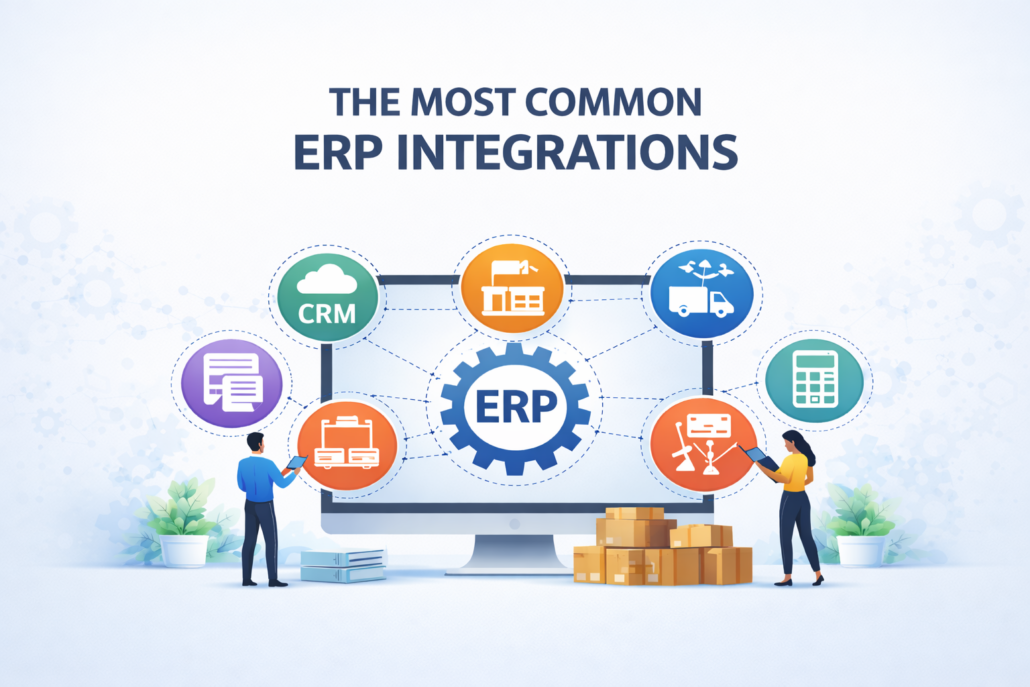
Common ERP integrations help manufacturing and distribution companies connect the software they use for sales, operations, finance, warehousing, shipping, and customer management. When these systems share data with the ERP, businesses can reduce duplicate entry, improve accuracy, automate routine processes, and give employees better information across the organization.
ERP integrations connect these systems into a unified environment, allowing information to flow automatically between applications.
In this article, we’ll explore the most common ERP integrations used by manufacturing and distribution organizations and explain how each one improves efficiency, accuracy, and scalability.
SAP Business One includes an Integration Framework designed to connect the ERP with third-party software, services, and other business systems.
Why Common ERP Integrations Matter
Without integrations, businesses often struggle with:
-
Duplicate data entry
-
Inconsistent information between systems
-
Slow order processing
-
Limited real-time visibility
ERP integrations eliminate these issues by creating a single source of truth and enabling automated workflows across departments.
The result is faster operations, better decision-making, and a stronger customer experience.
Integrations are one form of ERP customization that can extend system capabilities when properly planned.
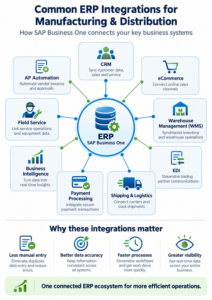
Common ERP integrations connect business systems with the ERP to reduce manual work and improve data flow.
CRM & ERP Integration
CRM and ERP integration connects sales activity with operations and finance.
What Gets Integrated
-
Customers and contacts
-
Quotes and opportunities
-
Sales orders
-
Order status
-
Invoice and payment history
Business Benefits
-
Sales teams see accurate order status
-
Operations receives clean orders
-
Finance has consistent customer data
This integration eliminates rekeying and improves coordination between sales and back-office teams.
ERP and CRM systems serve different purposes, but integrating them can give sales, service, operations, and finance a more complete view of the customer.
eCommerce & ERP Integration
eCommerce integration connects online stores with ERP so orders and inventory stay synchronized.
What Gets Integrated
-
Online orders
-
Products and pricing
-
Inventory levels
-
Order and shipment status
Business Benefits
-
Faster order processing
-
Accurate inventory visibility
-
Improved customer experience
For manufacturers and distributors selling online, this integration is essential.
Ecommerce integrations frequently expose inventory accuracy issues when stock levels fail to synchronize correctly between systems.
Shipping & Logistics Integration
Shipping integration connects ERP with shipping platforms and carriers.
What Gets Integrated
-
Shipment creation
-
Shipping labels
-
Tracking numbers
-
Freight costs
Business Benefits
-
Faster fulfillment
-
Reduced shipping errors
-
Real-time tracking visibility
This integration streamlines the entire shipping process.
Common ERP Integrations for Warehouse and Inventory Management
Warehouse integrations connect ERP with barcode scanning and warehouse management tools.
What Gets Integrated
-
Picking and packing confirmations
-
Inventory movements
-
Receiving transactions
-
Cycle counts
Business Benefits
-
Higher inventory accuracy
-
Faster warehouse operations
-
Fewer manual adjustments
This is especially valuable for high-volume environments.
While a WMS helps manage warehouse processes, the greatest value comes when warehouse operations are connected directly with your ERP system. Learn how SAP Business One WMS solutions help businesses improve efficiency and ROI.
EDI Integration
EDI (Electronic Data Interchange) integration automates document exchange with trading partners.
Common Documents
-
Purchase Orders
-
Sales Orders
-
Advance Ship Notices
-
Invoices
Business Benefits
-
Faster partner communication
-
Reduced manual entry
-
Improved compliance
EDI relies on standardized electronic business messages that allow trading partners to automate transactions such as orders, deliveries, invoicing, transportation, and warehouse activity.
Common ERP Integrations for Accounting & Finance
Financial integrations connect ERP with accounting, expense, or payment systems.
What Gets Integrated
-
Journal entries
-
Payments
-
Bank transactions
-
Expense reports
Business Benefits
-
Cleaner financial data
-
Faster month-end close
-
Better reporting
Manufacturing System Integrations
Manufacturers often integrate ERP with production systems.
Examples
-
Shop floor systems
-
Quality systems
-
Scheduling tools
Business Benefits
-
Real-time production visibility
-
Better planning
-
Reduced downtime
Each additional integration introduces potential points of failure. Organizations should understand the risks associated with connected systems and establish monitoring procedures to minimize disruptions. As organizations add more connected systems, monitoring ERP performance becomes increasingly important.
The greatest benefits often come when several systems work together, such as ERP, eCommerce, CRM, 3PL, and shipping platforms sharing information across one connected workflow.
The most useful common ERP integrations are usually the ones that eliminate duplicate work and connect the systems employees rely on every day.
Choosing the Right ERP Integrations for Your Business
Start by asking:
-
Where is manual data entry happening?
-
Which processes cause delays?
-
Where do errors occur most often?
-
Which systems must share data?
These answers point directly to your highest-priority integrations.
ERP Integrations + Automation = Greater Efficiency
Integrations move data between systems.
Automation uses that data to trigger actions.
Together, they create end-to-end digital workflows that dramatically reduce manual work.
How to Plan a Successful Integration Project
The right common ERP integrations can improve efficiency without forcing a company to replace every system it already uses.
How Support One Helps
Support One designs, implements, and supports ERP integrations for manufacturing and distribution companies.
Learn more about our ERP Integration Services:
👉 Support One Integration Services
Learn more about Support One’s Industry Leading Support Services: Why Choose Support One for SAP Business One Support
Common ERP Integrations Getting Started
ERP integrations are most valuable when they solve a specific business problem rather than simply adding more technology. For manufacturing and distribution companies, connecting systems such as CRM, eCommerce, WMS, EDI, shipping, payments, and field service can reduce manual work and create a more complete flow of information across the business. Support One helps SAP Business One users evaluate, plan, and implement integrations based on their operational priorities.
If you’re ready to connect your systems and eliminate manual processes, contact Support One to discuss your integration needs.

Interested in Common ERP Integrations to make your business more efficient? Let’s talk

