
How AI Improves Supply Chain Management with SAP Business One
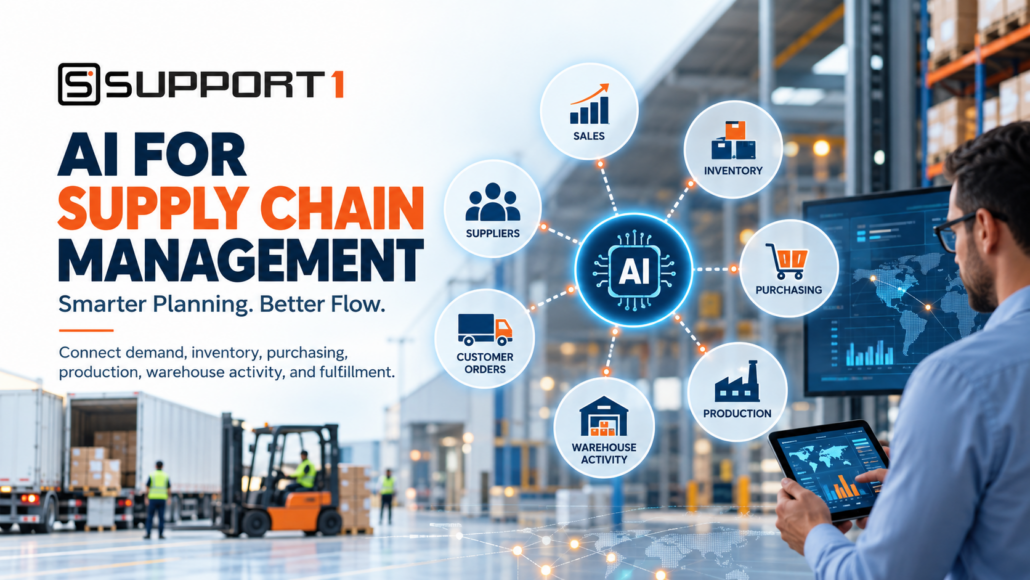
AI for Supply Chain Management with SAP Business One
AI for supply chain management can help businesses connect sales, inventory, purchasing, production, warehouse activity, suppliers, and customer orders. For SAP Business One users, AI supply chain management can make it easier to identify patterns, exceptions, risks, and relationships across the entire supply chain so employees can make faster, better-informed decisions.
The problem is that many businesses still manage these areas separately.
AI for supply chain management can help change that. Instead of looking at individual reports in isolation, artificial intelligence can help businesses identify patterns, exceptions, risks, and relationships across sales, inventory, purchasing, production, suppliers, and fulfillment.
For SAP Business One users, this creates an important opportunity. Much of the information needed to understand the supply chain is already being collected inside the ERP system. AI can help employees make better use of that information by highlighting what is changing, what may require attention, and where one problem could affect several other parts of the business.
The goal is not to replace experienced supply chain managers, buyers, planners, warehouse employees, or production teams. It is to give them better information sooner so they can make faster, more informed decisions.
What Is AI for Supply Chain Management?
AI for supply chain management uses artificial intelligence to analyze business information, recognize patterns, identify unusual conditions, and help employees make better decisions across the movement of products and materials.
Traditional ERP systems are excellent at recording what has happened. They track customer orders, purchase orders, inventory transactions, production activity, supplier information, warehouse movements, invoices, and other business activity.
AI adds another layer.
Instead of only asking, “What is our inventory level?” a company may be able to investigate questions such as:
- Which items are most likely to create shortages?
- Which customer orders could be affected by delayed materials?
- Which suppliers are becoming less reliable?
- Where are we carrying more inventory than current demand appears to justify?
- Which supply chain problems should management investigate first?
This is the difference between simply having data and using that data to support better decisions.
For SAP Business One users, AI supply chain management can potentially draw on information that already exists throughout the ERP environment and help connect activities that have traditionally been reviewed separately.
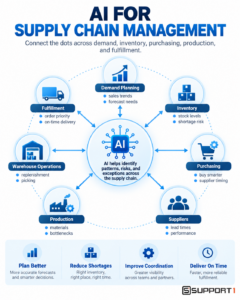
AI for supply chain management helps connect demand planning, inventory, purchasing, suppliers, production, warehouse operations, and fulfillment.
Why Supply Chain AI Is Different from Department-Level AI
We have already looked at how AI can help individual departments such as sales, inventory management, purchasing, manufacturing, finance, and warehouse operations.
Supply chain management is different because it focuses on what happens between those departments.
A sales increase may look like good news to the sales team, but it can create an inventory shortage. That shortage may require purchasing to expedite materials. A late supplier delivery can then delay production. The production delay may affect warehouse planning and ultimately put a customer shipment at risk.
Each department sees one part of the problem.
AI can help connect those pieces.
That makes supply chain management an especially valuable area for artificial intelligence because many costly problems develop through a series of connected events rather than one isolated transaction.
The biggest supply chain problems often occur between departments, not within them.
The real opportunity is therefore not simply to make purchasing smarter or inventory management faster. It is to help the entire organization understand how changes in one area may affect the rest of the supply chain.
1. Improve Demand and Supply Planning
One of the most important AI for supply chain management applications is improving the relationship between customer demand and supply.
Businesses have always tried to answer a basic question:
What will we need, and when will we need it?
The answer can depend on many different types of information, including:
- historical sales
- open customer orders
- seasonal demand
- inventory on hand
- purchase orders
- supplier lead times
- production requirements
- customer buying patterns
AI can help analyze these relationships and identify changes that might be difficult to spot in traditional reports.
For example, sales for an item may have increased gradually over several months. Inventory may still appear adequate today, but current open orders combined with longer supplier lead times could indicate a future shortage.
Instead of discovering the problem when stock is almost gone, AI can help employees investigate it earlier.
For manufacturers, the same analysis can help connect expected demand with raw materials and production requirements.
More sophisticated predictive forecasting may require additional AI tools, models, or integrations beyond standard SAP Business One functionality. But even without fully automated forecasting, AI can help businesses examine demand and supply information more quickly and ask better questions about what may happen next.
This builds naturally on the opportunities we discussed in AI for Sales, but expands the analysis beyond sales into inventory, purchasing, and production.
2. Identify Inventory Shortages Before They Become Problems
An inventory shortage rarely affects only the inventory department.
A missing component could delay production. A missing finished product could delay a customer order. A shortage may force purchasing to pay for expedited shipping or buy from a more expensive supplier.
That is why shortage identification is an important AI supply chain management use case.
AI can help analyze factors such as:
- current inventory quantities
- committed stock
- open sales orders
- incoming purchase orders
- historical demand
- production requirements
- supplier delivery patterns
Instead of simply showing that inventory is low, AI can help employees investigate why the shortage matters.
For example:
An item with low inventory but no current demand may not require immediate attention.
Another item with the same quantity could be critical because it is needed for several customer orders or upcoming production.
AI can help distinguish between those situations and focus attention on the items with the greatest business impact.
This is an important difference between basic inventory reporting and broader supply chain analysis.
The objective is not simply to identify low stock. It is to understand which shortages could affect customers, production, or profitability first.
For a deeper look at inventory-specific applications, see our article on AI Inventory Management.
3. Reduce Excess Inventory and Free Up Working Capital
Shortages are expensive, but carrying too much inventory can be expensive too.
Excess inventory ties up cash that could be used elsewhere in the business. It also creates additional storage costs and increases the risk of products becoming obsolete, damaged, or difficult to sell.
AI can help companies identify patterns that may contribute to excess inventory, including:
- declining sales
- slow-moving items
- unusually high stock levels
- repeated over-ordering
- changes in customer demand
- large safety-stock levels
- items with limited recent activity
Traditional inventory reports can identify slow-moving products, but AI can help employees look at several signals together.
For example, an item may still have regular sales, but inventory levels may have increased much faster than demand. Another item may have significant inventory on hand even though sales have been declining for several quarters.
These situations deserve different responses.
AI can help employees investigate where inventory may no longer match current demand and determine where purchasing, stocking, or planning decisions should be reviewed.
For SAP Business One users, this can connect inventory management directly to purchasing and financial performance.
Reducing unnecessary inventory is not simply an operational improvement. It can also release working capital and improve cash flow.
4. Improve Purchasing Decisions
Purchasing decisions affect almost every part of the supply chain.
Order too little and the company risks shortages.
Order too much and cash becomes tied up in inventory.
Order too late and production or customer deliveries may suffer.
AI for supply chain management can help purchasing teams evaluate more information before making those decisions.
Depending on the information available, AI analysis might consider:
- current inventory
- open purchase orders
- sales demand
- production requirements
- supplier lead times
- pricing history
- delivery performance
- minimum order quantities
- previous purchasing patterns
Instead of simply asking, “What should we reorder?” the purchasing team can begin asking more useful questions.
For example:
Which purchase orders deserve attention first?
Which items are likely to become critical before the next normal replenishment cycle?
Are we continuing to buy the same quantities even though demand has changed?
Which supplier provides the best combination of price, delivery reliability, and lead time for this requirement?
AI does not need to make the purchasing decision automatically to provide value. Helping a buyer identify the right issues and evaluate the relevant information faster can itself produce significant improvements.
Our AI for Purchasing article explores these applications in greater depth.
5. Monitor Supplier Performance and Risk
A business can have good inventory planning and still experience supply chain problems if suppliers do not perform as expected.
One late purchase order may not mean much.
Repeated delays from the same supplier could be a pattern.
AI can help companies examine supplier performance across factors such as:
- actual versus promised delivery dates
- lead-time changes
- incomplete shipments
- price increases
- order frequency
- quality problems
- purchasing volume
- dependency on individual suppliers
This can help purchasing and supply chain teams identify suppliers or materials that may require closer attention.
For example, a supplier’s average lead time may gradually increase over several months. Individually, each late delivery might not seem significant. Viewed together, the pattern may indicate that the purchasing team should adjust expected lead times, discuss performance with the supplier, or investigate alternative sources.
AI can also help identify supply chain concentration.
If one supplier provides a large percentage of an important component, that dependency may deserve additional attention even if the supplier has historically performed well.
The objective is not to have AI declare that a supplier will fail or predict every possible disruption. Supply chains are affected by events that ERP data alone cannot foresee.
The more practical goal is to use the information already available to identify risk signals earlier and help employees decide where additional investigation is warranted.
6. Coordinate Purchasing, Inventory, and Production
One of the biggest challenges in supply chain management is that purchasing, inventory, and production are often planned separately even though they depend on one another.
A change in demand can create a new production requirement. That production requirement may increase the need for raw materials. Purchasing then needs to consider the logistics and respond based on supplier lead times, current stock, open purchase orders, and production priorities.
AI can help employees examine these relationships together instead of relying on separate reports.
For example, a manufacturer may have enough inventory for today’s production schedule but not enough to support increased demand expected over the next several weeks. AI can help identify the relationship between:
- open sales orders
- inventory on hand
- planned production
- bill of materials requirements
- incoming purchase orders
- supplier lead times
This can help planners see where a shortage may develop before it causes a production delay.
The value comes from coordination.
A purchasing team may see that a material is below its usual reorder level. Production may know that the material is critical for an upcoming order. Sales may know that the customer involved is especially important. AI can help bring those pieces of information together so the business can make a better decision.
For SAP Business One users, this type of analysis can connect information already stored across purchasing, inventory, sales, and production.
The goal is not to let AI automatically change production plans or place orders without oversight. It is to help employees understand the downstream impact of a supply decision before the problem becomes urgent.
7. Detect Production and Supply Chain Bottlenecks
Supply chain delays are often caused by a bottleneck that starts in one area and then spreads throughout the business.
A delayed supplier shipment can hold up production.
A production delay can create a backlog.
A backlog can increase warehouse pressure.
Warehouse delays can then affect customer deliveries.
AI can help businesses look for patterns that indicate where these bottlenecks are forming.
Possible signals include:
- repeated material shortages
- delayed purchase orders
- work orders waiting on components
- growing production backlogs
- unusually long cycle times
- warehouse congestion
- increasing numbers of partially fulfilled customer orders
Traditional reports may show each condition separately. AI can help employees look at how the conditions are connected.
For example, if several production orders are delayed, the real cause may not be production capacity. The issue could be one component from one supplier that is repeatedly arriving late.
That distinction matters.
Without broader analysis, management may focus on the wrong problem.
AI supply chain management can help identify the likely source of a bottleneck and show which orders, customers, or processes may be affected.
For manufacturers, this builds directly on the opportunities discussed in our AI for Manufacturing article, but here the focus is on the full supply chain rather than production alone.
8. Improve Warehouse and Order Fulfillment
The warehouse is where many supply chain decisions become visible.
If purchasing buys too late, the warehouse may not have the materials needed.
If inventory records are inaccurate, pickers may waste time looking for products that are not actually available.
If order priorities are unclear, urgent shipments may be delayed behind less important work.
AI can help warehouse and fulfillment teams focus on the most important exceptions.
Potential applications include:
- prioritizing customer orders
- identifying incomplete orders
- highlighting items that need replenishment
- spotting unusual picking or shipping activity
- identifying orders waiting on unavailable inventory
- detecting recurring fulfillment delays
For example, two orders may both be scheduled to ship tomorrow.
One is complete and ready to pick.
The other is missing a critical item, and the incoming purchase order is already late.
Traditional reporting may show both orders as open. AI can help employees identify that the second order requires immediate attention.
This is where AI can improve fulfillment without necessarily automating the warehouse.
The goal is to help employees make better decisions about what needs attention first.
For SAP Business One users, warehouse, inventory, sales-order, and purchasing information can often provide the context needed to investigate these issues.
For a more detailed look at warehouse-specific applications, see our article on AI Warehouse Management.
Field service is another point where supply chain performance matters, and AI for Field Service Management can help connect parts, inventory, purchasing, technicians, and customer service.
9. Identify Customer Orders at Risk of Being Late
This may be one of the most valuable AI for supply chain management use cases because it connects nearly every part of the supply chain to the customer.
A late customer order can be caused by many different problems:
- inventory is unavailable
- a supplier shipment is delayed
- production is behind schedule
- a required component is missing
- the warehouse has not completed picking
- transportation timing has changed
The customer only sees one result: the order did not arrive when expected.
AI can help companies investigate the conditions behind open orders and identify which ones may deserve attention before they become late.
For example, AI analysis could help employees examine:
- promised ship dates
- inventory availability
- open purchase orders
- supplier delivery dates
- production status
- warehouse activity
- order priority
The goal is not necessarily to predict every late shipment with perfect accuracy.
A more practical goal is to identify orders with higher risk so employees can investigate them sooner.
That allows the company to respond while options still exist.
The team may be able to expedite a material, change production priorities, transfer inventory, contact a supplier, or communicate proactively with the customer.
That last point is important.
Supply chain AI is not only about efficiency. It can also improve customer service by giving employees earlier visibility into potential problems.
10. Create Supply Chain Exception Management
Many managers do not need another dashboard.
They need to know:
What requires my attention today?
This is where AI can become especially useful.
ERP systems contain enormous amounts of business information. The challenge is determining which changes are routine and which ones may indicate a problem.
AI can help create a more exception-driven approach to supply chain management.
Instead of reviewing dozens of reports, managers could focus on issues such as:
- critical inventory shortages
- late purchase orders
- supplier performance problems
- production delays
- unusual demand changes
- excess inventory
- delayed customer orders
- warehouse exceptions
- significant cost changes
The objective is not to hide information.
It is to help employees focus on the information that is most likely to require action.
For example, a supply chain manager may not need a list of every open purchase order. A more useful view might identify the small number of purchase orders that are late and are connected to important customer orders or production requirements.
That is a much more actionable question.
This is also where AI supply chain management can reduce the time employees spend manually searching through ERP reports.
Instead of asking employees to find the problem, AI can help surface the conditions that deserve investigation.
A useful principle is:
Don’t show managers everything. Show them what requires attention.
How SAP Business One Fits into AI Supply Chain Management
SAP Business One can provide much of the business information needed to support supply chain analysis.
Depending on how a company uses and configures the system, that information may include:
- sales orders
- customer history
- purchase orders
- supplier information
- inventory balances
- item master data
- warehouse transactions
- production activity
- bills of materials
- pricing
- invoices
- financial information
This matters because AI becomes more useful when it can examine relationships across the business.
A customer order is not just a sales transaction.
It may also affect inventory, purchasing, production, warehouse activity, cash flow, and customer service.
SAP Business One provides the underlying ERP structure that connects many of those processes.
AI can then help employees work with that information in new ways.
For example, instead of reviewing several separate reports, a user may be able to begin with a business question and investigate the related ERP information.
That does not mean every advanced supply chain AI capability is automatically included in SAP Business One.
Some applications, especially predictive forecasting, optimization, external risk monitoring, or sophisticated planning, may require additional software, integrations, data sources, or partner-developed solutions.
The important point is that SAP Business One can provide a strong operational data foundation for those applications.
Ask AI and Natural-Language Supply Chain Analysis
SAP Business One 10.0 FP 2608 introduces generative AI capabilities that make natural-language interaction with ERP information more practical.
Ask AI can help users work with SAP Business One information through conversational questions, while AI-generated user-defined queries can help turn natural-language requests into more structured analysis.
For supply chain teams, this creates an interesting shift.
Instead of always starting with a predefined report, employees can increasingly begin with a question.
Examples might include:
- Which items have low inventory and high open demand?
- Which suppliers have had the most delivery delays?
- Which customer orders may be affected by inventory shortages?
- Which products are carrying unusually high inventory?
- Which purchase orders may require immediate attention?
- Which production requirements are affected by missing materials?
The usefulness of the answers will still depend on the quality, completeness, and context of the underlying ERP data.
AI can make information easier to explore, but it does not replace good data, sound business processes, or experienced employees.
AI Agents and Future Supply Chain Workflows
The next stage of AI for supply chain management goes beyond answering questions.
It involves AI helping employees investigate issues, prepare recommendations, and potentially assist with defined business processes.
SAP Business One FP 2608 includes support for Model Context Protocol, or MCP, which creates a foundation for connecting AI agents with SAP Business One through the Service Layer.
This opens the door to partner-developed workflows that could eventually support scenarios such as:
- identifying a critical shortage
- determining which customer orders are affected
- reviewing available suppliers
- preparing a purchasing recommendation
- creating a draft transaction for employee review
- routing an exception to the appropriate manager
That is very different from saying SAP Business One now includes a broad collection of autonomous AI agents.
It does not.
The more accurate way to think about MCP is as an extensibility foundation that allows partners to build controlled AI applications around SAP Business One processes.
For supply chain management, this is particularly interesting because so many decisions cross multiple departments.
The long-term opportunity is not simply an AI assistant that answers a question.
It is an AI system that can help employees understand a problem, investigate the relevant business information, and prepare the next step while keeping people in control.
From Supply Chain Visibility to Better Decisions
The ten use cases in this article all point toward the same idea.
AI becomes most valuable when it helps businesses see the relationships between demand, inventory, purchasing, suppliers, production, warehouses, and customer orders.
A shortage is not just an inventory problem.
A late supplier shipment is not just a purchasing problem.
A delayed production order is not just a manufacturing problem.
Each can affect the entire supply chain.
AI helps connect the dots.
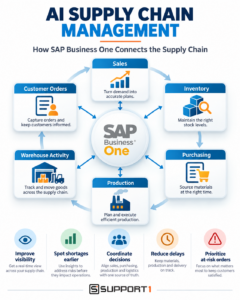
AI supply chain management helps SAP Business One users connect sales, inventory, purchasing, production, warehouse activity, and customer orders for better visibility and faster decisions.
Practical AI Prompts for Supply Chain Teams
One of the easiest ways to start using AI for supply chain management is to begin with practical business questions.
The most useful prompts are usually not highly technical. They are questions that supply chain managers, buyers, planners, warehouse teams, and operations leaders already ask.
Examples include:
Which products are most likely to experience shortages based on current inventory, open sales orders, purchase orders, and recent demand?
Which open customer orders are at the greatest risk of being delayed?
Identify suppliers whose average lead times have increased during the past six months.
Which items have high inventory levels but declining sales?
Show materials that could delay current production orders.
Which purchase orders should our purchasing team review first and why?
Identify supply chain exceptions that management should investigate this week.
Summarize the biggest inventory, purchasing, production, supplier, and fulfillment risks currently affecting customer orders.
These prompts can help employees move from static reporting toward more conversational analysis.
The quality of the response will still depend on the information available to the AI system, the permissions of the user, and the quality of the underlying ERP data.
The goal is not simply to ask more questions.
It is to ask better questions that lead to better decisions.
Best Practices for Using AI in Supply Chain Management
AI can provide real value in supply chain management, but the best results usually come from starting small and focusing on specific business problems.
Start with a Defined Problem
Do not begin with, “How can we use AI?”
Begin with a problem such as:
- We have too many stockouts.
- We are carrying too much inventory.
- Supplier delays are hurting production.
- Customer orders are shipping late.
- Buyers spend too much time reviewing reports.
- Managers do not know which exceptions require attention.
A clearly defined problem makes it much easier to determine whether AI is actually helping.
Use Clean and Reliable ERP Data
AI depends heavily on the quality of the information it analyzes.
Duplicate customers, inaccurate inventory, outdated supplier information, inconsistent item descriptions, or incorrect lead times can all reduce the usefulness of AI-assisted analysis.
As AI becomes easier to use, ERP data quality becomes even more important.
Before expanding AI across the supply chain, make sure the information inside SAP Business One is accurate enough to support the decisions you want employees to make.
Keep Employees Involved
Experienced supply chain employees understand details that may not exist in ERP data.
They know which suppliers are dependable during busy periods, which customers frequently change orders, which production constraints matter most, and which exceptions deserve immediate attention.
AI should support that experience, not replace it.
Verify Important Recommendations
AI-generated analysis should be reviewed before employees make important purchasing, production, inventory, or customer-service decisions.
This is especially important when recommendations could affect:
- large purchases
- important customers
- production schedules
- cash flow
- supplier relationships
Human review should remain part of the process.
For organizations developing formal AI policies, the NIST AI Risk Management Framework provides a useful framework for managing AI risk and promoting trustworthy AI practices.
Measure Business Results
A successful AI supply chain management project should improve something measurable.
Possible metrics include:
- fewer stockouts
- lower excess inventory
- improved on-time delivery
- shorter lead times
- fewer expedited purchases
- reduced late orders
- improved supplier performance
- lower working capital requirements
The goal is not to deploy AI.
The goal is to improve the business.
Common Mistakes to Avoid
AI can improve supply chain management, but several mistakes can limit the results.
Trying to Automate Everything
The first AI project does not need to automate the entire supply chain.
Decision support is often a better place to start.
Use AI to identify problems, summarize information, and help employees prioritize work before trying to automate transactions or approvals.
Using Poor Data
AI cannot turn inaccurate information into reliable analysis.
If inventory balances, supplier lead times, item records, or customer information are unreliable, those issues should be addressed before depending heavily on AI.
Treating Predictions as Certainty
Forecasts and risk indicators are estimates.
Demand can change. Suppliers can experience unexpected problems. Customers can change orders. External events can disrupt even the best supply chain plan.
AI can help identify probabilities and patterns, but it cannot eliminate uncertainty.
Ignoring Broken Processes
AI should not be used to hide a poor process.
If purchasing approvals are unclear, inventory transactions are inconsistent, or departments do not communicate, adding AI may simply make those weaknesses more visible.
Fix the process where necessary.
Excluding the People Who Do the Work
Supply chain employees should be involved in selecting use cases and evaluating results.
They often know which problems are worth solving and which AI recommendations are realistic.
Chasing AI Instead of Business Value
The newest AI feature is not automatically the most valuable one.
A simple system that identifies five critical late orders every morning may deliver more business value than a complicated AI project that employees rarely use.
Start with the problem. Then choose the technology.
Frequently Asked Questions About AI for Supply Chain Management
What Is AI for Supply Chain Management?
AI for supply chain management uses artificial intelligence to help businesses analyze demand, inventory, purchasing, suppliers, production, warehouse activity, and customer orders.
AI can identify patterns, highlight exceptions, summarize information, and help employees prioritize decisions across the supply chain.
How Can AI Help SAP Business One Users Manage the Supply Chain?
SAP Business One can contain much of the operational information needed to understand the supply chain, including sales orders, purchase orders, inventory, suppliers, production, warehouses, and financial data.
AI can help users investigate relationships across that information, identify exceptions, and ask more natural business questions.
More advanced forecasting, optimization, and automation may require additional tools, integrations, or partner-developed solutions.
Can AI Predict Inventory Shortages?
AI can help identify conditions that may indicate a future shortage by analyzing factors such as current stock, open orders, demand patterns, supplier lead times, purchase orders, and production requirements.
However, AI predictions are not guarantees.
Unexpected demand changes, supplier disruptions, data errors, and external events can still affect actual results.
Does SAP Business One Include Supply Chain AI?
SAP Business One has begun adding native generative AI capabilities, including conversational AI and AI-assisted query generation.
These capabilities can help users work with ERP information more naturally.
However, advanced supply chain functions such as predictive optimization, autonomous planning, or sophisticated supplier-risk analysis may require additional applications, integrations, external data, or partner-developed solutions.
Will AI Replace Supply Chain Planners and Managers?
AI is more likely to change how supply chain professionals work than replace the need for experienced people.
AI can help analyze information, identify exceptions, and prepare recommendations.
People are still needed to understand business context, evaluate tradeoffs, communicate with suppliers and customers, approve decisions, and respond to unexpected situations.
The strongest approach combines AI analysis with human experience.
Getting Started with AI for Supply Chain Management
Businesses do not need to redesign the entire supply chain to begin experimenting with AI.
A practical starting point is to identify one recurring problem that already has good data behind it.
For example:
- frequent inventory shortages
- excess inventory
- late supplier deliveries
- production delays
- late customer orders
- time-consuming weekly supply chain reporting
Then ask several questions.
Do we have the necessary information in SAP Business One?
Is the information accurate?
Who currently investigates the problem?
How long does that process take?
What decision does the employee ultimately make?
Could AI help identify the problem earlier or reduce the time required to investigate it?
Starting with a specific problem makes it easier to evaluate AI objectively.
If the project works, expand to the next use case.
Over time, those individual applications can create a more connected and intelligent supply chain.
How Support One Can Help
SAP Business One already provides many manufacturers and distributors with the operational foundation needed to manage sales, inventory, purchasing, production, warehousing, suppliers, and financial information.
The next question is how to make better use of that information.
Support One can help SAP Business One users evaluate where AI may provide practical value, including:
- assessing ERP data quality
- identifying useful AI use cases
- reviewing business processes
- evaluating integrations
- improving reporting and visibility
- identifying opportunities for automation and AI
- helping establish appropriate controls and governance
The objective is not to add AI simply because it is available.
It is to identify where AI can help employees make better decisions, solve real operational problems, and improve measurable business results.
See why companies are Choosing Support One for their SAP Business One support.
AI Helps Connect the Supply Chain
The biggest opportunity for AI for supply chain management is not simply improving one department.
It is helping businesses understand how decisions and problems move across the organization.
Sales affects demand.
Demand affects inventory.
Inventory affects purchasing.
Purchasing affects suppliers and production.
Production affects warehouse activity.
Warehouse performance affects customer delivery.
And every one of those decisions affects financial performance.
AI can help connect those relationships, identify exceptions earlier, and give employees better information before small problems become expensive ones.
AI does not replace the supply chain. It helps people see the supply chain more clearly.
Ready to Explore AI in Your SAP Business One Environment?
Support One can help you evaluate your data, processes, and current SAP Business One environment to identify practical opportunities for AI.
Schedule Your Complimentary AI Readiness Review and discover where AI could deliver the greatest value for your business.

Let’s Schedule Your AI Readiness Review.

