
How AI Improves Field Service Management with SAP Business One

AI for Field Service Management: Smarter Service with SAP B1
AI for field service management can help service organizations improve scheduling, technician preparation, parts planning, equipment diagnostics, and customer communication. For companies exploring AI field service management, the biggest opportunity is using better data and smarter analysis to help dispatchers, technicians, and service managers make faster, more informed decisions.
That creates a natural opportunity for AI for field service management.
Artificial intelligence can help field service teams analyze service history, identify patterns, prioritize work, summarize information, and make better decisions before and during a service visit. Instead of replacing dispatchers, technicians, or service managers, AI can help those employees work with better information and spend less time searching through disconnected records.
For businesses using ERP systems such as SAP Business One, much of the information needed to support field service decisions may already exist in the ERP environment. Customer records, service history, parts, inventory, billing information, and equipment data can all help provide useful context.
The goal is simple:
Right technician. Right information. Right parts. Right time.
What Is AI for Field Service Management?
AI for field service management uses artificial intelligence to help service organizations plan, prioritize, analyze, and improve field-service work.
Traditional field service management software helps companies manage activities such as:
- service calls
- work orders
- technician schedules
- customer information
- equipment
- parts
- service history
- billing
AI can add another layer by helping employees identify patterns and exceptions in that information.
For example, instead of simply seeing a list of open service calls, a dispatcher may want to know:
- Which jobs are most urgent?
- Which technician is best suited for a particular piece of equipment?
- What parts are most likely to be needed?
- Has this customer experienced the same problem before?
- Which jobs are at risk of requiring a second visit?
- Which service calls are most likely to miss a service commitment?
This is where AI field service management can be useful.
The value does not come from having AI make every decision automatically. It comes from helping employees understand what deserves attention and giving them better information before they act.
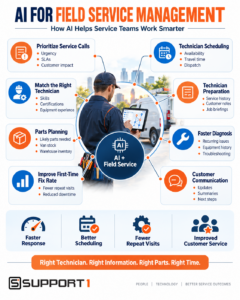
AI for field service management can help service teams prioritize calls, improve technician scheduling, prepare technicians, plan parts, diagnose problems faster, and improve customer service.
Why Field Service Is a Strong AI Opportunity
Field service is especially well suited to AI because decisions often have to be made quickly.
A technician may be heading to a customer site with limited information.
A dispatcher may have dozens of open jobs and several technicians with different skills.
A service manager may need to understand why repeat visits are increasing.
A customer may want an update before anyone has had time to review the complete service history.
AI can help reduce the time required to gather and interpret the information behind those decisions.
For example, a service organization may already have:
- customer history
- technician experience
- equipment records
- parts usage
- prior service notes
- service-call status
- travel information
- billing history
The challenge is that the information may be spread across multiple records, reports, or systems.
AI can help summarize that information and highlight relationships that might otherwise take employees much longer to find.
That makes field service a good example of where AI can support people without taking them out of the process.
A useful way to think about it is:
Field service is not just about sending someone to a job. It is about sending the right person, with the right information and the right parts, at the right time.
1. Prioritize Service Calls
Not every service call has the same level of urgency.
One customer may have a minor issue that can wait until tomorrow. Another may have a critical piece of equipment down, a contract commitment, or a problem that is already affecting production.
AI can help service teams evaluate multiple factors at once and identify which jobs may need attention first.
Those factors could include:
- service-call priority
- customer importance
- service-level commitments
- equipment type
- repeat failures
- downtime impact
- age of the open service call
- parts availability
- technician availability
Instead of simply working through a queue in the order that calls were received, a dispatcher can use AI-assisted analysis to understand which calls could create the greatest business impact if they are delayed.
This does not mean AI should automatically override the dispatcher.
The dispatcher may know that a customer has special circumstances or that a technician is already nearby.
The value comes from giving the dispatcher another layer of information.
For example, AI might identify a call as high risk because the same piece of equipment has failed several times recently and the customer has already experienced significant downtime.
That is much more useful than simply seeing “Priority: High” on a work order.
2. Improve Technician Scheduling and Dispatch
Technician scheduling can become complicated very quickly.
A service manager may need to consider:
- technician availability
- location
- travel time
- skills
- certifications
- customer requirements
- job duration
- service priority
- parts availability
Trying to balance all of those factors manually can take time.
AI based scheduling can help dispatchers review the available information and identify scheduling options that may make better use of technician time.
For example, two technicians may both be available.
One may be closer to the customer, while the other may have more experience with the equipment involved.
The best choice may depend on the urgency of the job, expected repair difficulty, parts availability, and the rest of the day’s schedule.
AI can help bring those factors together.
That does not mean every field service organization needs fully automated scheduling.
In many cases, AI for field service management can create value simply by helping dispatchers compare options faster and recognize potential conflicts before assigning the job.
This can help reduce unnecessary travel, improve response times, and make better use of available technicians.
3. Match the Right Technician to the Job
Scheduling determines who is available.
Technician matching asks a different question:
Who is most likely to handle this job successfully?
AI can help evaluate factors such as:
- technician skills
- equipment experience
- certifications
- previous service history
- first-time fix performance
- customer familiarity
- geographic location
For example, a technician may technically be available and qualified for a job, but another technician may have repaired the same equipment model several times before.
That experience could increase the likelihood of resolving the issue on the first visit.
The same principle can apply to customers.
A technician who already understands a customer’s facility, equipment, or operating environment may be able to work more efficiently than someone arriving for the first time.
AI technician matching can help identify those relationships.
The final assignment should still consider real-world factors that may not appear in the data, but AI can help service managers make technician-selection decisions with more context.
4. Prepare Technicians Before They Arrive
One of the most practical uses of AI in field service is helping technicians prepare before they arrive at the customer site.
A technician may need to understand:
- the equipment involved
- previous service calls
- recurring problems
- prior technician notes
- parts replaced previously
- open customer issues
- warranty or service information
Finding and reading all of that information manually can take time.
AI can help summarize it.
For example, before a technician leaves for a job, an AI-generated briefing could potentially highlight:
- the customer’s recent service history
- the equipment involved
- the last repair performed
- recurring symptoms
- likely parts that may be required
- unresolved issues from previous visits
This can give the technician a better starting point.
Instead of arriving and asking the customer to explain the entire problem again, the technician can arrive with useful context.
That can improve both efficiency and customer experience.
It can also reduce the amount of time technicians spend searching through old records on a phone, tablet, or laptop.
Field service information can also create sales opportunities, and AI for Sales can help identify customers who may need replacement products, upgrades, or additional services.
5. Improve Parts Planning
A technician can arrive at the right place with the right skills and still fail to complete the job if the necessary part is unavailable.
That makes parts planning a critical part of field service management.
AI can help analyze information such as:
- parts used on similar jobs
- equipment type
- prior repair history
- technician van inventory
- warehouse inventory
- local stock availability
- recurring failure patterns
The goal is not necessarily to predict the exact part required every time.
A more practical goal is to improve the probability that the technician has the parts most likely to be needed.
For example, if a particular equipment model frequently requires one of three replacement components, AI could help highlight those parts before the technician leaves.
It may also identify whether the required parts are:
- already on the technician’s vehicle
- available in a warehouse
- at another nearby location
- currently on order
This connects field service directly to inventory and supply chain management.
Better parts preparation can reduce return visits, improve technician productivity, and increase the chance of resolving the customer’s issue on the first trip.
Field service does not operate in isolation, and AI for Supply Chain Management can help connect parts availability, purchasing, inventory, and customer demand with service operations.
Better Preparation Creates Better Service
These first five applications all focus on what happens before or at the beginning of the service visit.
AI can help service teams decide:
- which calls matter most
- which technician should go
- when the technician should go
- what the technician should know
- what parts the technician may need
That is a major part of improving field service performance.
But the opportunity does not stop once the technician arrives.
In Part 2, we’ll look at how AI can help with equipment diagnosis, repeat service issues, first-time fix rates, customer communication, and field-service exception management.
6. Help Diagnose Equipment Problems
Field technicians often arrive at a customer site with limited time to determine what is wrong.
The faster they can understand the problem, the faster they can begin working toward a solution.
AI for field service management can help technicians and service teams analyze information such as:
- equipment type
- service history
- previous failures
- technician notes
- error descriptions
- parts replaced previously
- similar service calls
AI can use those patterns to help identify likely causes or suggest areas that deserve further investigation.
For example, if a particular piece of equipment has experienced the same symptom several times and the same component has previously failed, AI can help bring that history to the technician’s attention.
This does not mean AI should make the diagnosis by itself.
Field service work often involves physical inspection, testing, customer input, and technical judgment that cannot be replaced by historical data alone.
The better use of AI is to give the technician a stronger starting point.
Instead of spending the first part of the visit searching through old service records, the technician can begin with a summary of what has happened before and which issues may be worth checking first.
That can reduce diagnostic time and help technicians work more efficiently.
For manufacturers servicing installed equipment, AI for Manufacturing can help connect production, equipment, parts, and service information.
7. Identify Repeat Service Issues
One service call may be an isolated problem.
Several similar service calls may indicate a pattern.
AI can help service organizations identify those patterns by analyzing:
- repeat visits
- recurring equipment failures
- repeated customer complaints
- parts replaced multiple times
- technician notes
- service-call categories
- time between failures
This can help managers distinguish between a one-time repair and a problem that may require deeper investigation.
For example, a customer may have called three times during the past six months about the same piece of equipment.
Each individual service call may have been closed successfully.
But when those records are analyzed together, the pattern may show that the underlying issue was never fully resolved.
AI can help surface those situations.
The same analysis can be useful across multiple customers.
If the same equipment model repeatedly experiences a similar failure, service management may want to investigate the equipment, installation process, maintenance procedure, or replacement part involved.
This is where AI field service management can help move a company from reactive service toward more proactive problem solving.
The goal is not simply to close the current work order.
It is to understand whether the problem is likely to happen again.
8. Improve First-Time Fix Rates
Few field service metrics are as important as the first-time fix rate.
When a technician solves the problem during the first visit, the company avoids:
- an additional trip
- additional travel time
- another scheduling requirement
- additional administrative work
- more customer downtime
- increased customer frustration
Improving the first-time fix rate usually requires several parts of field service management to work together.
The right technician needs to be assigned.
The technician needs useful information.
The correct parts need to be available.
The likely problem needs to be understood.
That makes first-time fix performance an excellent example of how several AI applications can work together.
AI can potentially help by:
- matching technician skills to the service call
- summarizing equipment history
- identifying recurring failures
- recommending likely parts
- highlighting previous unsuccessful repairs
- identifying similar service situations
No single recommendation guarantees that the technician will solve the problem on the first visit.
But better preparation can improve the odds.
Improving the first-time fix rate can reduce repeat visits, technician travel, customer downtime, and service costs at the same time.
That makes it one of the most practical business outcomes for AI in field service.
Accurate inventory information is especially important in field service because AI Inventory Management can help teams understand parts availability, shortages, and stocking needs before a technician is dispatched.
9. Improve Customer Communication
Customers want to know what is happening with their service request.
They may want to know:
- Has the service call been received?
- When will the technician arrive?
- Is the necessary part available?
- Has the repair been completed?
- What work was performed?
- Is additional service required?
Keeping customers informed can improve the service experience, but writing updates and summaries also takes employee time.
AI can help support customer communication by drafting:
- appointment confirmations
- technician arrival updates
- service-delay notifications
- completed-work summaries
- follow-up messages
- explanations of next steps
For example, after a service visit, technician notes may be detailed and technical.
AI could help turn those notes into a shorter, customer-friendly summary explaining what was found, what work was performed, and whether further action is required.
This can save time while helping customers receive more consistent communication.
Human review is still important.
Customer-facing messages should be checked for accuracy, especially when they involve pricing, warranties, contractual commitments, equipment safety, or promised completion dates.
The goal is not to remove people from customer communication.
It is to help them communicate more quickly and clearly.
Field service is a major part of the customer experience, and AI Customer Service can help improve communication, response times, and follow-up.
10. Identify Field Service Exceptions
Service managers often have access to more information than they have time to review.
There may be dozens or hundreds of open service calls, technician schedules, customer records, parts requirements, and completed jobs.
The real challenge is identifying which ones need attention.
This is where AI can support exception management.
Instead of asking managers to review every service call, AI can help surface situations such as:
- overdue service calls
- jobs that remain unassigned
- repeated equipment failures
- missed appointments
- parts shortages
- technician overload
- service calls approaching SLA limits
- unusually long job durations
- completed jobs waiting for billing
- customers with repeated unresolved issues
For example, a service manager may not need to see every open job.
A more useful view might show:
- three high-priority jobs still unassigned
- two service calls waiting on unavailable parts
- one customer with its third repeat visit
- four jobs approaching a service-level deadline
That gives the manager something actionable.
A useful principle is:
Managers do not need to review every service call. They need to know which service calls require attention.
This is one of the areas where AI for field service management can provide value without requiring full automation.
AI can help identify the exceptions.
People can decide what to do about them.
Using AI Across ERP and Field Service Management
Field service rarely operates as a completely separate business function.
A service visit may involve customer records, equipment, inventory, purchasing, technician activity, billing, contracts, and financial information.
That creates an important connection between field service management and ERP.
A field service system can help manage the operational side of service, while the ERP system can provide broader business context.
Together, those systems can create a stronger foundation for AI.
Read more: SAP Field Service and Asset Management
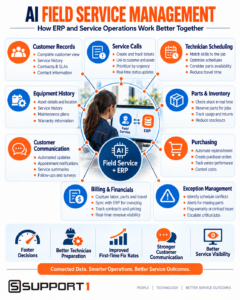
AI field service management works best when field service and ERP data are connected across scheduling, equipment, parts, purchasing, billing, and customer service.
How SAP Business One Supports Field Service AI
For businesses using SAP Business One, useful field service information may already exist across several areas of the ERP system.
Depending on how the system is configured and used, that may include:
- customers
- service calls
- equipment records
- service contracts
- inventory
- replacement parts
- purchasing
- invoices
- financial history
This information can help provide context for AI-assisted service decisions.
For example, a service manager may want to know not only that a customer has an open service call, but also:
- whether the customer has had repeated service problems
- whether the required parts are available
- whether a replacement part is already on order
- what previous repairs were performed
- whether the work has been billed
AI can help employees explore relationships across that information more efficiently.
That does not mean SAP Business One automatically includes every advanced field service AI capability discussed in this article.
Scheduling optimization, predictive maintenance, advanced diagnostics, route optimization, or other specialized capabilities may require additional field service software, integrations, external data, or partner-developed applications.
The important point is that ERP data can provide an important part of the information foundation.
Reliable service records, technician notes, customer information, and inventory data are essential, which is why Clean Data for AI in ERP Systems should be part of any field-service AI strategy.
Where CoreFunction Field Service Fits
Field service teams also need an operational system that supports the day-to-day work of managing technicians, jobs, schedules, and service activity.
That is where products such as CoreFunction Field Service can fit.
CFX Field Service is being developed as a separate field service management solution that can work alongside ERP environments. Its role is different from the ERP itself.
An ERP system can provide customer, inventory, purchasing, financial, and transactional information.
A field service platform can focus more directly on activities such as:
- service jobs
- technician assignments
- schedules
- field activity
- mobile work
- service execution
Connecting those two layers can create a more complete view of service operations.
For example, a technician may need field-service information about the current job, but also ERP information about:
- the customer
- equipment
- parts availability
- purchasing
- prior transactions
- billing
That connected environment can also create a stronger foundation for AI because the AI system can potentially work with a broader set of relevant business information.
Because CoreFunction Field Service is still approaching release, its final launch capabilities should be confirmed before specific AI features or automation functions are presented publicly.
Watch: The Two Latest Videos on the CoreFunction Field Service application
The broader opportunity, however, is clear:
Better-connected field service and ERP data can give AI more useful context for helping employees make decisions.
CoreFunction can extend SAP Business One beyond field service by helping businesses automate additional operational workflows while keeping information connected to SAP B1.
AI and the Future of Field Service Workflows
The next stage of field service AI goes beyond answering questions or summarizing information.
It involves AI helping employees move from identifying a problem toward preparing the next action.
A future workflow might look something like this:
A customer creates a service request.
AI reviews the customer’s service history and equipment information.
The system identifies technicians with relevant skills and experience.
It checks likely parts requirements and availability.
The technician receives a summary before the visit.
During or after the job, AI helps summarize technician notes.
The service manager sees any exceptions that still require attention.
The customer receives an appropriate follow-up.
Not every organization will need this level of automation, and not every step should happen without human review.
But the direction is important.
The value of AI in field service is likely to grow as field service data, ERP information, mobile technology, and AI become more connected.
The objective should not be autonomous service for its own sake.
The objective should be a better service process.
From Better Field Work to Better Business Results
The second half of these use cases shows that AI can support much more than scheduling.
It can help service organizations:
- diagnose problems faster
- identify recurring failures
- improve first-time fix rates
- communicate with customers
- identify exceptions
- connect field activity with ERP information
Together with the preparation-focused applications in Part 1, this creates a simple field service objective:
Right technician. Right information. Right parts. Right time.
In Part 3, we’ll turn that into practical action with AI prompts for field service teams, best practices, mistakes to avoid, FAQs, and guidance for getting started with AI in field service management.
Practical AI Prompts for Field Service Teams
One of the easiest ways to begin using AI for field service management is to start with questions that dispatchers, technicians, and service managers already ask every day.
Useful prompts might include:
Which open service calls should be prioritized first based on urgency, customer impact, equipment history, and service commitments?
Which technicians have the most experience with this type of equipment or repair?
Summarize this customer’s recent service history before the technician arrives.
Which parts were most frequently used on similar service calls?
Identify equipment with repeated failures or multiple service visits during the past six months.
Which current service calls appear most likely to require a second visit?
Which jobs are at risk of missing service-level commitments?
Summarize the most important field service exceptions management should review today.
The quality of these answers depends on the information available to the AI system.
If technician notes are incomplete, equipment records are inconsistent, or parts information is inaccurate, the results will be less useful.
The goal is not simply to ask AI more questions.
It is to help employees find important information faster and make better decisions with it.
Best Practices for Using AI in Field Service Management
AI can improve field service operations, but the best results usually come from solving specific operational problems rather than trying to automate everything at once.
Start with One Field Service Problem
A good AI project begins with a clear problem.
Examples include:
- too many repeat visits
- poor first-time fix rates
- slow technician assignment
- frequent parts shortages
- missed service commitments
- too much time spent reviewing old service records
- customers not receiving timely updates
Once the problem is clear, it becomes easier to determine whether AI is actually improving the process.
Use Reliable Service and Equipment Data
AI depends on the quality of the information it receives.
Incomplete equipment history, inconsistent technician notes, duplicate customer records, inaccurate inventory, or outdated service information can reduce the value of AI-assisted analysis.
Field service organizations should pay particular attention to:
- equipment records
- service history
- technician notes
- parts usage
- customer information
- job status
- inventory availability
Clean, consistent data gives AI a stronger foundation.
Involve Dispatchers and Technicians
The people doing the work understand field service in ways that software cannot.
Technicians know which symptoms matter.
Dispatchers understand scheduling realities.
Service managers know which exceptions deserve immediate attention.
Those employees should be involved when selecting AI use cases and evaluating recommendations.
AI should support their experience rather than work around it.
Keep Human Review in the Process
Important field service decisions should still involve people.
This is especially true when decisions affect:
- customer commitments
- technician safety
- equipment safety
- warranties
- pricing
- large parts orders
- service-contract obligations
AI can prepare recommendations, but employees should remain responsible for important operational decisions.
As conversational AI expands, an ERP AI Copilot can help employees investigate service history, customer information, inventory, and other ERP data using natural-language questions.
Measure the Results
A successful AI field service management project should improve something measurable.
Possible metrics include:
- first-time fix rate
- repeat visits
- response time
- travel time
- technician utilization
- service-call backlog
- SLA performance
- parts availability
- customer satisfaction
- time from service completion to billing
If AI does not improve an important business result, it may not be solving the right problem.
Common Mistakes to Avoid
AI can make field service more efficient, but several mistakes can limit the value.
Trying to Automate Too Much Too Soon
Decision support is often a better starting point than full automation.
Use AI first to summarize, prioritize, identify patterns, and prepare recommendations.
Once employees trust the process, more advanced automation can be evaluated.
Relying on Poor Technician Notes
Technician notes are often one of the most valuable sources of field-service information.
If notes are vague, inconsistent, or incomplete, AI may have difficulty identifying meaningful patterns.
Improving how technicians document work can improve both operational reporting and future AI applications.
Ignoring Parts Availability
Assigning the ideal technician does not help if the required part is unavailable.
Scheduling, technician selection, equipment history, and parts planning should be considered together whenever possible.
When technicians depend on warehouse stock, AI Warehouse Management can help improve visibility into picking, replenishment, and parts availability.
Focusing Only on Scheduling
Scheduling is an important field-service AI use case, but it is not the only one.
Some organizations may gain more value from improving first-time fix rates, reducing repeat visits, preparing technicians more effectively, or improving exception management.
Treating AI Recommendations as Facts
AI can identify likely patterns and possible risks.
It cannot guarantee that a specific diagnosis, part, technician assignment, or service outcome will be correct.
Recommendations should be validated by employees who understand the situation.
Leaving Technicians Out of the Process
If technicians do not trust the information or recommendations they receive, adoption will suffer.
The people using AI in the field should help shape how it is introduced.
Frequently Asked Questions About AI for Field Service Management
What Is AI for Field Service Management?
AI for field service management uses artificial intelligence to help service organizations analyze information, prioritize work, prepare technicians, identify patterns, and improve service decisions.
Applications can include scheduling support, technician matching, service-history summaries, parts planning, repeat-failure analysis, exception management, and customer communication.
How Can AI Help SAP Business One Field Service Teams?
SAP Business One can provide valuable business information related to customers, inventory, parts, purchasing, service history, billing, and financial activity.
AI can help employees work with that information more efficiently by identifying patterns, summarizing records, and helping them investigate service-related questions.
Advanced field-service functionality may also require dedicated field service software or additional integrations.
Can AI Improve Technician Scheduling?
Yes. AI can help evaluate factors such as technician availability, location, skills, certifications, job priority, expected duration, and travel requirements.
The best use is usually decision support rather than completely removing dispatchers from the scheduling process.
Experienced dispatchers still understand real-world factors that may not appear in the data.
Can AI Help Technicians Diagnose Equipment Problems?
AI can help technicians review service history, recurring failures, previous notes, and similar repair situations.
That can provide a useful starting point for diagnosis.
However, physical inspection, testing, technical expertise, and safety procedures remain essential. AI should assist the technician rather than replace professional judgment.
Does CFX Field Service Include AI?
CFX Field Service is being developed as a separate field-service management platform, but its final launch capabilities should be confirmed before specific AI functionality is described publicly.
The broader opportunity is that a connected field-service platform can provide operational information that may support AI-assisted scheduling, service analysis, technician preparation, exception management, and other future workflows.
Getting Started with AI for Field Service Management
Businesses do not need to redesign their entire service organization to start using AI.
A practical approach is to choose one recurring service problem with reasonably good data behind it.
For example:
- repeat visits are too high
- technicians arrive without enough information
- dispatchers spend too much time assigning jobs
- parts are frequently unavailable
- service managers struggle to identify overdue jobs
- customers do not receive timely updates
Then ask:
What information is needed to understand the problem?
Where is that information stored?
Is the data accurate?
Who currently reviews it?
How much time does that take?
What decision does the employee make?
Could AI help identify the issue earlier or reduce the time required to investigate it?
This approach keeps the project practical.
Start with one useful workflow.
Measure the result.
Then decide whether to expand.
How Support One Can Help
For organizations using SAP Business One, field service does not operate separately from the rest of the business.
Customer information, inventory, purchasing, parts, financial data, and service history can all affect the quality and speed of field-service decisions.
Support One can help SAP Business One users evaluate the ERP side of that environment, including:
- ERP data quality
- inventory and parts information
- integrations
- reporting
- service-related workflows
- automation opportunities
- AI readiness
- governance and controls
The goal is not to add AI simply because it is available.
It is to identify where AI can help employees respond faster, reduce repeat work, improve service visibility, and deliver better customer outcomes.
Better Information Creates Better Field Service
The strongest AI opportunities in field service all point toward the same objective.
Service organizations want to send the right technician to the right job with the right information and parts at the right time.
AI can help by:
- prioritizing calls
- improving technician matching
- summarizing service history
- identifying likely parts requirements
- spotting repeat failures
- improving first-time fix rates
- highlighting service exceptions
- supporting customer communication
But the technology is only part of the answer.
Good data, connected systems, experienced employees, and clear processes remain essential.
Right technician. Right information. Right parts. Right time.
That is where AI for field service management can create practical value.
If you’re looking for a practical way to connect technicians, dispatchers, inventory, customer information, and SAP Business One, explore our SAP Field Service Management solution.
Ready to Explore AI in Your Field Service Operations?
Support One can help SAP Business One users evaluate their data, processes, integrations, and current environment to identify practical opportunities for AI.
Schedule Your Complimentary AI Readiness Review to determine where AI could provide the greatest value in your field service and ERP operations.

Questions about Field Service Automation for SAP Business One?
