
How AI Improves Warehouse Operations: Work Faster and Reduce Errors
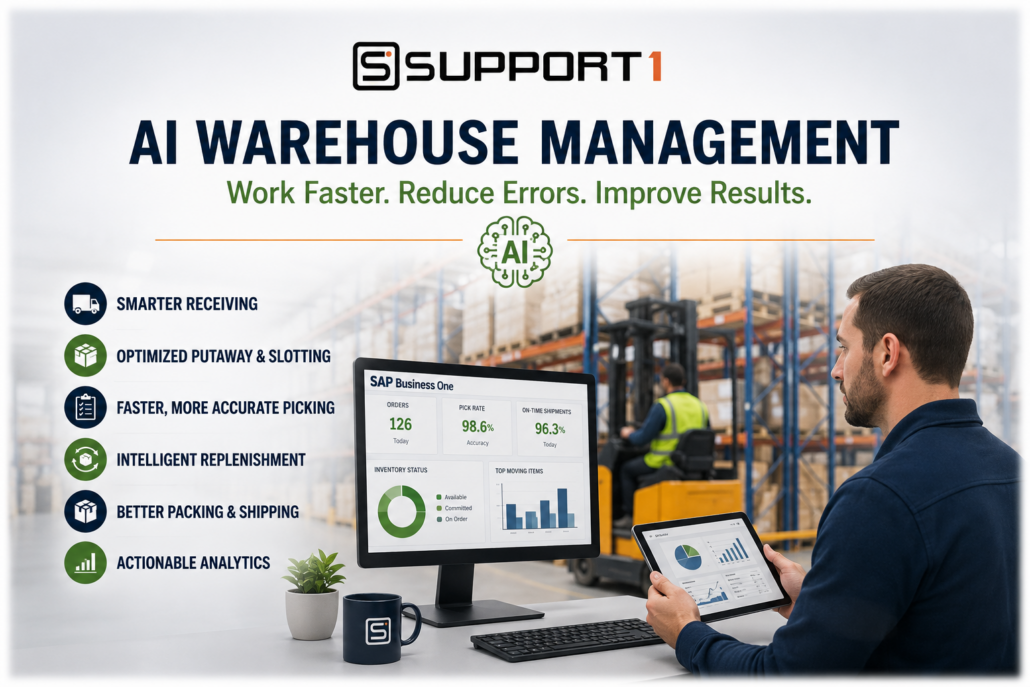
AI Warehouse Management Is About More Than Inventory
AI warehouse management and AI warehouse operations can help manufacturers and distributors improve how products move through the warehouse—from receiving and put-away to replenishment, picking, packing, and shipping.
That distinction is important.
In our AI Inventory Management article, we focused primarily on questions such as:
- What should we stock?
- How much inventory do we need?
- When will demand change?
- Which products may stock out?
- Where are we carrying too much inventory?
AI warehouse operations addresses a different set of questions:
- Where should products be stored?
- Which orders should be picked first?
- What is the most efficient picking sequence?
- Which bins need replenishment?
- Where are warehouse bottlenecks developing?
- Which transactions or movements look unusual?
- How can employees complete more work with fewer errors?
Inventory management determines what you need.
Warehouse management determines how efficiently you handle it.
For manufacturers and distributors using SAP Business One, the opportunity is particularly interesting because the ERP system can already contain information about inventory, warehouses, bin locations, sales orders, purchase orders, production requirements, batches, serial numbers, and inventory movements.
SAP Business One supports bin-location management as well as pick-and-pack processes, including creating pick lists for warehouses, warehouse sublevels, and specific bin locations.
Read more: SAP Business One – Bin Locations in Pick and Pack
AI can potentially add another analytical layer to this information.
The objective isn’t to replace warehouse employees.
It’s to help them make better decisions about what needs to happen next.
Why AI Warehouse Operations Matter
Warehouses generate enormous amounts of operational information.
Every day may include:
- Purchase receipts
- Inventory transfers
- Put-away
- Bin movements
- Pick lists
- Sales orders
- Production requirements
- Packing
- Deliveries
- Returns
- Inventory counts
- Replenishment
Individually, each transaction may seem routine.
Collectively, they create patterns.
Which products are picked most frequently?
Which bins require constant replenishment?
Which orders consistently take longer to pick?
Where do picking errors occur?
Which products are frequently purchased together?
When does warehouse workload peak?
Which receiving days create the most congestion?
AI can help analyze those patterns and identify opportunities that may be difficult to recognize manually.
For example:
Orders containing Product Group A take 22% longer to pick than similar orders because the most frequently purchased items are stored across three separate warehouse zones.
Or:
Bin A-02-04 required replenishment nine times this week. Consider increasing the quantity stored in this location.
Or:
Tomorrow’s expected order volume is 28% above the normal Tuesday workload. Consider adjusting labor assignments before the morning picking cycle begins.
These insights don’t require a science-fiction warehouse full of autonomous robots.
They’re examples of using existing operational data to make better warehouse decisions.
Recent McKinsey analysis of distribution supply chains argues that AI’s greatest value can come from improving interconnected operational decisions rather than treating isolated use cases as standalone projects.
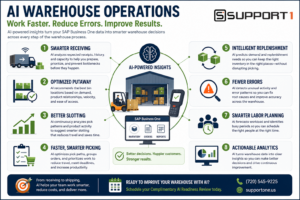
See how AI warehouse operations can turn SAP Business One data into smarter receiving, picking, replenishment, labor planning, and warehouse decisions.
What AI Warehouse Management Actually Does
Warehouse automation and warehouse AI are related, but they aren’t the same thing.
Automation follows predefined rules.
For example:
When inventory in a picking bin drops below 20 units, create a replenishment task.
AI can analyze broader information and potentially recommend:
Product A is expected to experience unusually high demand tomorrow. Replenish the primary picking location to 60 units before the morning shift to reduce replenishment interruptions.
Automation executes a rule.
AI analyzes information and helps determine what action may make sense.
The two can also work together.
AI identifies what should happen.
Automation helps make it happen consistently.
Read more: AI vs. Automation in ERP Systems.
10 Ways AI Warehouse Management Can Improve Operations
1. AI Warehouse Management Can Improve Receiving
Warehouse efficiency begins at the receiving dock.
Incoming products need to be:
- Received accurately
- Inspected when necessary
- Identified correctly
- Assigned to appropriate locations
- Made available for downstream processes
Problems at receiving can affect everything that happens afterward.
AI could analyze expected purchase receipts, historical receiving activity, product characteristics, available warehouse space, and current workload to help teams prepare.
For example:
Tomorrow morning includes four expected deliveries totaling 3,200 units. Two shipments contain high-volume items that should be prioritized for immediate put-away because current picking locations are below minimum quantities.
That gives warehouse management an opportunity to prepare before the trucks arrive.
AI could also identify unusual receipts.
Vendor ABC normally ships approximately 500 units per delivery. Tomorrow’s expected receipt contains 1,800 units. Verify receiving capacity and available storage space.
Instead of simply recording what arrives, AI can help employees anticipate what receiving activity may mean for the rest of the warehouse.
SAP Business One’s bin-location functionality can designate receiving bin locations for incoming goods before those items are moved into storage locations.
Read more: SAP Business One – Bin Location Management
2. AI Warehouse Operations Can Improve Put-away Decisions
Once products are received, they need to go somewhere.
Traditional put-away rules may assign products based on:
- Available space
- Product category
- Default locations
- Item characteristics
AI can potentially consider additional information.
For example:
- How frequently is the item picked?
- Which products are commonly ordered with it?
- How much inventory is already in the picking area?
- Is demand expected to increase?
- Which locations are easiest to access?
- How much space will the product require?
Instead of simply asking:
Where is there room for this product?
AI warehouse optimization can help ask:
Where should this product be stored to improve future warehouse efficiency?
Suppose a fast-moving product is stored at the far end of the warehouse because that’s where space happened to be available when it first arrived.
Employees may walk past hundreds of other locations every time they pick it.
Moving that item closer to the primary packing area could reduce travel on every order containing that product.
One decision might save only a minute.
Multiply that by hundreds or thousands of picks, and the impact becomes much more significant.
SAP’s own Business One warehouse training notes that bin-location management can help optimize storage space, locate items quickly, and support more efficient picking routes.
3. AI Warehouse Management Can Improve Warehouse Slotting
Warehouse slotting is the process of determining where products should be stored.
And it isn’t necessarily a one-time decision.
Product demand changes.
Seasonality changes.
Customers change.
Product mixes change.
A product that was slow-moving last year might become one of your fastest-moving items this year.
AI can continuously analyze:
- Pick frequency
- Order history
- Product velocity
- Product size
- Product relationships
- Seasonality
- Warehouse travel
- Replenishment frequency
It can then identify products that may be stored in inefficient locations.
For example:
The 25 highest-volume items represent 41% of all picks but are distributed across six warehouse zones. Moving eight of these products closer to the primary packing area could reduce average picking travel.
Or:
Products A, B, and C appear together on 64% of orders containing Product A. Consider locating these items closer together.
The warehouse manager still determines whether moving the inventory makes operational sense.
AI simply makes the pattern easier to see.
Small Warehouse Improvements Can Multiply Quickly
Saving 30 seconds on one pick doesn’t sound important.
Saving 30 seconds across 20,000 picks is very different.
AI warehouse optimization is often about finding small inefficiencies that repeat hundreds or thousands of times.
Visit our ROI calculator to determine your own savings: Support One ROI Calculator
4. AI Warehouse Operations Can Optimize Picking
Picking is often one of the most labor-intensive warehouse activities.
Employees may need to determine:
- Which orders to pick
- In what sequence
- Which locations to visit
- Which items to pick together
- Which orders are urgent
- Which inventory is available
SAP Business One already supports creating pick lists and allocating items from specific bin locations.
AI can potentially help optimize the decisions surrounding those processes.
For example:
These 18 orders contain overlapping products. Grouping them into three picking waves could reduce repeated travel through the same warehouse zones.
Or:
Order 10482 should be prioritized because it contains an item with limited available inventory and has a same-day shipping commitment.
Or:
Picking Products A, B, and C together would reduce warehouse travel because all three appear on nine open orders.
The objective isn’t simply to pick faster.
It’s to reduce unnecessary movement while still meeting customer priorities.
Support One Barcode Scanning Guide explains how barcode scanning can help ensure the physical warehouse transaction is captured accurately while AI helps improve the decisions surrounding the work.
5. AI Warehouse Management Can Improve Replenishment
A picking location can only be useful if it contains enough inventory to fulfill orders.
When the bin runs empty, someone has to stop and replenish it.
Too little inventory creates interruptions.
Too much inventory consumes valuable picking space.
SAP Business One bin locations can include minimum and maximum quantities, providing a foundation for replenishment decisions.
AI could potentially make replenishment more dynamic by considering:
- Current inventory
- Open orders
- Historical demand
- Expected demand
- Upcoming promotions
- Product seasonality
- Replenishment history
- Warehouse workload
Instead of waiting until a bin reaches a static minimum, AI might recommend:
Product A currently has 30 units in the picking location. Based on today’s open orders and expected afternoon demand, replenish an additional 50 units before the next picking wave.
Or:
Product B has reached its normal replenishment point, but current demand is unusually low. Replenishment can likely wait until tomorrow.
This is where AI Warehouse Management and AI Inventory Management work together particularly well.
Inventory AI helps determine expected demand and overall stock requirements.
Warehouse AI helps determine where that inventory needs to be and when employees need it there.
Warehouse performance is closely connected to purchasing, inventory, production, and customer orders, making AI for Supply Chain Management a natural next step for businesses seeking better coordination across operations.
How SAP Business One Provides the Foundation for AI Warehouse Management
For many SAP Business One users, the first step toward better warehouse intelligence isn’t replacing the ERP.
It’s making better use of the operational information already being generated.
SAP Business One can track information involving:
Warehouses — Where is inventory stored?
Bin Locations — Where within the warehouse is it located?
Inventory — What is physically in stock, committed, ordered, and available?
Sales Orders — What needs to ship?
Purchase Orders — What is expected to arrive?
Production Orders — What materials are required for manufacturing?
Pick Lists — What needs to be picked?
Batches and Serial Numbers — Which specific inventory needs to move?
Inventory Transfers — Where is inventory moving?
SAP Business One’s detailed inventory reporting distinguishes quantities that are in stock, committed, ordered, and available, while also supporting bin-level information.
Access Report: SAP Business One – Inventory in Warehouse Report
AI can potentially analyze this connected information and help employees understand what deserves attention.
Consider asking:
What are the five biggest warehouse issues we should address today?
A useful answer might combine:
- Today’s orders
- Available inventory
- Expected receipts
- Picking workload
- Bin replenishment
- Shipping commitments
- Production requirements
That is much more useful than simply adding another warehouse report.
Reports show employees what is happening.
AI can help employees understand what deserves attention next.
AI Warehouse Management Does Not Require a Fully Automated Warehouse
When people hear “AI warehouse,” they may picture massive fulfillment centers filled with robots.
That certainly represents one end of the spectrum. Advanced operators are already using AI to coordinate robotic warehouse activity and continuously optimize routing and inventory movement.
But manufacturers and distributors don’t need thousands of robots to benefit from AI.
Practical AI warehouse operations can begin with much simpler questions:
Which bins need replenishment before today’s picking begins?
Which open orders should we prioritize?
Which products are stored inefficiently?
Where are picking errors increasing?
Which receiving activity could create a bottleneck tomorrow?
Which warehouse processes consume the most employee time?
That approach fits the philosophy we’ve used throughout this AI series:
Start with the business problem. Then determine how AI can help.
Part 2: Practical AI Warehouse Management Applications
6. Detect Picking and Shipping Errors Before They Become Costly
Speed matters in a warehouse, but accuracy matters just as much.
A warehouse can process orders quickly and still create expensive problems if employees pick the wrong product, select the wrong quantity, use the wrong batch or serial number, or ship an order incorrectly.
These mistakes can lead to:
- Returns and credits
- Replacement shipments
- Additional freight costs
- Inventory discrepancies
- Customer complaints
- Lost employee time
- Reduced customer confidence
Barcode scanning and warehouse management systems can prevent many transactional errors by validating what employees actually pick and move.
AI warehouse management can add another layer by looking for patterns and exceptions.
For example, AI could identify:
Product A has generated three picking corrections this week. All occurred when Product B was stored in an adjacent bin. Review product placement to determine whether the locations are contributing to picking errors.
Or:
Order 10532 contains a quantity significantly higher than this customer’s normal purchasing pattern. Verify the quantity before shipment.
Or:
Picking errors involving Product Group C have increased 18% during the last four weeks.
The objective isn’t to have AI automatically decide that a transaction is wrong.
It’s to help employees recognize transactions and patterns that deserve a second look.
AI Can Look for Patterns, Not Just Individual Errors
This is one of the important differences between traditional validation and AI.
A warehouse management system might prevent an employee from scanning the wrong item.
AI can potentially investigate why errors keep occurring in the first place.
Perhaps:
- Two similar products are stored next to each other.
- Packaging is difficult to distinguish.
- A particular warehouse zone produces more errors.
- Errors increase during certain shifts.
- One product repeatedly causes quantity mistakes.
- Certain order types are more difficult to pick accurately.
Finding the underlying pattern gives management an opportunity to correct the process rather than repeatedly fixing individual mistakes.
7. Improve Warehouse Labor Planning
Warehouse workload isn’t constant.
Some days may have hundreds of orders.
Others may be relatively quiet.
Receiving volume can fluctuate.
Production schedules can change.
Seasonal demand can create significant peaks.
Large customer orders can suddenly increase the workload.
Traditional labor planning often depends heavily on experience:
Mondays are usually busy, so we’ll schedule more people.
AI warehouse operations can potentially make those labor-planning decisions more data-driven.
It could analyze:
- Open sales orders
- Historical order volume
- Number of order lines
- Products being picked
- Expected purchase receipts
- Production requirements
- Historical picking time
- Shipping commitments
- Seasonal patterns
- Day-of-week trends
Then it might identify:
Tomorrow’s expected picking workload is approximately 24% higher than the average Wednesday because of increased order volume and a higher-than-normal number of multi-line orders.
Or:
Receiving activity is expected to peak between 9:00 a.m. and noon while outbound picking volume is relatively low. Consider shifting available warehouse resources toward receiving during that period.
This doesn’t mean AI should automatically determine employee schedules.
Warehouse managers understand factors that may never appear in the ERP system.
But AI can provide better information for making those decisions.
Warehouse operations can also affect field service, because AI for Field Service Management depends on accurate visibility into parts availability, replenishment, and fulfillment.
AI Warehouse Management Can Help Identify Hidden Labor Problems
AI can also help management understand where warehouse time is actually being consumed.
For example:
Picking represents 42% of warehouse labor hours, but 17% of picking time is associated with replenishment interruptions.
That insight changes the question.
Instead of asking:
How do we make employees pick faster?
Management can ask:
Why are employees being interrupted so frequently?
The answer might be better replenishment, improved slotting, more appropriate picking quantities, or different warehouse processes.
AI isn’t necessarily about asking employees to work faster. It can help identify the things preventing employees from working efficiently.
8. Prioritize the Right Orders
Not every order has the same priority.
One order might need to ship today.
Another could ship tomorrow.
One customer may have requested expedited delivery.
Another order may be waiting for inventory.
A production order could require material immediately.
A major customer might have an important delivery commitment.
Warehouse employees need to determine what should happen first.
Traditional systems can sort orders according to predefined criteria such as:
- Required date
- Customer priority
- Shipping method
- Order date
- Warehouse
- Route
AI can potentially consider several factors simultaneously.
For example:
Prioritize Orders 10521, 10524, and 10531. All three can ship today, have complete inventory availability, and have same-day carrier cutoffs.
Or:
Order 10540 is marked urgent, but one item will not be available until tomorrow. Prioritize the next complete order while customer service reviews the shortage.
Or:
Five open orders contain the same high-demand product. Available inventory can fulfill only four. Review customer commitments before releasing the orders to picking.
That last example demonstrates why AI warehouse operations become more powerful when they have access to information outside the warehouse.
Order priority might depend on:
- Inventory availability
- Customer commitments
- Sales information
- Shipping deadlines
- Production requirements
- Customer history
The warehouse doesn’t operate independently from the rest of the company.
Neither should the AI.
In our blog AI for Sales. We share how Sales intelligence can help identify customer priorities and demand while warehouse intelligence helps determine how those commitments are fulfilled efficiently.
9. AI Warehouse Operations Can Improve Packing and Shipping
Picking isn’t the end of the warehouse process.
AI warehouse operations can help teams analyze these activities together and identify opportunities to improve shipping efficiency without sacrificing accuracy or customer service.
Packing decisions may depend on:
- Product dimensions
- Product weight
- Number of items
- Fragility
- Customer requirements
- Carrier requirements
- Shipping method
- Delivery commitments
AI could potentially analyze historical shipping activity and order characteristics to identify opportunities for improvement.
For example:
Orders containing Products A and B are frequently shipped in oversized cartons. Review packaging options to reduce unused space and dimensional shipping charges.
Or:
Seven orders scheduled to ship today are going to customers in the same geographic area. Review whether shipment consolidation or route coordination is possible.
Or:
Customer ABC frequently requests expedited shipping even though orders are normally completed two days before the required delivery date. Review whether the standard shipping process could reduce freight expense without affecting service.
Some of these recommendations may involve information outside SAP Business One, such as carrier rates, transportation-management data, or shipping-platform information.
That’s an important point.
AI Does Not Have to Work with ERP Data Alone
SAP Business One can provide the core business information.
Other systems might provide:
- Carrier rates
- Tracking information
- Warehouse scans
- Transportation data
- eCommerce orders
- Shipping-system information
- Customer-service information
AI can become more useful when appropriate information from multiple systems can be brought together.
This is one reason ERP integration matters as companies explore more advanced AI applications.
10. Turn Warehouse Data into Better Decisions
Warehouse managers already have access to reports and KPIs.
Common warehouse measurements might include:
- Orders picked per day
- Lines picked per hour
- Picking accuracy
- Inventory accuracy
- Dock-to-stock time
- Order cycle time
- Shipping accuracy
- Replenishment frequency
- Returns
- Warehouse utilization
These metrics tell management what happened.
AI can potentially help investigate why it happened.
Suppose a report shows:
Average picking time increased 12% this month.
A traditional dashboard identifies the problem.
AI could potentially analyze the underlying data and respond:
Most of the increase occurred in Warehouse Zone C. Pick volume increased only 3%, but replenishment interruptions increased 27%. Three high-volume products accounted for nearly half of those interruptions.
Now management has something actionable to investigate.
The same concept could apply to many warehouse questions.
Instead of simply asking:
What was our picking accuracy last month?
Ask:
Which products, warehouse locations, order types, or shifts contributed most to picking errors last month?
Instead of:
How many orders shipped late?
Ask:
What were the most common factors associated with late shipments?
Instead of:
How many times did we replenish picking locations?
Ask:
Which products generated the most replenishment activity, and would changing their picking locations or stocking quantities reduce interruptions?
This is where AI warehouse management can move beyond reporting and become a decision-support tool.
In our recent blog: Business Intelligence for SAP Business One. We explain how Business intelligence helps companies organize and visualize information.
AI can help employees explore that information conversationally and identify patterns they may not have thought to look for.
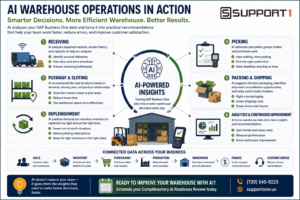
See how AI warehouse operations can turn connected SAP Business One data into smarter decisions across receiving, picking, replenishment, shipping, and continuous improvement.
How AI Warehouse Management Connects the Entire Business
Warehouse operations don’t exist in isolation.
A warehouse decision can affect sales.
A sales decision can affect inventory.
An inventory decision can affect purchasing.
A purchasing delay can affect production.
A production delay can affect shipping.
A shipping problem can affect customer service.
This is where connected SAP Business One data becomes particularly valuable.
Consider a customer placing an unusually large order.
Sales creates the demand.
Inventory determines whether sufficient stock exists.
Purchasing may need to replenish inventory.
Warehouse operations determine how efficiently the order can be picked and shipped.
Finance evaluates the revenue, cost, and margin.
Customer service manages communication if something changes.
Warehouse efficiency also affects what happens on the production floor. AI for manufacturing can connect material availability and warehouse activity with production requirements to help prevent shortages and keep production moving.
AI can potentially analyze information across these functions rather than viewing each transaction separately.
For example:
Customer ABC placed an order 40% larger than normal. Current inventory is sufficient, but fulfilling the order will reduce Product A below its normal safety level. A purchase order is expected in three days. The order can ship today without affecting other committed orders.
That’s a much more useful business answer than:
Product A: 1,240 units on hand.
This is why we’ve emphasized connected ERP data throughout this AI series.
The value of AI isn’t simply generating answers faster. It’s helping employees understand how decisions in one part of the company affect another.
Practical AI Warehouse Management Prompts
One of the easiest ways to understand AI’s potential is to stop thinking about “implementing AI” and start thinking about the questions employees would like answered.
Here are practical examples.
Daily Warehouse Priorities
Review today’s open orders, available inventory, expected receipts, and shipping commitments. Identify the five warehouse issues that deserve the most attention today and explain why.
Picking Efficiency
Analyze our picking activity for the last 90 days. Which products and warehouse locations generate the most picking activity, and where might we reduce unnecessary travel?
Warehouse Slotting
Identify our 50 most frequently picked products. Compare their picking frequency with their current warehouse locations and identify potential slotting improvements.
Replenishment
Which picking locations required replenishment most frequently during the last 60 days? Identify products where different minimum quantities or bin locations may reduce interruptions.
Receiving
Review tomorrow’s expected purchase receipts and identify unusual quantities, high-volume products, or deliveries that could create receiving or storage problems.
Order Prioritization
Review today’s open sales orders and identify which orders should be prioritized based on required ship date, inventory availability, customer commitments, and carrier cutoff times.
Picking Errors
Analyze warehouse picking corrections and shipping errors during the last six months. Identify recurring patterns involving products, locations, order types, or time periods.
Warehouse Labor
Compare historical warehouse workload with open orders and expected receipts. Identify the days and times when workload is likely to be highest next week.
Shipping Performance
Analyze late shipments during the last six months. What factors appear most frequently when orders miss their scheduled shipping date?
Warehouse Management
If you were the warehouse manager reviewing our operational data this morning, what are the five things you would investigate first and why?
That last question is intentionally broad.
Sometimes the most valuable use of AI isn’t answering a predefined report question.
It’s asking AI:
What am I not noticing?
Good AI Warehouse Prompts Need Business Context
There’s an important limitation to those examples.
AI cannot produce a useful answer simply because we ask a clever question.
It needs the right information.
Consider this prompt:
Which orders should we ship first?
AI would need to understand what “first” means to your business.
Does priority depend on:
- Promised delivery date?
- Customer status?
- Carrier cutoff?
- Inventory availability?
- Order profitability?
- Customer service commitments?
- Production requirements?
- Whether the order is complete?
The answer depends on your company’s policies.
That’s why effective AI requires both good data and good business context.
A better prompt might be:
Review today’s open orders. Prioritize orders that are fully available, must ship today, and have carrier cutoffs before 3:00 p.m. Flag any high-priority customer orders that cannot ship because of inventory shortages.
Now AI understands more about the decision you’re trying to make.
This is the same principle we’ve discussed throughout the series:
AI needs to understand your business, not just your data.
Human Experience Still Matters in AI Warehouse Operations
Warehouse employees often know things the computer doesn’t.
An experienced warehouse manager may know:
- A truck is running late.
- A forklift is unavailable.
- A customer changed an order verbally.
- A product’s packaging has changed.
- A warehouse aisle is temporarily blocked.
- A vendor frequently arrives later than scheduled.
- A particular product requires special handling.
AI may not know any of that unless the information is captured and made available.
That’s why we shouldn’t treat an AI recommendation as an instruction.
Instead, think of it as another source of information.
AI might say:
Move Product A closer to the packing area because it is one of the most frequently picked products.
The warehouse manager might respond:
We can’t. Product A requires storage conditions that aren’t available in that area.
That’s not AI failing.
That’s AI and human expertise working together.
The AI identified a data pattern.
The employee added real-world operational knowledge.
Together, they can make a better decision.
The Goal Isn’t an AI Warehouse. It’s a Better Warehouse.
Businesses can easily become distracted by the technology.
Robots.
Machine learning.
Computer vision.
Generative AI.
Autonomous warehouses.
Those technologies can be valuable, but they aren’t the objective.
The business objectives are much simpler:
- Receive products accurately.
- Put inventory in the right place.
- Reduce unnecessary movement.
- Pick orders efficiently.
- Reduce mistakes.
- Ship on time.
- Use warehouse space effectively.
- Help employees be productive.
- Serve customers better.
- Control operating costs.
If AI helps accomplish those goals, it has value.
If it doesn’t, adding AI simply because everyone is talking about artificial intelligence doesn’t improve the warehouse.
Start with the warehouse problem—not the AI tool.
Part 3: Building a Practical AI Warehouse Management Strategy
Best Practices for Using AI in the Warehouse
The potential applications for AI warehouse management are extensive, but that doesn’t mean a company should try to implement all of them at once.
A better approach is to identify a specific warehouse problem, determine what information is needed to address it, and begin with an application where the results can be measured.
Here are several principles that can help.
Start AI Warehouse Management with a Specific Problem
“Let’s use AI in the warehouse” isn’t a business objective.
Instead, start with a measurable operational problem.
For example:
- Picking takes too long.
- Picking errors are increasing.
- Employees spend too much time replenishing bins.
- Fast-moving products are stored inefficiently.
- Receiving creates bottlenecks.
- Orders frequently miss shipping deadlines.
- Warehouse managers struggle to anticipate workload.
- Employees spend too much time searching for information.
Then ask:
What information would help us understand and improve this problem?
Suppose picking productivity is declining.
Instead of immediately purchasing an AI application, analyze:
- Order volume
- Number of order lines
- Product locations
- Pick frequency
- Replenishment activity
- Picking errors
- Travel patterns
- Product velocity
AI may help uncover patterns that aren’t obvious from individual warehouse reports.
This is one of the principles we emphasize throughout our Practical AI for SAP Business One approach:
Start with the business problem. Then determine whether AI is an appropriate solution.
Make Sure Your Warehouse Data Is Reliable
AI recommendations are only as useful as the information behind them.
If SAP Business One says Product A is in Bin A-01-02, but the product is actually somewhere else, AI cannot magically correct the physical discrepancy.
If warehouse transactions aren’t recorded consistently, analysis becomes less reliable.
Common data-quality problems can include:
- Incorrect inventory quantities
- Inaccurate bin locations
- Duplicate item records
- Inconsistent product descriptions
- Old or inactive products
- Incorrect units of measure
- Missing dimensions or weights
- Inaccurate lead times
- Inconsistent warehouse transactions
- Poorly maintained customer or vendor information
Imagine asking AI:
Which products should we move closer to the packing area?
If historical picking information is incomplete or warehouse locations are inaccurate, the recommendation may be wrong.
This is why clean ERP data remains one of the most important foundations for practical artificial intelligence.
Before implementing sophisticated warehouse AI, make sure you trust the information you’re asking it to analyze.
Give AI Warehouse Operations the Right Context
Good data alone isn’t enough.
AI also needs business context.
For example, data might show that Product A is one of the most frequently picked items in the warehouse.
AI could reasonably recommend:
Move Product A closer to the packing area.
But there may be a reason it is stored elsewhere.
Perhaps the product:
- Is oversized
- Requires refrigeration
- Is hazardous
- Needs secure storage
- Has special handling requirements
- Must be separated from other products
- Is picked using specialized equipment
The data pattern may be correct.
The recommendation may still be inappropriate.
This is why AI warehouse operations should incorporate operational rules and constraints wherever possible.
The more AI understands about how your warehouse actually operates, the more useful its recommendations can become.
Keep Employees Involved in AI Warehouse Decisions
Warehouse managers and employees possess operational knowledge that may never appear in the ERP system.
AI should support that expertise—not replace it.
Consider an AI recommendation:
Increase the minimum quantity in Bin B-04 from 25 units to 75 units because the location required replenishment 14 times last month.
That sounds reasonable.
But the warehouse employee may know:
Seventy-five units won’t physically fit in that bin.
Human review turns an interesting analytical recommendation into a practical operational decision.
This becomes increasingly important as AI recommendations affect:
- Inventory movement
- Order priorities
- Labor assignments
- Customer commitments
- Purchasing decisions
- Production requirements
- Shipping decisions
AI provides the analysis. People remain responsible for the decision.
Measure Whether Your AI Strategy IS Actually Working
An AI project should produce more than an impressive demonstration.
It should improve the business.
Before implementing an application, determine what success looks like.
Depending on the project, you might measure:
Picking productivity
Lines or orders picked per labor hour.
Picking accuracy
Percentage of orders picked correctly.
Shipping accuracy
Percentage of shipments completed without errors.
Order cycle time
Time between order release and shipment.
Replenishment frequency
Number of interruptions required to refill picking locations.
Receiving time
Time between receipt and inventory availability.
Warehouse travel
Distance or time employees spend moving through the warehouse.
Late shipments
Percentage of orders missing the expected shipping date.
Inventory accuracy
Difference between system inventory and physical inventory.
Warehouse labor cost
Labor required to process a given volume of transactions.
Compare the results before and after implementing the AI-assisted process.
If the technology isn’t improving the metric that justified the project, investigate why.
The objective isn’t to prove that AI works. It’s to determine whether AI works for this particular business problem.
Common AI Warehouse Management Mistakes
Trying to Implement Everything at Once
After seeing all the potential applications, it can be tempting to build a massive AI warehouse initiative.
Receiving.
Slotting.
Picking.
Replenishment.
Labor planning.
Shipping.
Forecasting.
Analytics.
All at once.
That dramatically increases complexity.
Instead, choose one or two problems where:
- The business impact matters.
- Reliable data exists.
- Employees understand the process.
- Results can be measured.
- The implementation risk is manageable.
Solve something useful.
Learn from it.
Then expand.
Confusing AI with Warehouse Automation
A warehouse doesn’t automatically become “AI-powered” because it uses barcode scanners, conveyors, mobile devices, automated storage, or warehouse-management software.
Those technologies can be extremely valuable.
But automation and AI solve different problems.
Automation is excellent for repeatable processes.
AI is particularly useful when employees need help analyzing information, recognizing patterns, forecasting outcomes, or deciding what deserves attention.
Often the best approach uses both.
For example:
AI: Predict which picking bins are likely to require replenishment tomorrow.
Automation: Create replenishment tasks when approved conditions are met.
Mobile warehouse technology: Direct employees to the appropriate bins.
Barcode scanning: Verify that the correct inventory was moved.
Each technology has a role.
The goal should be a better process—not using AI where traditional automation already solves the problem effectively.
Using AI with Poor Warehouse Data
This is one of the fastest ways to lose employee confidence.
If an AI tool repeatedly recommends actions based on incorrect inventory, outdated locations, or incomplete transactions, employees will stop trusting it.
And they should.
Fixing the underlying data is often more valuable than adding another layer of technology.
AI can sometimes help identify suspicious data or unusual transactions, but it shouldn’t be treated as a substitute for good ERP discipline.
Automating AI Recommendations Too Quickly
Suppose AI recommends moving 20 products to new picking locations.
Should the system automatically create inventory transfers?
Probably not on day one.
First determine:
- Why did AI make the recommendation?
- Is the underlying information accurate?
- Are there operational constraints it doesn’t understand?
- Does an experienced warehouse manager agree?
- Can the recommendation be tested on a smaller scale?
As confidence improves, companies may decide to automate certain low-risk decisions.
But automation should follow understanding—not replace it.
Ignoring AI Security and Governance
Warehouse AI may require access to significant amounts of company information.
Depending on the application, that could include:
- Customers
- Sales orders
- Inventory
- Pricing
- Vendors
- Purchasing
- Production
- Financial information
- Employees
- Shipping activity
Before connecting company data to an AI system, businesses should understand:
- What information the AI can access
- Where the information is processed
- Whether information is retained
- Who can use the system
- What employees are allowed to submit
- How access is controlled
- How AI-generated recommendations are reviewed
- Who is accountable for decisions
NIST’s AI Risk Management Framework emphasizes incorporating trustworthiness and risk management into the design, development, use, and evaluation of AI systems.
Read the article: NIST AI Risk Management Framework
Suggested reading: AI Governance: Why Your Business Needs an AI Policy
Is Your Warehouse Ready for AI?
Successful AI warehouse operations depend on reliable data, consistent processes, and a clear understanding of the problems the business wants to solve.
Before investing in AI warehouse management, ask some basic questions.
Do we trust our inventory data?
If employees routinely say, “SAP says we have ten, but nobody knows where they are,” start there.
Are warehouse transactions recorded consistently?
AI needs reliable historical activity to identify meaningful patterns.
Do we use bin locations effectively?
Detailed location information can make many warehouse analyses significantly more useful.
Can we clearly describe the warehouse problem we’re trying to solve?
“Use AI” isn’t specific enough.
Can we measure the current process?
Without a baseline, it becomes difficult to determine whether AI improved anything.
Do employees understand the process?
Technology cannot compensate for a process nobody understands.
Do we know what information an AI application will access?
Security and governance should be addressed before sensitive business information is exposed.
If several answers are “no,” that doesn’t mean your company cannot use AI.
It helps identify what needs to be fixed first.
Frequently Asked Questions About AI Warehouse Management
What Is AI Warehouse Management?
AI warehouse management is the use of artificial intelligence to analyze warehouse and business information and help improve decisions involving receiving, put-away, slotting, replenishment, picking, packing, shipping, labor planning, and warehouse performance.
It can complement existing ERP, warehouse-management, automation, barcode, and mobile technologies.
How Is AI Different from a WMS?
A warehouse management system typically manages and controls warehouse processes such as inventory locations, picking, replenishment, and movement.
AI can add an analytical layer that helps identify patterns, predict potential problems, prioritize work, and recommend improvements.
The technologies can work together rather than replace one another.
Can AI Warehouse Operations Work with SAP Business One?
Yes. SAP Business One can provide valuable information involving inventory, warehouses, bin locations, sales orders, purchase orders, production, pick lists, batches, serial numbers, and inventory movements.
The specific AI capabilities available will depend on the tools, integrations, data structure, and business requirements involved.
Can AI Improve Warehouse Picking?
Potentially.
AI can analyze order history, product locations, picking frequency, order combinations, replenishment activity, and other operational information to identify opportunities to reduce travel, improve order prioritization, or optimize product placement.
Barcode scanning and warehouse-management technology can then help execute and validate the physical process.
Can AI Reduce Warehouse Errors?
AI may help identify unusual transactions and recurring patterns associated with picking, packing, inventory, or shipping errors.
It can also help management investigate why errors are occurring.
AI shouldn’t replace transaction validation, barcode scanning, employee training, or human review.
Can AI Help with Warehouse Labor Planning?
Yes. AI can potentially analyze historical workload, open orders, expected receipts, production requirements, seasonality, and other factors to help warehouse managers anticipate periods of higher or lower workload.
Managers should still consider real-world staffing and operational factors before making scheduling decisions.
Do We Need Robots to Use AI in the Warehouse?
No.
A company can use AI for warehouse analysis and decision support without operating a robotic or fully automated warehouse.
For many small and midsize businesses, analyzing existing ERP and warehouse information may be a much more practical starting point.
Will AI Replace Warehouse Employees?
AI is more likely to change how employees work than eliminate the need for warehouse expertise.
Employees still need to handle products, understand operational realities, manage exceptions, communicate with other departments, and make decisions that require experience and judgment.
The goal is to give those employees better information.
Is AI Warehouse Management Expensive?
It depends entirely on the application.
A sophisticated automated warehouse using robotics, computer vision, and advanced optimization can require significant investment.
A focused project analyzing existing SAP Business One data to improve replenishment, identify warehouse exceptions, or analyze operational performance could be considerably more approachable.
Start by identifying the business problem and potential financial benefit before selecting the technology.
What Is the Best Place to Start with AI Warehouse Management?
Choose a repetitive, measurable problem where reliable data already exists.
Good candidates might include:
- Excessive replenishment
- Picking errors
- Poor warehouse slotting
- Late shipments
- Receiving bottlenecks
- Warehouse workload forecasting
- Identifying operational exceptions
A small project that produces a measurable result is usually a better starting point than a large AI transformation initiative.
How Support One Can Help Prepare Your Warehouse for AI
For SAP Business One users, AI readiness often begins long before choosing an AI product.
The first questions should be:
Is your SAP Business One data accurate?
Are you using the warehouse capabilities you already have effectively?
Are important processes still happening outside the ERP system?
Are integrations providing reliable information?
Are warehouse employees capturing the information AI would eventually need?
Where could AI realistically produce measurable value?
Support One can help businesses evaluate their current SAP Business One environment, identify process and data issues, and determine practical opportunities for AI and automation.
In some cases, the answer may be AI.
In others, the better first step could be:
- Cleaning up ERP data
- Improving bin-location management
- Implementing barcode scanning
- Improving mobile warehouse processes
- Integrating disconnected systems
- Updating workflows
- Improving reporting
- Making better use of existing SAP Business One functionality
That’s an important part of AI readiness.
Sometimes the best first AI project is fixing the foundation that AI will eventually depend on.
The Future of AI Warehouse Operations Is Human + AI
Warehouses will continue to become more intelligent.
AI will get better at recognizing demand patterns, prioritizing work, predicting bottlenecks, optimizing product placement, identifying exceptions, and helping employees understand increasingly complex operations.
Automation will continue to handle more repetitive tasks.
Mobile technology will continue to put information directly in employees’ hands.
Robotics will become practical for more organizations.
But the warehouse will still depend on people who understand:
- The products
- The customers
- The building
- The equipment
- The suppliers
- The processes
- The exceptions
- The realities that don’t always appear in the data
The strongest warehouse operations won’t necessarily be the ones that remove people from the process.
They’ll be the ones that give people better information and better tools for making decisions.
AI identifies the opportunity. People improve the operation.
Ready to Explore AI Warehouse Management?
You don’t need to automate your entire warehouse to begin preparing for AI.
You need to understand your current processes, trust your SAP Business One data, identify the problems worth solving, and determine where artificial intelligence could realistically improve the business.
Support One can help you identify those opportunities.
Schedule Your Complimentary AI Readiness Review
We’ll review how you’re using SAP Business One today, discuss your operational challenges, and help identify practical opportunities for AI, automation, data improvement, and process optimization.

Questions about AI in Warehouse Management? Let’s Talk

