
How AI Improves Sales: Find Opportunities and Close More Business
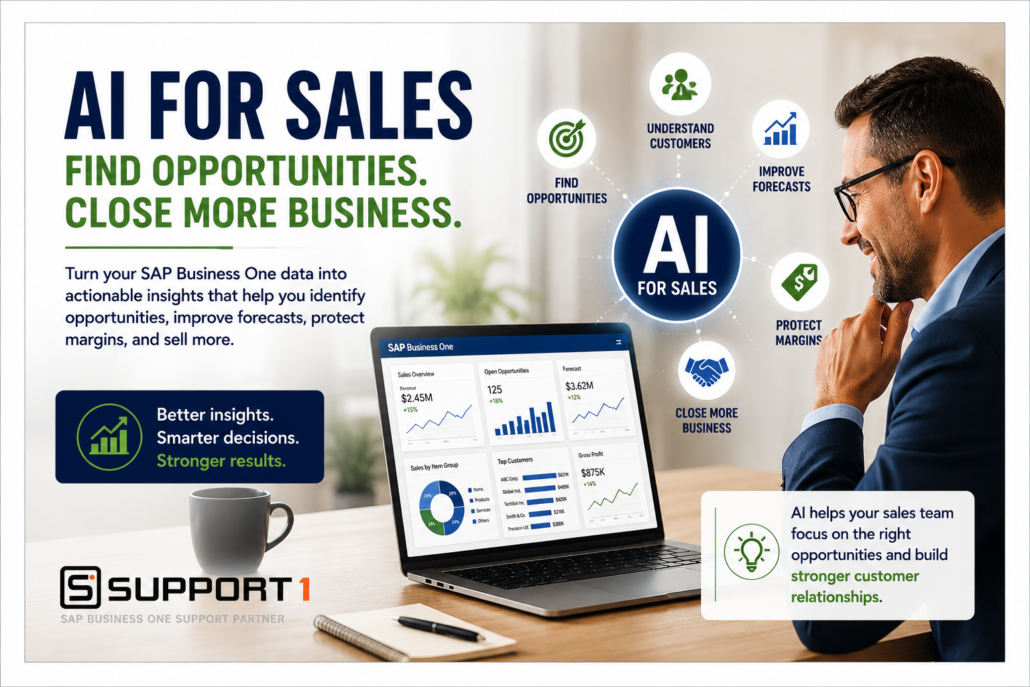
AI for Sales Is Changing How Businesses Find Opportunities
AI for sales is changing how sales teams identify opportunities, understand customers, prioritize their time, and make better decisions.
For manufacturers and distributors using SAP Business One, this opportunity is particularly interesting because much of the information salespeople need may already exist inside the business.
That information can include:
- Customer purchase history
- Quotes
- Sales orders
- Products purchased
- Pricing
- Inventory availability
- Gross margins
- Returns
- Open invoices
- Sales trends
The challenge isn’t necessarily collecting more information.
The challenge is turning all that information into something a salesperson can actually use.
Imagine a salesperson preparing to call a customer they’ve worked with for several years. Traditionally, the salesperson might review recent orders, look through emails, check open quotes, and perhaps ask someone about inventory availability.
With appropriately implemented AI, the salesperson could potentially ask:
Summarize this customer’s activity during the past 12 months. Highlight changes in purchasing, open quotes, declining product categories, potential cross-sell opportunities, and anything I should know before calling them.
Instead of spending 20 minutes gathering information, the salesperson starts with a concise summary and can spend that time talking to customers and pursuing opportunities.
That’s the real promise of AI sales.
It isn’t replacing salespeople.
It’s helping salespeople spend more time selling.
For a broader look at how artificial intelligence can be applied throughout the organization, see our AI for SAP Business One: A Complete Practical Guide.
Why AI Sales Is Becoming More Important
Salespeople have always relied on information.
The difference today is the amount of information available.
A long-term customer may have:
- Hundreds of orders
- Dozens of products
- Multiple contacts
- Previous quotes
- Special pricing
- Seasonal purchasing patterns
- Returns
- Service issues
- Changing order quantities
No salesperson can continuously analyze all of that information across every account.
AI can.
Rather than expecting a salesperson to notice every change manually, AI can help identify patterns that deserve attention.
The opportunity extends well beyond individual sales tasks. McKinsey research on generative AI identifies sales and marketing as one of the business functions with significant potential to capture value from generative AI.
For example:
Customer purchases are down 18% during the past six months, primarily because purchases of Product Group A have declined.
Or:
This customer regularly purchases Products A and B but has never purchased Product C, which is commonly purchased by similar customers.
Or:
Three customers in your territory haven’t placed an order in more than 90 days despite historically ordering every month.
These aren’t simply reports.
They’re potential actions.
The salesperson can decide whom to call, what to discuss, and where the greatest opportunity may exist.
That is where AI becomes much more valuable than another dashboard.
What AI for Sales Actually Does
There is an important difference between reporting, automation, and AI.
A traditional report might tell a salesperson:
Customer sales declined 18%.
Automation might:
Send the salesperson an alert when customer sales decline more than 15%.
AI can go further:
Customer sales declined 18%, primarily because purchases of Product Group A decreased. The customer historically purchases these products every 45 days but hasn’t ordered them in 82 days. Consider contacting the customer to determine whether demand has changed or whether they are purchasing from another supplier.
Each technology has value.
But AI helps move from information to interpretation.
A useful way to think about it is:
SAP Business One stores the business data.
Reporting shows what happened.
Automation triggers predefined actions.
AI helps determine what the information might mean and what deserves attention next.
See the difference between AI and Automation and hos they compliment each other: AI vs. Automation in ERP Systems.
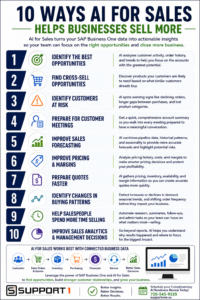
10 ways AI for sales can use SAP Business One data to uncover opportunities, improve sales decisions, strengthen customer relationships, and help sales teams sell more.
10 Ways AI for Sales Can Help Businesses Sell More
1. AI for Sales Helps Identify the Best Opportunities
Most salespeople have more potential opportunities than they have time to pursue.
The challenge is determining where to focus.
AI can analyze information such as:
- Customer purchasing history
- Quote activity
- Order frequency
- Revenue
- Gross margin
- Product mix
- Recent customer activity
- Previous wins and losses
These applications are already becoming part of modern sales strategies. IBM’s overview of AI in sales describes uses including customer insights, sales forecasting, lead prioritization, and helping sales teams work more productively.
It can then help identify accounts or opportunities that deserve attention.
For example:
These five customers have the highest potential for additional sales based on purchasing history, recent activity, and product gaps.
The salesperson still decides what to do.
AI simply helps prioritize the possibilities.
This can be particularly valuable for companies with hundreds or thousands of existing customers where opportunities may be hidden inside years of transaction history.
2. AI Sales Can Find Cross-Sell Opportunities
Existing customers are often one of the best sources of additional revenue.
But salespeople may not know every complementary product available—especially when the company carries thousands of items.
AI can analyze buying patterns across customers and identify products frequently purchased together.
Imagine a distributor discovers:
72% of customers purchasing Product A also purchase Product B.
AI could then identify customers who regularly purchase Product A but have never purchased Product B.
Instead of sending a generic promotion to everyone, salespeople receive a targeted opportunity list.
A salesperson might ask:
Which products are commonly purchased by customers similar to ABC Company that ABC Company has never purchased from us?
That’s a much more actionable question than simply looking at a sales report.
Your Existing Customers May Be Your Best AI Opportunity
Businesses often think of AI sales tools primarily as a way to find new prospects.
But your ERP may already contain years of purchasing history from customers who know and trust your company.
AI can help uncover revenue opportunities hidden inside that existing customer base.
Read How: How AI Helps SAP Business One Users Increase Revenue and Profit.
Field service information can also reveal sales opportunities, and AI for Field Service Management can help identify equipment replacement needs, recurring service issues, and potential upgrades.
3. AI for Sales Can Identify Customers at Risk
AI isn’t only useful for finding growth.
It can also help identify revenue that may be disappearing.
A customer who normally orders every 30 days may suddenly go 60 days without placing an order.
Another customer’s average order value may decline gradually over several months.
A third may stop purchasing an entire product category.
These changes can be difficult to notice when salespeople manage many accounts.
AI can look for signals such as:
- Declining order frequency
- Falling revenue
- Smaller average orders
- Lost product categories
- Increased returns
- Repeated service problems
- Long periods without purchases
The system might flag:
Customer purchasing has declined 27% over the past six months. Orders from the Industrial Components category have stopped completely.
That doesn’t automatically mean the customer is leaving.
But it gives the salesperson a reason to investigate.
Perhaps demand has changed.
Perhaps the customer has excess inventory.
Perhaps they’re buying from a competitor.
Or perhaps there’s a service problem nobody has connected to the sales decline.
Learn how AI in Customer Service can provide Customer-service activity and provide valuable context when sales patterns begin changing.
4. AI Sales Helps Salespeople Prepare for Customer Meetings
Experienced salespeople often spend significant time preparing for important customer conversations.
They may review:
- Recent orders
- Open quotes
- Previous meeting notes
- Customer service issues
- Product purchases
- Pricing
- Inventory availability
- Outstanding invoices
AI can summarize this information before the meeting.
A salesperson could ask:
Prepare me for my meeting with ABC Company. Summarize sales for the past 12 months, open quotes and orders, major product trends, service issues, outstanding concerns, and potential opportunities.
The result could provide a concise briefing:
Account performance: Sales increased 8% year over year.
Recent activity: Three orders during the past 60 days.
Open opportunity: Quote 10345 for $18,500 remains open.
Product trend: Purchases of Product Group B declined 22%.
Service issue: One unresolved delivery complaint.
Potential opportunity: Customer has never purchased Product C despite purchasing complementary Products A and B.
Now the salesperson can enter the meeting prepared to have a meaningful business conversation rather than spending the first ten minutes asking questions the company should already know the answers to.
5. AI for Sales Can Improve Sales Forecasting
Forecasting is one of the most important—and difficult—sales-management responsibilities.
Traditional forecasts often depend heavily on salesperson estimates.
A salesperson may believe an opportunity has a 75% chance of closing.
But AI can potentially compare that opportunity with historical information such as:
- Customer buying patterns
- Previous quote conversions
- Opportunity age
- Product availability
- Typical sales cycles
- Order history
- Seasonality
- Similar opportunities
AI doesn’t eliminate salesperson judgment.
It adds another perspective.
For example:
This opportunity is currently forecast at 80%, but similar opportunities at this stage historically close 52% of the time.
Or:
Sales for Product Group A typically increase during the next eight weeks. Current open opportunities suggest demand may be 12% higher than last year.
This can help sales managers build more realistic forecasts and identify potential gaps earlier.
Better sales forecasts can also improve decisions elsewhere in the company.
Purchasing can prepare for future demand.
Inventory managers can anticipate product requirements.
Finance can improve cash-flow forecasts.
Management can make better decisions about staffing and investment.
That demonstrates an important point about AI:
The value of better sales information doesn’t stop with the sales department.
Changes in customer demand eventually become production requirements. AI for manufacturing can help connect sales trends and customer orders with inventory, materials, and production capacity so manufacturers can respond earlier.
Where SAP Business One Fits into AI Sales
AI becomes much more useful when it can work with reliable business information.
For SAP Business One users, valuable sales-related information can already exist across:
Customers — Who buys from you?
Sales Orders — What are they currently buying?
Invoices — What have they purchased historically?
Quotes — What opportunities remain open?
Inventory — What can you sell now?
Purchasing — When will additional products arrive?
Financials — Which customers and products generate profitable revenue?
Service — Are unresolved problems affecting the relationship?
This connected information can give AI much more context than a standalone prospecting tool.
Consider a salesperson asking:
Which existing customers should I contact this week?
A useful answer shouldn’t simply identify the customers with the highest historical revenue.
AI might also consider:
- Recent purchasing changes
- Open quotes
- Product gaps
- Inventory availability
- Customer profitability
- Service issues
- Previous order frequency
The result could be a prioritized list based on actual business information.
SAP Business One brings sales, customer, inventory, purchasing, and financial information together in one ERP system, providing the connected business data that can make AI-generated sales insights more useful.
That’s why clean ERP data remains so important throughout this entire AI series.
AI cannot reliably identify opportunities if customer records are duplicated, product information is inconsistent, or transaction history is incomplete.
Part 2
In Part 1, we explored how AI for sales can help businesses identify opportunities, find cross-sell possibilities, recognize customers at risk, prepare salespeople for meetings, and improve forecasting.
Those applications help sales teams determine where to focus.
The next group of opportunities focuses on helping salespeople make better decisions once an opportunity has been identified—from protecting margins and preparing quotes to recognizing buying trends and understanding overall sales performance.
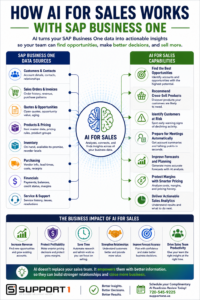
See how AI for sales can turn SAP Business One data into actionable insights that help sales teams find opportunities, protect margins, improve forecasts, and sell more.
6. AI for Sales Can Improve Pricing and Margin Decisions
Winning more business is important.
Winning profitable business is even more important.
Salespeople frequently make pricing decisions while balancing several factors:
- Customer history
- Previous pricing
- Order volume
- Product cost
- Gross margin
- Competitive pressure
- Inventory levels
- Customer importance
- Current promotions
The challenge is understanding all those factors quickly enough to make a good decision.
AI can help analyze historical transactions and provide useful context before a salesperson changes a price or offers a discount.
For example:
This customer typically receives a 7% discount on Product Group A. Increasing the discount to 10% would reduce estimated gross margin from 28% to 24%. Similar customers purchasing this volume average an 8% discount.
The salesperson still makes the pricing decision.
But now the decision is based on more information.
AI could also help identify situations where salespeople are discounting unnecessarily.
For example:
This customer has accepted the current price on its last eight orders. No recent decline in order volume has occurred. Consider maintaining the existing price.
That type of insight can help protect margin without creating rigid pricing rules.
More Sales Doesn’t Always Mean More Profit
Revenue growth looks good on a sales report.
But sales teams also need to understand the profitability of the business they’re winning.
AI for sales can help employees consider revenue, pricing, cost, and margin together before making important sales decisions.
This is where AI in Sales and AI Financial Management work together, because pricing and gross-margin decisions connect sales directly to financial performance.
7. AI Sales Can Help Prepare Quotes Faster
Creating an accurate sales quote may require more research than customers realize.
A salesperson may need to determine:
- Customer pricing
- Previous purchase prices
- Available inventory
- Product alternatives
- Current costs
- Expected replenishment
- Delivery timing
- Gross margin
- Related products
AI can help gather and summarize this information before the quote is prepared.
Imagine asking:
ABC Company wants 250 units of Product A. Review its previous pricing, current inventory, expected replenishment, product cost, and gross margin. Identify any issues I should consider before preparing the quote.
The AI response might summarize:
ABC Company last purchased Product A four months ago at $48.50 per unit. Current standard price is $51.00. There are 175 units available, with another 500 expected next Tuesday. At the previous selling price, estimated gross margin would be 26%.
The salesperson now has the information needed to prepare the quote without searching through multiple screens.
AI could also suggest complementary products:
Customers purchasing Product A frequently purchase Products C and D. Consider including them as optional items on the quote.
Again, AI isn’t necessarily creating and approving the final quote.
It is helping the salesperson prepare a better quote faster.
8. AI for Sales Identifies Changes in Buying Patterns
Customer purchasing behavior changes constantly.
Some changes create opportunities.
Others provide early warnings.
AI can continuously analyze customer transaction history and identify patterns that may be difficult for a salesperson to notice manually.
Examples include:
Increasing demand
Customer purchases of Product Group B increased 34% during the past three months.
Declining demand
Customer purchases of Product C declined for four consecutive months.
Changing order frequency
This customer historically orders every 30–40 days but hasn’t placed an order in 68 days.
New product interest
Three recent quotes include products the customer has never purchased previously.
Seasonal patterns
This customer typically increases purchases of Product Group A beginning in October.
Each of these observations can lead to a different sales action.
The salesperson might:
- Contact a declining customer
- Prepare for seasonal demand
- Follow up on an open quote
- Recommend complementary products
- Investigate why purchasing behavior changed
This is where AI can help turn years of ERP transaction history into a practical sales tool.
Instead of relying exclusively on memory, salespeople can have AI continually look for changes that deserve attention.
9. AI Sales Helps Salespeople Spend More Time Selling
Salespeople perform a surprising amount of work that isn’t actually selling.
They may spend time:
- Searching for customer information
- Reviewing previous orders
- Preparing meeting notes
- Writing follow-up emails
- Researching product availability
- Summarizing conversations
- Updating account information
- Preparing management reports
Individually, these tasks may only take a few minutes.
Across an entire week, they can consume hours.
AI can help reduce some of that administrative work.
For example, after a customer meeting, a salesperson could provide their notes and ask:
Summarize this meeting, identify the agreed-upon next steps, draft a follow-up email, and create a list of action items.
Before the next meeting, AI could prepare an account briefing.
At the end of the week, AI could summarize:
- Major opportunities
- Quotes requiring follow-up
- Customers showing declining activity
- Important customer conversations
- Recommended priorities for next week
The broader trend is toward using technology to augment salespeople rather than simply automate customer interactions, with AI increasingly helping sellers access information, improve productivity, and focus their time on higher-value activities. For more AI for Sales insights see: Gartner For Sales Leaders
The goal isn’t simply to make salespeople work faster.
It’s to help them spend a larger percentage of their time doing the work that creates value:
Talking to customers.
10. AI for Sales Improves Sales Analytics and Management Decisions
Sales managers already have access to many useful metrics.
Typical sales reports might include:
- Revenue
- Gross profit
- Sales by customer
- Sales by salesperson
- Sales by product
- Quote conversion
- Open opportunities
- Sales versus budget
These reports tell management what happened.
AI can help investigate why it happened.
A sales manager might ask:
Why did Western Region sales decline last quarter?
Instead of simply returning a chart, AI could potentially identify:
Western Region sales declined 9%. Approximately 70% of the decline came from five customers. Three reduced purchases of Product Group A, while two haven’t ordered in more than 90 days.
Now management has something actionable.
Another question might be:
Which salespeople increased revenue but experienced declining gross margins?
Or:
Which product categories have the highest quote conversion rates?
Or:
Which customers represent the greatest cross-sell opportunity?
Or:
What are the three biggest risks to achieving this quarter’s sales target?
This is where AI sales analysis becomes particularly valuable.
Traditional dashboards help managers monitor performance.
AI can help managers investigate performance.
From Dashboard to Decision
A dashboard might show:
Sales are down 8%.
AI can help answer:
Why are sales down 8%, which customers caused the decline, and where should we focus first?
That shift—from reporting to interpretation—is one of the most practical opportunities for AI in sales management.
See how Business Intelligence for SAP Business One can help tie all of these departments together.
How AI for Sales Connects the Entire Business
One reason sales is such an interesting AI application is that sales decisions rarely affect only the sales department.
Consider a salesperson who identifies a significant new opportunity.
That opportunity could affect:
Inventory
Do we have enough product available?
Purchasing
Do we need to order additional materials or products?
Finance
What will the sale do to revenue, margin, and cash flow?
Customer Service
Are there existing issues that could affect the relationship?
Warehouse
Can we pick and ship the order when promised?
Management
How will the opportunity affect the forecast?
AI can help connect these questions.
For example, a salesperson might discover a potential $100,000 order.
The important question isn’t simply:
Can we win the order?
The business also needs to understand:
Can we fulfill the order profitably and deliver it when promised?
That is where connected ERP information becomes especially valuable.
AI can potentially help salespeople see the broader business implications of an opportunity before making commitments to the customer.
As we discussed in AI Inventory Management, better demand visibility helps businesses anticipate product requirements. And AI Purchasing can help procurement teams prepare for changing demand and supplier requirements.
Together, those capabilities can help salespeople make promises based on better information.
Winning the order is only part of delivering a great customer experience. AI warehouse management can help operations prioritize orders, improve picking and shipping efficiency, and turn sales commitments into more reliable fulfillment.
Sales demand often triggers activity throughout the business, and AI for Supply Chain Management can help connect customer demand with inventory, purchasing, production, and fulfillment.
Practical AI for Sales Prompts
One of the best ways to understand the potential of AI is to consider the questions a salesperson or sales manager could ask.
Account Preparation
Summarize this customer’s sales activity during the past 12 months. Highlight major purchasing changes, open quotes, service issues, and potential sales opportunities.
Cross-Selling
Identify products commonly purchased by similar customers that this customer has never purchased.
Customer Retention
Identify customers whose purchasing activity has declined significantly during the past six months.
Quote Follow-Up
Show me open quotes that have not received follow-up activity during the past seven days and prioritize them by potential value.
Pricing
Compare this customer’s proposed price with previous purchases, similar customers, current product cost, and estimated gross margin.
Customer Meeting Preparation
Prepare a one-page briefing for my meeting with this customer, including sales trends, open orders, quotes, service issues, and potential opportunities.
Sales Forecasting
Based on current opportunities, historical conversion rates, customer buying patterns, and seasonality, identify the biggest risks to this quarter’s sales forecast.
Product Trends
Which products have experienced the fastest sales growth during the past six months, and which customer segments are driving that growth?
Inactive Customers
Identify customers who historically ordered at least once every 60 days but haven’t purchased anything during the past 90 days.
Sales Management
Summarize the five most important sales opportunities and the five greatest risks management should review this week.
These prompts illustrate an important point.
AI doesn’t necessarily need to invent new information to provide value.
Some of the greatest opportunities come from helping employees ask better questions of information the business already has.
AI Sales Works Best When Employees Understand the Business
A salesperson who understands the customer will usually ask better questions than someone who doesn’t.
A sales manager who understands margins will know when an AI recommendation deserves further investigation.
An experienced employee will recognize when a purchasing trend is unusual.
AI doesn’t eliminate the value of experience.
It can make experience more powerful.
Consider two people using the same AI system.
One asks:
Tell me about this customer.
The other asks:
Compare this customer’s purchasing activity over the past 12 months with the previous 12 months. Identify declining product categories, changes in order frequency, margin trends, open quotes, and potential cross-sell opportunities.
The second person is much more likely to receive useful information.
AI Doesn’t Replace Sales Experience
The best salespeople understand customers, ask good questions, recognize opportunities, negotiate effectively, and build relationships.
AI can give them better information.
Experience determines what they do with it.
Part 3
AI can help sales teams identify opportunities, understand customers, improve forecasting, protect margins, and spend more time selling.
But successful AI for sales initiatives require more than adding an AI tool.
The quality of your ERP data, sales processes, employee training, security, and governance will determine whether AI produces useful insights—or simply creates more noise.
The goal isn’t to automate the salesperson out of the sales process.
The goal is to give salespeople better information so they can make better decisions and build stronger customer relationships.
Best Practices for AI for Sales
Start AI for Sales with Clean ERP Data
AI depends on accurate information.
Before using AI to analyze sales opportunities, businesses should review the quality of their:
- Customer master records
- Contact information
- Item records
- Pricing
- Sales orders
- Quotes
- Salesperson assignments
- Product groups
- Inventory information
- Cost and margin data
- Customer service records
Consider a simple example.
You ask AI:
Which customers have the greatest cross-sell opportunity?
If duplicate customer records divide purchasing history between multiple accounts, the analysis may be incomplete.
Or you ask:
Which quotes should our sales team follow up on this week?
If employees aren’t consistently updating quotes and opportunities, AI may prioritize information that is no longer relevant.
AI doesn’t fix poor data automatically.
In many cases, AI simply makes existing data-quality problems more visible.
That’s why preparing ERP data should be one of the first steps in any practical AI initiative.
Give AI Sales Tools the Right Business Context
Sales data doesn’t exist in isolation.
A salesperson may see a large opportunity.
But AI needs additional context to determine whether that opportunity is truly attractive.
For example:
- Is inventory available?
- When can additional inventory arrive?
- What is the current product cost?
- What gross margin would the sale generate?
- Does the customer have outstanding service issues?
- Is the customer on credit hold?
- Can the warehouse meet the requested delivery date?
The more relevant business context AI can appropriately access, the more useful its recommendations can become.
This is one reason an ERP system can play such an important role in AI adoption.
A standalone AI sales application might know about the opportunity.
SAP Business One can provide information about the business behind the opportunity.
Keep Salespeople in Control of Customer Relationships
AI can recommend which customer to call.
AI can summarize account history.
AI can suggest products.
AI can draft an email.
AI can even identify that a customer may be at risk.
But AI doesn’t truly understand the relationship the way an experienced salesperson does.
Perhaps the customer recently changed ownership.
Maybe a major project was postponed.
Maybe the salesperson knows the customer is preparing for an expansion.
Perhaps the customer is frustrated about an issue that hasn’t been documented properly.
Human knowledge still matters.
The best approach is:
AI identifies the signal.
The salesperson provides the context.
Together, they support a better decision.
Use AI for Sales to Prioritize, Not Overwhelm
One danger of AI is that it can generate more recommendations than employees can possibly act upon.
Imagine receiving this every morning:
147 customers have potential sales opportunities.
That’s technically useful.
Practically, it isn’t.
A better AI system might say:
These five customers deserve attention today based on open quotes, declining purchasing activity, recent buying patterns, and potential revenue.
The objective should be prioritization.
AI should help salespeople answer:
What deserves my attention right now?
rather than simply creating another enormous list of things to do.
Measure Whether AI Sales Is Producing Business Results
AI projects should have measurable objectives.
Depending on the application, sales organizations could monitor:
- Revenue growth
- Gross margin
- Quote conversion
- Average sales cycle
- Cross-sell revenue
- Customer retention
- Inactive customer recovery
- Forecast accuracy
- Salesperson productivity
- Follow-up activity
- Average order value
For example, if AI identifies cross-sell opportunities, measure how many of those recommendations result in actual sales.
If AI helps prioritize quotes, measure whether quote conversion improves.
If AI identifies inactive customers, track how many are reactivated.
This moves the conversation from:
Are we using AI?
to:
Is AI improving our sales performance?
That’s a much more important question.
Common AI for Sales Mistakes
Buying AI Before Identifying the Sales Problem
Businesses can easily become distracted by impressive AI demonstrations.
But the starting point shouldn’t be:
We need an AI sales tool.
Instead, ask:
Where is our sales process struggling?
Perhaps:
- Salespeople spend too much time finding information.
- Cross-sell opportunities are being missed.
- Quotes aren’t followed up consistently.
- Forecasts aren’t accurate.
- Customers quietly stop purchasing.
- Salespeople discount too aggressively.
- Management can’t identify the best opportunities.
- Account preparation takes too long.
Once the business problem is clear, you can determine whether AI can help solve it.
Start with the Sales Problem
Don’t begin with:
“Where can we add AI?”
Begin with:
“Where are we missing revenue, margin, customers, or salesperson time?”
Then determine whether AI can help.
Using AI Sales with Incomplete Customer Information
AI can’t analyze information your company never captured.
If customer interactions remain exclusively in individual email inboxes, handwritten notes, or employee memory, AI may not have the complete picture.
This doesn’t mean every conversation needs to become another complicated data-entry exercise.
It does mean businesses should think carefully about which customer information needs to be captured consistently.
Good AI requires good information.
Letting AI Make Pricing Decisions Without Human Review
AI can provide excellent pricing context.
It can analyze:
- Previous prices
- Customer volume
- Product cost
- Gross margin
- Historical discounts
- Similar customers
But important pricing decisions still require judgment.
A salesperson may know something AI doesn’t.
Perhaps the company is deliberately trying to win a strategic account.
Perhaps a competitor recently changed prices.
Maybe management has decided to reduce inventory of a particular product.
AI should support pricing decisions—not automatically approve every discount or customer commitment.
Treating Every AI Recommendation as Correct
Artificial intelligence can make mistakes.
It can misunderstand information.
It can identify correlations that aren’t meaningful.
And generative AI can sometimes produce confident answers that are inaccurate.
Salespeople should verify important information before:
- Quoting prices
- Promising delivery dates
- Making product recommendations
- Communicating financial information
- Offering discounts
- Making contractual commitments
A polished AI-generated answer is not necessarily a correct answer.
Human review remains essential.
As explained in this article from the Deloitte AI Institute as businesses expand their use of artificial intelligence, responsible AI practices—including governance, transparency, risk management, and human oversight—become increasingly important.
Ignoring AI Governance and Security
Sales teams work with sensitive business information.
That can include:
- Customer pricing
- Discounts
- Margins
- Contracts
- Customer contacts
- Sales forecasts
- Financial information
- Competitive information
Employees shouldn’t simply copy confidential ERP information into whichever public AI application happens to be convenient.
Businesses need policies covering:
- Approved AI tools
- Data access
- User permissions
- Confidential information
- Customer information
- AI-generated content
- Human approval
- Data retention
The objective isn’t to prevent employees from using AI.
It’s to provide a safe framework for using it.
Our AI Governance guide explores these issues in greater detail.
AI for Sales FAQs
What is AI for Sales?
AI for sales uses artificial intelligence to help sales teams analyze customer information, identify opportunities, prioritize accounts, improve forecasting, prepare for customer conversations, and make better sales decisions.
It can also help automate or accelerate administrative work such as summaries, research, and first drafts of communications.
How Can AI Help Salespeople Sell More?
AI can identify patterns across customer and transaction data that may be difficult for employees to recognize manually.
Examples include:
- Cross-sell opportunities
- Customers with declining purchases
- Inactive customers
- Open quotes requiring attention
- Changing buying patterns
- Pricing and margin opportunities
- Products gaining demand
The salesperson then decides how to act on those insights.
Can AI Identify Cross-Sell Opportunities?
Yes.
AI can compare purchasing patterns across customers and identify products frequently purchased together.
It can then identify customers who buy one product but not a related product, giving salespeople targeted cross-sell opportunities based on actual purchasing behavior.
Can AI Identify Customers Who May Be Leaving?
AI can identify warning signals such as declining revenue, reduced order frequency, lost product categories, repeated service issues, or unusually long periods without purchases.
These signals don’t prove that a customer is leaving.
They tell the salesperson that the account may deserve attention.
Can AI Improve Sales Forecasting?
Yes.
AI can potentially combine current opportunities with historical conversion rates, customer buying patterns, seasonality, quote activity, and other business information to provide another perspective on the sales forecast.
Sales management should still apply experience and judgment when finalizing forecasts.
Can AI Help with Pricing?
AI can analyze historical prices, customer purchasing volume, product costs, discounts, and gross margins to provide pricing context.
The salesperson or manager should remain responsible for approving important pricing decisions.
Will AI Replace Salespeople?
AI will automate or accelerate some work currently performed by salespeople, particularly research, summaries, analysis, and administrative tasks.
But successful selling still requires:
- Relationships
- Trust
- Negotiation
- Business knowledge
- Creativity
- Judgment
- Communication
For most manufacturers and distributors, the larger opportunity is using AI to make good salespeople more productive and better informed.
Can AI for Sales Work with SAP Business One?
Yes. SAP Business One contains valuable information that can support AI-assisted sales analysis, including customer records, quotes, sales orders, invoices, products, pricing, inventory, purchasing, financial information, and service activity.
The specific capabilities available will depend on your SAP Business One environment, integrations, AI tools, security requirements, and data quality.
Businesses don’t necessarily need to replace their ERP system to begin preparing for AI.
A well-maintained SAP Business One environment can provide a valuable data foundation.
Is AI Sales Secure?
It can be, but security depends on how AI is implemented.
Businesses should understand:
- Which AI platform is being used
- What information it can access
- Where data is processed
- How information is retained
- Which employees have access
- What permissions apply
- Whether sensitive information is protected
Customer pricing, margins, financial information, and other confidential business data should only be used with appropriately approved AI systems.
How Support One Helps Businesses Prepare for AI Sales
For manufacturers and distributors using SAP Business One, implementing AI doesn’t necessarily begin with buying another piece of software.
It often begins by understanding the business problems you want to solve.
Support One can help organizations evaluate:
- SAP Business One data quality
- Sales processes
- Customer information
- Reporting
- Dashboards
- Integrations
- Inventory visibility
- Business intelligence
- Automation opportunities
- AI readiness
The objective is to identify practical AI opportunities that can produce measurable business results.
For sales teams, that might mean:
- Identifying cross-sell opportunities
- Recovering inactive customers
- Improving sales forecasting
- Protecting gross margin
- Accelerating quote preparation
- Reducing administrative work
- Giving salespeople better customer information
AI should solve business problems.
It shouldn’t become another technology project looking for a purpose.
The Future of AI for Sales Is Human + AI
Sales has always been a human profession.
Customers buy from people they trust.
Experienced salespeople understand things that don’t always appear in a database.
They understand personalities.
They recognize hesitation.
They negotiate.
They solve problems.
They build relationships over years.
Artificial intelligence doesn’t eliminate those skills.
It can make them more valuable.
Imagine giving an experienced salesperson immediate access to:
- Every customer transaction
- Every open quote
- Every purchasing trend
- Every product opportunity
- Every important service issue
- Every meaningful change in account activity
That’s where AI for sales becomes powerful.
AI handles the analysis.
The salesperson decides what it means.
AI finds the opportunity. People win the business.
Ready to Find More Sales Opportunities with AI?
Your SAP Business One system may already contain years of customer and sales information that could help your sales team identify new opportunities.
The question is whether your business is ready to put that information to work.
Schedule a Complimentary AI Readiness Review with Support One.
We’ll help you evaluate your SAP Business One environment, identify practical opportunities for AI and automation, and prioritize projects that can improve sales productivity and business performance.
That could include opportunities to:
- Find cross-sell opportunities
- Identify inactive customers
- Improve sales forecasting
- Protect margins
- Accelerate sales analysis
- Give salespeople better information
- Connect sales insights with inventory, purchasing, finance, and customer service
Call Support One at (720) 545-9225 or visit supportone.us to schedule your Complimentary AI Readiness Review.

Ready for your Free AI Readiness Review? Let’s Chat

