
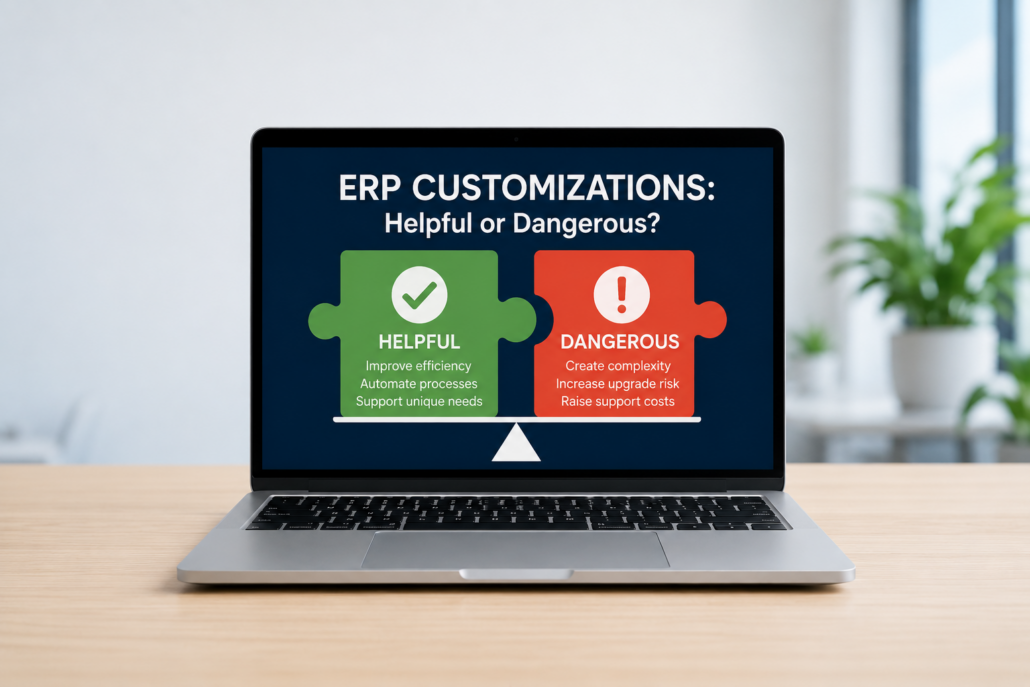
ERP Customizations: Helpful or Dangerous?
How to Know When ERP Customizations Add Value — and When They Create Problems
ERP customizations are a common consideration for businesses looking to improve their ERP systems and better support their unique processes. ERP systems are designed to help businesses manage operations, improve efficiency, and provide better visibility across the organization, but many companies eventually need additional functionality beyond the standard system.
The question many businesses face is:
Are ERP customizations helping our company, or are they creating future problems?
The answer depends on how the customization was designed, maintained, and aligned with business goals.
Well-planned ERP customizations can improve productivity, automate processes, and provide valuable functionality. Poorly managed customizations can create upgrade challenges, increase support costs, and make future improvements more difficult.
For more information about common ERP challenges businesses experience, read:
The Most Common ERP Support Questions Businesses Ask
What Are ERP Customizations?
ERP customizations are changes made to an ERP system to modify or extend its standard functionality.
Examples include:
- Custom reports
- Automated workflows
- User-defined fields
- Custom screens
- Industry-specific processes
- Custom integrations
- Specialized calculations
- Add-ons and extensions
Most ERP platforms, including SAP Business One, provide customization options because businesses often have unique requirements.
A manufacturing company may need different production workflows than a distribution company. A business with complex reporting requirements may need additional tools beyond standard ERP functionality.
The goal of customization should always be to improve business processes — not simply change the system because users are accustomed to doing things a certain way.
Why Businesses Customize Their ERP Systems
Companies typically customize their ERP systems for several reasons.
To Automate Manual Processes
One of the best uses of customization is eliminating repetitive work.
Examples:
- Automatically creating documents
- Reducing manual data entry
- Improving approval workflows
- Connecting disconnected systems
A good customization saves employees time and reduces errors.
To Improve Reporting and Visibility
Standard ERP reports do not always provide every business metric a company needs.
Custom reports can help organizations analyze:
- Sales performance
- Inventory trends
- Production efficiency
- Profitability
- Customer activity
However, reports should be reviewed regularly to ensure they are still providing valuable information.
ERP reporting problems? Why Financial Reports Don’t Match in ERP Systems
To Support Unique Business Processes
Some companies have legitimate reasons for customization.
Examples:
- Manufacturing requirements
- Industry regulations
- Complex approval processes
- Specialized inventory management
In these situations, customization can provide a competitive advantage.
When ERP Customizations Become Dangerous
Not all customizations create value.
Problems often occur when customizations are added without a clear strategy or long-term plan.
1. Too Many Customizations Create Complexity
Over time, companies may accumulate dozens or even hundreds of modifications.
This can make the ERP system:
- Harder to maintain
- More expensive to support
- More difficult to upgrade
- More dependent on specific individuals
A customization created five years ago may no longer provide value today.
Businesses should periodically review existing customizations and ask:
Does this still improve our business?
2. Poorly Documented Customizations Create Risk
One of the biggest challenges with ERP customizations is a lack of documentation.
Companies often encounter problems when:
- The original developer is no longer available
- Employees do not understand how a process works
- System changes are made without records
- Support teams cannot easily troubleshoot issues
Every important customization should have documentation explaining:
- What it does
- Why it exists
- Who uses it
- How it should be maintained
3. Customizations Can Create ERP Upgrade Problems
One of the biggest concerns businesses have with ERP upgrades is whether their customizations will continue working.
Older customizations may:
- No longer be compatible
- Require redesign
- Conflict with new system features
- Increase testing requirements
This is why customization planning should always include future upgrades.
Poorly maintained customizations can create unexpected system issues, making troubleshooting more difficult and increasing the risk of ERP downtime.
ERP upgrade problems? ERP Upgrade Problems: Causes and Solutions
4. Customizations Can Hide Process Problems
Sometimes businesses customize their ERP system to replicate inefficient processes.
For example:
A company may request a customization because employees have always used a spreadsheet-based workaround.
Before customizing, businesses should ask:
- Is the current process efficient?
- Does the ERP already have this functionality?
- Could training solve the issue?
- Would changing the process create better results?
Sometimes the best solution is not changing the ERP system — it is improving the business process.
Many customization challenges can be avoided through regular system reviews and guidance from an experienced SAP Business One support partner.
SAP Business One Customizations: Finding the Right Balance
SAP Business One is designed to be flexible and adaptable for growing businesses.
Common SAP Business One enhancements include:
- Crystal Reports modifications
- Queries
- User-defined fields
- Approval workflows
- Add-ons
- Integrations
- Automation tools
For manufacturing and distribution companies, these capabilities can provide significant value.
However, SAP Business One customers should regularly review their customizations to ensure they continue supporting business goals. SAP Business One provides businesses with options for extending functionality through configuration, integrations, and approved solutions.
Support One helps companies evaluate existing customizations, identify opportunities for improvement, and determine when standard functionality, configuration changes, or new solutions may be better options.
SAP Business One consulting and support: Why Choose Support One for SAP Business One?
ERP Customizations vs. ERP Configuration
A common mistake is confusing customization with configuration.
Configuration
Configuration uses built-in ERP options to adjust the system.
Examples:
- User permissions
- Workflows
- Settings
- Standard reports
- Business rules
Configuration is generally easier to maintain because it uses native ERP functionality.
Customization
Customization changes or extends the ERP system.
Examples:
- Custom code
- New applications
- Specialized integrations
- Custom functionality
Customization can provide greater flexibility but requires more planning and ongoing maintenance.
A good ERP strategy uses configuration whenever possible and customization when it creates measurable business value. Read more from the Project Management Institute: ERP implementation best practices
How to Manage ERP Customizations Successfully
Review Existing Customizations Regularly
Businesses should periodically evaluate:
- Which customizations are still used?
- Which provide measurable value?
- Which create unnecessary complexity?
Document Everything
Maintain records of:
- Custom functionality
- Developers involved
- Business purpose
- Dependencies
- Upgrade considerations
Consider Future Technology
ERP systems continue evolving with:
- Automation
- Cloud technologies
- Artificial intelligence
- Improved analytics
Before adding a customization, consider whether future ERP functionality may provide a better solution.
The Future of ERP Customizations and AI
As artificial intelligence becomes more integrated into ERP systems, businesses will need to rethink how they customize their platforms.
Future ERP capabilities may reduce the need for some custom development by providing:
- AI-powered recommendations
- Automated workflows
- Intelligent reporting
- Natural language searches
- Predictive insights
However, companies will still need experts who understand their business processes and ERP environment.
Clean data, well-designed processes, and a thoughtful customization strategy will become even more important.
Future Internal Links:
- AI and ERP Support: What Businesses Need to Know
- How AI Is Changing ERP Troubleshooting
- Will AI Replace ERP Consultants?
The Role of an ERP Support Partner
A knowledgeable ERP support partner can help businesses make better customization decisions.
A good partner helps determine:
- Should we customize?
- Should we configure?
- Should we use an add-on?
- Should we change the business process?
- Will this create upgrade issues?
The goal is not to eliminate customizations.
The goal is to ensure every customization creates business value. An experienced SAP Business One support partner can help businesses determine which customizations provide value and which create unnecessary complexity.
Final Thoughts
ERP customizations can be extremely valuable when they are planned, documented, and aligned with business objectives.
The problem is not customization itself.
The problem is:
- Unnecessary complexity
- Poor documentation
- Outdated solutions
- Lack of planning
Businesses that regularly review their ERP customizations can continue improving their systems while avoiding future challenges.
A successful ERP system should adapt to your business — but it should also be positioned for future growth.
Need Help Evaluating Your ERP Customizations?
Not sure whether your ERP customizations are helping your business or creating future challenges?
Support One helps SAP Business One customers review their systems, optimize processes, improve workflows, and prepare for future upgrades.
Whether you need help with SAP Business One support, consulting, integrations, or system optimization, our team can help.
Let’s talk about your ERP system support needs.

Have an ERP Customization You’d Like to Discuss?

