ERP Support Questions: Top Business Challenges
The Ultimate Guide to ERP Troubleshooting, Performance, Reporting, Integrations, and Support Success
ERP support questions are among the most common challenges businesses face after implementing an ERP system. Whether you use SAP Business One, Microsoft Dynamics, Oracle NetSuite, Acumatica, or another ERP solution, organizations regularly search for answers about performance issues, reporting problems, integrations, upgrades, and ongoing support.
Why is the system running slowly?
Why don’t reports match?
Why do integrations keep breaking?
Why does every upgrade seem risky?
And perhaps the biggest question of all:
How do we get more value from our ERP system?
These are not isolated issues. They are some of the most searched ERP support questions online and represent the day-to-day challenges businesses face after go-live.
This guide answers the most common ERP support questions businesses ask and serves as the hub for our ERP support content series.
Why These ERP Support Questions Matter
Many companies view ERP implementation as the finish line.
In reality, implementation is only the beginning.
ERP systems continuously evolve due to:
- Business growth
- New users
- Software updates
- Integration changes
- Regulatory requirements
- Data volume increases
- Artificial Intelligence initiatives
Without proper support, even well-implemented ERP systems can experience declining performance and user adoption over time.
According to research from the Gartner official website, organizations continue to prioritize ERP modernization, automation, and operational efficiency as critical business initiatives.
The difference between successful ERP systems and struggling ones often comes down to the quality of ongoing support.
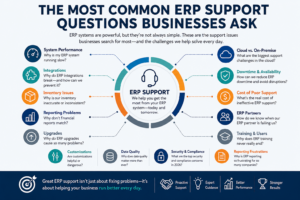
The Most Common ERP Support Questions Businesses Ask
The following ERP support questions consistently rank among the most searched topics by ERP users and support teams.
1. Why Is My ERP System Running Slow?
Performance issues are among the most common ERP complaints.
Symptoms often include:
- Slow report generation
- Delayed transaction processing
- Long login times
- Inventory updates taking too long
- User frustration
Common causes include:
- Database growth
- Poor indexing
- Outdated hardware
- Excessive customizations
- Integration bottlenecks
- Network issues
For SAP Business One users, performance challenges often become more noticeable as transaction volumes increase and additional modules are implemented.
Why Is My ERP System Running Slow? Common Causes and Fixes: Why is My ERP System Running Slow
2. Why Do ERP Integrations Break?
Modern ERP systems rarely operate alone.
They frequently connect with:
- CRM systems
- Ecommerce platforms
- Shipping providers
- Payroll systems
- Manufacturing software
- Business intelligence tools
When integrations fail, businesses often experience:
- Missing orders
- Duplicate records
- Inventory discrepancies
- Financial reporting issues
Most integration failures result from:
- API changes
- Software updates
- Mapping errors
- Authentication failures
- Data quality problems
3. How Do I Fix Inventory Problems in ERP Systems?
Inventory accuracy directly impacts customer satisfaction, purchasing decisions, and profitability.
Common issues include:
- Negative inventory
- Quantity discrepancies
- Missing transactions
- Warehouse transfer errors
- Unit of measure inconsistencies
These problems often stem from process gaps rather than software defects.
Inventory inaccuracies can disrupt purchasing, production, customer service, and financial reporting. Learn the most common causes of inventory problems in ERP systems and practical steps to improve inventory accuracy.
Businesses looking to improve inventory discrepancies often discover that SAP Business One Field Service gives technicians and sales teams secure access to customer, inventory, and work order information from virtually anywhere.
4. Why Don’t Financial Reports Match?
Few ERP issues create more stress than conflicting financial reports.
Businesses frequently discover differences between:
- General Ledger reports
- Financial statements
- Inventory valuations
- Sales reports
- Management dashboards
Root causes often include:
- Posting errors
- Timing differences
- Data integrity issues
- Incorrect report filters
- Custom reporting logic
Learn why financial reports don’t match in ERP systems and the most common causes of reporting discrepancies.
5. Why Do ERP Upgrades Cause So Many Problems?
ERP upgrades are necessary but can create anxiety.
Organizations worry about:
- Downtime
- Broken integrations
- Add-on compatibility
- User disruption
- Data issues
While upgrades bring new functionality and security improvements, poor planning can introduce unexpected complications. ERP upgrades can introduce unexpected challenges if businesses do not properly prepare their data, integrations, and users. Learn about the most common ERP upgrade problems and how to avoid them.
6. What Are the Biggest Cloud ERP Support Challenges?
As businesses migrate from on-premise systems to cloud environments, support requirements change.
Cloud ERP challenges often include:
- Integration management
- Security concerns
- User access controls
- Vendor dependencies
- Connectivity issues
Cloud deployments reduce some infrastructure burdens but introduce new support considerations.
7. How Can We Reduce ERP Downtime?
Every minute of ERP downtime can affect:
- Order processing
- Manufacturing
- Shipping
- Customer service
- Financial operations
Preventing downtime requires:
- Proactive monitoring
- Disaster recovery planning
- Regular maintenance
- User training
- Infrastructure reviews
8. What Is the Real Cost of Poor ERP Support?
Many businesses focus on software costs but underestimate support costs.
Poor ERP support can lead to:
- Lost productivity
- Delayed decisions
- Customer dissatisfaction
- Inventory issues
- Compliance risks
- Employee frustration
The true cost often far exceeds monthly support fees.
9. How Do I Know If My ERP Partner Is Failing Me?
An ERP partner should help your business grow, not simply react to problems.
Warning signs include:
- Slow response times
- Limited expertise
- Frequent unresolved issues
- Poor communication
- Lack of strategic guidance
A strong ERP partner becomes an extension of your team. A complete SAP Business One support services approach combines troubleshooting with user education, optimization, and ongoing guidance.
10. What Are the Most Common SAP Business One Support Requests?
As a leading ERP solution for small and mid-sized businesses, SAP Business One generates recurring support needs.
Common requests include:
- Performance optimization
- Reporting assistance
- User permissions
- Inventory troubleshooting
- Upgrade planning
- Integration support
- Data cleanup
These challenges are familiar to virtually every long-term SAP Business One customer.
11. Why Does ERP User Training Never End?
Many organizations treat training as a one-time event.
In reality, ERP training is continuous because:
- Employees change roles
- New features are introduced
- Processes evolve
- Staff turnover occurs
Many recurring ERP issues are not caused by the software itself, but by gaps in user knowledge. Ongoing SAP Business One training can help employees understand best practices and prevent avoidable mistakes.
Organizations with strong training programs typically achieve better ERP adoption and higher ROI.
12. Are ERP Customizations Helpful or Dangerous?
Customization can solve business challenges but also create support complications.
Potential benefits include:
- Improved workflows
- Better user experiences
- Industry-specific functionality
Potential risks include:
- Upgrade difficulties
- Increased maintenance
- Performance issues
- Compatibility concerns
The key is knowing when customization adds value and when it creates technical debt.
13. Why Does ERP Data Quality Matter More Than Ever?
Many ERP problems are not caused by the software itself, but by inaccurate, incomplete, or inconsistent information inside the system. Learn why ERP data quality is critical for reliable reporting, operations, and future growth.
ERP data drives:
- Reporting
- Forecasting
- Automation
- Business intelligence
- Artificial Intelligence
Poor data quality can undermine every one of these initiatives.
Common issues include:
- Duplicate records
- Incomplete master data
- Outdated information
- Inconsistent standards
As AI adoption accelerates, data quality becomes even more critical.
AI in ERP Systems: What It Actually Does Today
14. What Are the Top ERP Security and Compliance Concerns?
Cybersecurity risks continue to grow.
ERP systems often contain:
- Financial data
- Customer records
- Vendor information
- Employee details
Businesses must address:
- Access controls
- Data protection
- Audit trails
- Compliance requirements
- Backup strategies
Resources such as the National Institute of Standards and Technology (NIST) provide valuable cybersecurity frameworks applicable to ERP environments.
15. Why Is ERP Reporting So Frustrating?
Reporting remains one of the most searched ERP support topics.
Businesses often struggle with:
- Conflicting numbers
- Slow report performance
- Limited visibility
- Complex report design
- Spreadsheet dependence
The challenge is rarely a lack of data.
The challenge is turning data into meaningful information.
Understanding these common ERP support questions can help organizations reduce risk, improve user adoption, and maximize the value of their ERP investment.
How to Prevent Common ERP Support Questions
Across all ERP platforms, successful support programs typically share several characteristics:
Proactive Maintenance
Addressing issues before they become emergencies.
Strong Documentation
Creating consistency and reducing dependency on individual employees.
Ongoing User Training
Helping users stay productive as systems evolve.
Visit our Resources page for access to over 80 training videos on SAP Business One functionality
Data Governance
Maintaining clean, accurate, reliable information.
AI Governance in ERP: The Missing Piece Most Companies Ignore
Strategic Partnership
Working with ERP experts who understand both technology and business operations.
SAP Business One Help Documentation: SAP Business One Help Portal
The Growing Impact of AI on ERP Support
One of the biggest shifts occurring today is the introduction of Artificial Intelligence into ERP support processes.
AI is beginning to assist with:
- Troubleshooting
- Reporting
- Forecasting
- Anomaly detection
- Knowledge retrieval
- Automation
However, successful AI adoption still depends on strong ERP fundamentals.
That is why our next content cluster will focus on AI and ERP Support, exploring how businesses can prepare their systems for the next generation of ERP technology.
The Future of AI in ERP: What Businesses Should Do Now
Final Thoughts
ERP systems are among the most important technology investments a business can make. Yet the greatest value often comes not from implementation, but from ongoing support, optimization, and continuous improvement.
Resolving individual ERP problems is important, but businesses also need a long-term support strategy that helps prevent recurring issues and improves system performance. Businesses should also take a proactive approach to system health, security, and long-term reliability.
In addition to taking a proactive approach, one of the most common ways businesses improve efficiency is through SAP Business One Automation, eliminating repetitive tasks while improving visibility across departments.
The questions covered in this guide represent the issues that businesses search for most often because they affect real-world operations every day.
Over the coming weeks, we’ll dive deeper into each topic, providing practical guidance, troubleshooting insights, and lessons learned from supporting ERP systems in the real world.
If your team is facing any of these ERP support questions, working with an experienced ERP support partner can help resolve issues faster and prevent future problems.
Businesses running SAP Business One should also consider the experience and responsiveness of their support provider. Learn why many organizations choose Support One as their trusted SAP Business One support partner.
Whether you use SAP Business One or another ERP platform, understanding these common support challenges can help you reduce risk, improve performance, and maximize the return on your ERP investment. Contact Support One for your free consultation.