
Why Your ERP Data Quality Matters More Than Ever
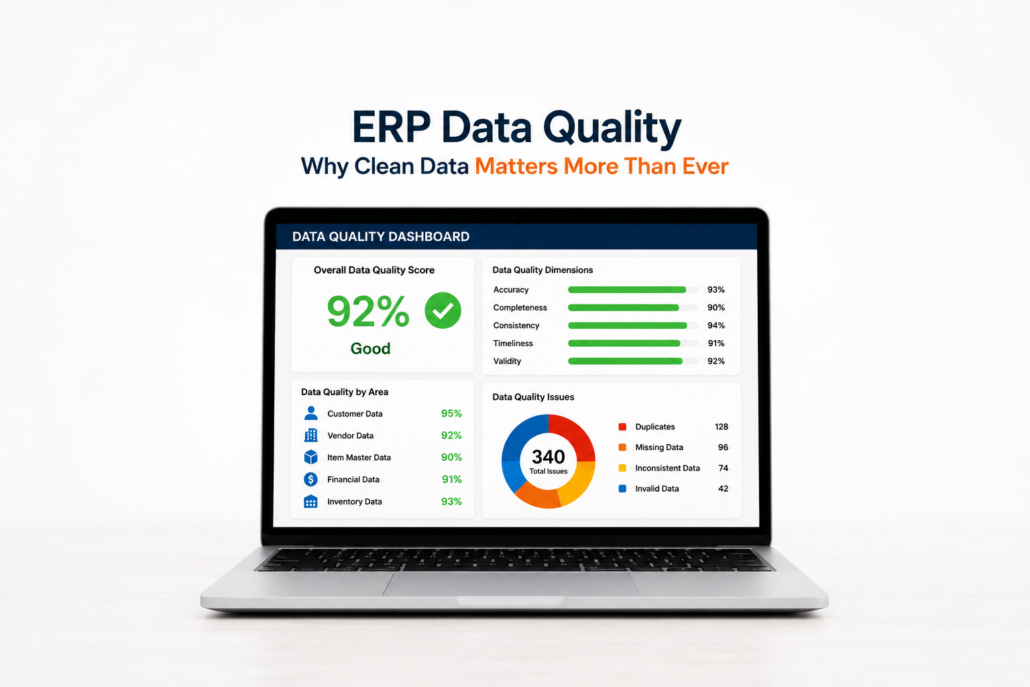
How Poor ERP Data Quality Impacts Reporting, Operations, and Future AI Initiatives
ERP data quality has become one of the most important factors affecting business performance. ERP systems are designed to provide businesses with accurate, reliable information to make better decisions, but even the best ERP software is only as valuable as the data inside it.
ERP data quality has become one of the most important factors affecting business performance. Poor data can create inventory problems, inaccurate financial reports, broken integrations, inefficient processes, and unreliable business insights.
As companies begin exploring artificial intelligence, automation, and advanced analytics, clean ERP data has become even more critical. AI tools can help businesses uncover opportunities and improve decision-making, but only when they have accurate and trustworthy information to analyze.
For more information about common ERP challenges businesses face, read:
Read About: The Most Common ERP Support Questions Businesses Ask
What Is ERP Data Quality?
ERP data quality refers to the accuracy, completeness, consistency, and reliability of the information stored within your ERP system. Organizations often use data quality frameworks to improve accuracy, consistency, and trust in business information.
ERP data includes:
- Customer information
- Vendor records
- Inventory items
- Product information
- Pricing data
- Financial transactions
- Sales orders
- Purchase orders
- Production information
- Employee and user data
When this information is accurate and maintained properly, businesses can trust their ERP system as a single source of truth.
When data quality declines, problems quickly spread throughout the organization.
Why Poor ERP Data Creates Business Problems
Many companies assume ERP problems are caused by software limitations. However, many ongoing ERP challenges are actually caused by inaccurate or inconsistent data.
Poor ERP data quality can lead to:
- Incorrect reports
- Inventory discrepancies
- Delayed decisions
- Failed integrations
- Manual workarounds
- Customer service issues
- Increased operational costs
The longer poor data remains in the system, the more difficult and expensive it becomes to correct. Clean data and reliable processes help reduce the risk of operational disruptions and make ERP troubleshooting easier.
Common ERP Data Quality Problems
Duplicate Customer and Vendor Records
Duplicate records are one of the most common ERP data issues.
Examples include:
- The same customer entered multiple times
- Different spellings of company names
- Duplicate vendor accounts
- Incorrect contact information
These problems can affect:
- Sales reporting
- Customer communication
- Accounts receivable
- Purchasing analysis
Regular data cleanup helps maintain accurate business information.
Incorrect Item Master Data
For manufacturing and distribution companies, item master data is critical.
Common issues include:
- Incorrect item descriptions
- Wrong units of measure
- Duplicate inventory items
- Incorrect warehouse settings
- Missing product information
Poor item data can create:
- Inventory shortages
- Purchasing mistakes
- Production delays
- Incorrect reporting
Inventory problems in ERP systems? How to Fix Inventory Problems in ERP Systems
Inconsistent Business Processes
ERP data quality is often affected by how employees use the system.
Examples:
- Users entering information differently
- Missing required fields
- Manual spreadsheet tracking
- Inconsistent approval processes
Even a well-designed ERP system requires clear processes and user training.
Incorrect Financial Data
Financial reporting depends on accurate transactions and properly maintained data.
Poor ERP data quality can contribute to:
- Incorrect account balances
- Reconciliation problems
- Reporting discrepancies
- Incorrect financial analysis
Financial reporting discrepancies? Why Financial Reports Don’t Match in ERP Systems
How ERP Integrations Impact Data Quality
Modern businesses rely on integrations between ERP systems and other applications.
Examples include:
- CRM platforms
- Ecommerce systems
- Warehouse management systems
- Shipping applications
- Manufacturing software
When integrations are not properly maintained, data quality can suffer.
Common integration-related data problems include:
- Missing transactions
- Duplicate records
- Incorrect information transfers
- Delayed updates
A business may believe it has an ERP data problem when the root cause is actually an integration issue.
ERP integration problems? Why ERP Integrations Break — And How to Prevent Them
SAP Business One and Data Quality Challenges
SAP Business One provides businesses with powerful tools to manage financials, inventory, sales, purchasing, and operations. SAP provides extensive documentation and resources to help organizations better understand SAP Business One functionality and best practices.
However, maintaining high-quality data is essential to getting the most value from the system.
Common SAP Business One data quality challenges include:
- Duplicate business partners
- Incorrect item master records
- Inconsistent inventory information
- Reporting discrepancies
- Manual data entry errors
- Poorly maintained user-defined fields
Poorly designed customizations can also contribute to data quality problems by creating inconsistent workflows or duplicate data entry processes.
Data problems often impact multiple areas of an ERP system, which is why ongoing SAP Business One support and system optimization are important.
Improving ERP data quality often requires more than correcting information. Businesses need ongoing SAP Business One support services that help improve processes and user adoption.
Support One helps SAP Business One customers improve system reliability by reviewing processes, identifying data issues, and recommending practical solutions.
Looking for a SAP Business One support partner? Why Choose Support One for SAP Business One?
How to Improve ERP Data Quality
Improving ERP data quality requires ongoing attention, not a one-time cleanup project.
Establish Data Ownership
Assign responsibility for maintaining important ERP information.
Examples:
- Who maintains customer records?
- Who approves item changes?
- Who reviews vendor information?
Create Data Entry Standards
Define clear rules for:
- Naming conventions
- Required fields
- Approval processes
- Data updates
Regularly Review Master Data
Schedule routine reviews of:
- Customers
- Vendors
- Inventory items
- Financial accounts
Train ERP Users
Users should understand how their actions impact:
- Reports
- Inventory
- Accounting
- Operations
Improving ERP data quality often begins with improving user understanding. SAP Business One training helps employees follow consistent processes and maintain more accurate information.
Ongoing ERP education improves both adoption and data accuracy. Visit Support One Resources Page for over 80 support related and training videos.
Monitor Integrations
Regularly review connected systems to ensure information is transferring correctly.
Maintaining clean ERP data is especially important before major system changes. Poor data quality is one of the most common causes of problems during an ERP upgrade.
Why ERP Data Quality Is Critical for AI
Artificial intelligence is becoming an important part of the future of ERP systems.
Businesses are exploring AI for:
- Forecasting
- Reporting
- Process automation
- Customer insights
- Operational improvements
However, AI cannot fix poor ERP data.
If the underlying information is incomplete, inconsistent, or inaccurate, AI recommendations may also be unreliable.
Clean ERP data is the foundation for successful AI adoption. Strong data management practices help organizations improve data quality, governance, and readiness for advanced analytics.
Inventory forecasting is only as accurate as the data behind it. See how clean ERP data supports successful AI Inventory Management initiatives.
Clean ERP data becomes especially important when AI is used to answer customer questions. AI Customer Service depends on accurate customer, order, inventory, purchasing, and service information to provide useful insights.
Sales also provides a good example of why data quality matters. AI for Sales depends on accurate customer, product, pricing, order, inventory, and margin information to identify opportunities and provide useful recommendations.
Warehouse operations in another good example of why AI depends on accurate ERP information. AI warehouse management needs reliable inventory quantities, bin locations, orders, receipts, product information, and transaction history to produce useful recommendations.
Manufacturing provides a good example of why AI depends on reliable ERP data. AI for production management may rely on accurate bills of materials, inventory, production orders, purchasing, resource information, costs, and sales demand to produce useful recommendations.
The Role of an ERP Support Partner
Maintaining ERP data quality requires more than occasional cleanup.
An experienced ERP support partner can help businesses:
- Identify data issues
- Improve processes
- Optimize workflows
- Review integrations
- Train users
- Prepare systems for future technology
For SAP Business One customers, having a knowledgeable support team can make the difference between simply maintaining an ERP system and continuously improving it. Why Choose Support One for SAP Business One?
Final Thoughts
ERP data quality is one of the most important factors affecting business success.
Accurate data improves:
- Reporting confidence
- Inventory visibility
- Operational efficiency
- Customer service
- Decision-making
As ERP systems continue to evolve and businesses adopt AI-powered tools, clean and reliable data will become even more valuable.
Companies that prioritize ERP data quality today will be better prepared for the future.
Need Help Improving Your ERP Data Quality?
If your business is experiencing reporting issues, inventory problems, integration challenges, or inconsistent ERP information, Support One can help.
Our team works with SAP Business One customers to improve system performance, optimize processes, and ensure their ERP system continues to support business growth.
Let’s talk about your ERP system support needs.
Contact Support One today to discuss how we can help improve your SAP Business One environment.

Let Us Help with Improving Your ERP Data Quality

