
Can You Trust AI Inside ERP Systems?

Artificial Intelligence is rapidly becoming part of modern business software, but many organizations still question whether they can truly trust AI ERP systems to support critical operations. Businesses are exploring AI-powered forecasting, automation, reporting assistants, and conversational ERP tools, yet concerns about governance, security, accuracy, and oversight continue growing as AI adoption expands.
But as AI becomes more involved in business operations, many organizations are asking an important question:
Can you trust AI inside ERP systems?
The answer is more complicated than many software vendors suggest.
AI can deliver tremendous value inside ERP environments, but it also introduces new risks involving accuracy, governance, compliance, security, and accountability. Businesses that trust AI too much — or implement it without proper oversight — may expose themselves to operational and financial problems.
As we discussed in our earlier article, “The Biggest Mistakes Companies Make with AI in ERP,” successful AI adoption depends heavily on realistic expectations, strong governance, and reliable ERP data. AI should support decision-making, not replace operational discipline.
In this article, we’ll explore where AI can be trusted inside ERP systems, where caution is still necessary, and how businesses can balance automation with human oversight.
Why Businesses Are Concerned About AI in ERP Systems
ERP systems manage some of the most critical information inside an organization, including:
- financial data
- purchasing
- inventory
- payroll
- customer records
- operational reporting
When AI begins influencing these areas, businesses naturally become concerned about:
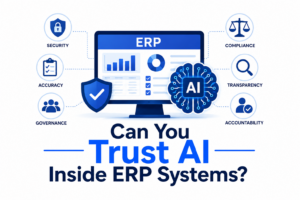
- accuracy
- compliance
- security
- auditability
- accountability
Unlike traditional ERP automation, AI systems may generate recommendations or responses based on probabilities and learned patterns rather than fixed rules.
This creates uncertainty for many organizations, especially in finance and operations.
According to Gartner, governance and trust are becoming major priorities as businesses scale AI adoption across enterprise systems.
Where AI in ERP Systems Can Be Trusted
Not every AI use case carries the same level of risk.
Some AI applications are relatively low-risk and already delivering strong business value today.
Low-Risk AI Applications Include:
- reporting assistance
- inventory forecasting
- anomaly detection
- customer service recommendations
- workflow suggestions
- predictive maintenance alerts
In these cases, AI typically:
- assists employees
- highlights patterns
- improves visibility
- accelerates analysis
…while humans still make the final decisions.
For example:
- AI may flag unusual purchasing activity
- AI may identify inventory shortages
- AI may summarize financial trends
- AI may recommend reorder quantities
These use cases often improve operational efficiency without removing human oversight.
Checkout our recent blog on: Top 10 Use Cases That Deliver Real ROI
Many of the AI capabilities earning the highest levels of user trust are also among the ERP applications generating the strongest ROI today.
Where Businesses Should Be More Careful
Higher-risk ERP processes require much stronger governance and oversight.
Businesses should be cautious when AI directly influences:
- financial postings
- purchasing approvals
- compliance reporting
- payroll decisions
- customer communications
- inventory adjustments
AI systems can still:
- generate inaccurate outputs
- misinterpret data
- overlook business context
- produce hallucinations
- make flawed recommendations
Unlike traditional automation, AI outputs are not always predictable.
This is why businesses should avoid giving AI unrestricted authority over critical ERP processes.
AI Hallucinations Are a Real Concern
One growing concern in enterprise AI is hallucination risk.
AI hallucinations occur when AI systems generate:
- incorrect information
- fabricated explanations
- misleading recommendations
- inaccurate summaries
Inside ERP systems, hallucinations could potentially lead to:
- reporting errors
- incorrect forecasts
- financial confusion
- poor operational decisions
For example:
- an AI assistant may summarize data incorrectly
- forecasting tools may misinterpret poor-quality ERP data
- conversational ERP systems may provide incomplete answers
According to IBM – What Are AI Hallucinations?, hallucinations remain one of the major challenges in generative AI systems today.
Read why: Why Clean ERP Data Matters More Than AI Tools
ERP Data Quality Directly Impacts AI Trust
One of the biggest factors affecting trust in AI is the quality of the ERP data underneath it.
AI systems learn from historical ERP information. If that data is inaccurate, inconsistent, or incomplete, AI outputs may become unreliable.
Common ERP data problems include:
- duplicate records
- inconsistent naming conventions
- outdated inventory information
- spreadsheet workarounds
- disconnected systems
Businesses often assume AI will somehow “fix” these problems automatically.
In reality, AI frequently exposes bad ERP data faster.
Organizations with clean ERP data typically achieve:
- more reliable analytics
- better forecasting
- stronger automation
- improved trust in AI outputs
Read more about preparing your ERP to be AI ready:
Human Oversight Is Still Essential
One of the biggest misconceptions about AI is that it should replace human decision-making entirely.
In most ERP environments, AI works best when it supports people — not when it operates independently.
Human oversight remains essential for:
- financial approvals
- compliance decisions
- purchasing controls
- strategic planning
- customer communications
Successful organizations typically use AI to:
- accelerate analysis
- improve visibility
- reduce manual work
- identify anomalies
- support operational decisions
…while employees remain responsible for final approvals and accountability.
Businesses that trust AI ERP systems successfully usually combine automation with strong governance and human accountability.
Governance Matters More Than Ever
As AI becomes more integrated into ERP systems, governance is becoming increasingly important.
Businesses should establish clear policies around:
- AI access permissions
- approval workflows
- audit trails
- data ownership
- security controls
- compliance requirements
Without governance, AI adoption may create:
- operational risks
- security concerns
- inconsistent reporting
- compliance issues
The NIST AI Risk Management Framework emphasizes governance, transparency, accountability, and oversight as critical components of responsible AI adoption.
AI Governance in ERP: The Missing Piece Most Companies Ignore
Trust, transparency, and governance will become even more important as the future of AI in ERP introduces increasingly intelligent and autonomous capabilities.
Employees Must Understand How AI Works
Trust in AI also depends heavily on employee understanding.
If users do not understand:
- what AI is doing
- where the data comes from
- how recommendations are generated
- what the limitations are
…they may either:
- distrust AI completely
- trust AI too much
Both situations create problems.
Businesses should educate employees on:
- AI strengths
- AI limitations
- oversight responsibilities
- data quality importance
- approval requirements
AI literacy is becoming an important part of ERP modernization.
AI in ERP Systems Should Be Introduced Gradually
One of the safest approaches to AI adoption is gradual implementation.
Businesses should start with lower-risk AI use cases before expanding into more critical operational areas.
Good starting points include:
- reporting assistants
- forecasting support
- anomaly detection
- workflow recommendations
- conversational reporting
This allows organizations to:
- build confidence
- improve governance
- strengthen ERP data quality
- identify operational gaps
- refine oversight processes
Read about: The Biggest Mistakes Companies Make with AI in ERP
AI Trust Depends on ERP Readiness
Ultimately, trust in AI depends heavily on trust in the ERP environment itself.
Businesses with:
- clean ERP data
- standardized processes
- disciplined governance
- strong reporting
- reliable integrations
are far more likely to trust and benefit from AI systems successfully.
Organizations with weak ERP foundations often struggle with:
- inconsistent AI outputs
- poor user adoption
- reporting confusion
- operational risk
Companies that improve ERP data quality and governance will be in a much stronger position to trust AI ERP technologies responsibly in the future.
Final Thoughts
AI can absolutely deliver value inside ERP systems — but trust should be earned carefully, not assumed automatically.
Businesses should approach AI strategically by:
- improving ERP data quality
- strengthening governance
- maintaining human oversight
- standardizing processes
- educating employees
- starting with lower-risk use cases
The future of ERP will almost certainly involve more AI-driven capabilities, but successful organizations will balance automation with accountability and operational discipline.
While today’s AI features are already delivering measurable value, businesses should also understand how the future of AI in ERP is likely to shape the next generation of business systems.
At Support One, we help businesses improve ERP processes, reporting, governance, and operational efficiency so they can adopt AI technologies responsibly and effectively.
Talk with an expert about how AI can deliver real results in your ERP system.

