
AI Governance in ERP: The Missing Piece Most Companies Ignore
AI Governance in ERP: The Missing Piece Most Companies Ignore
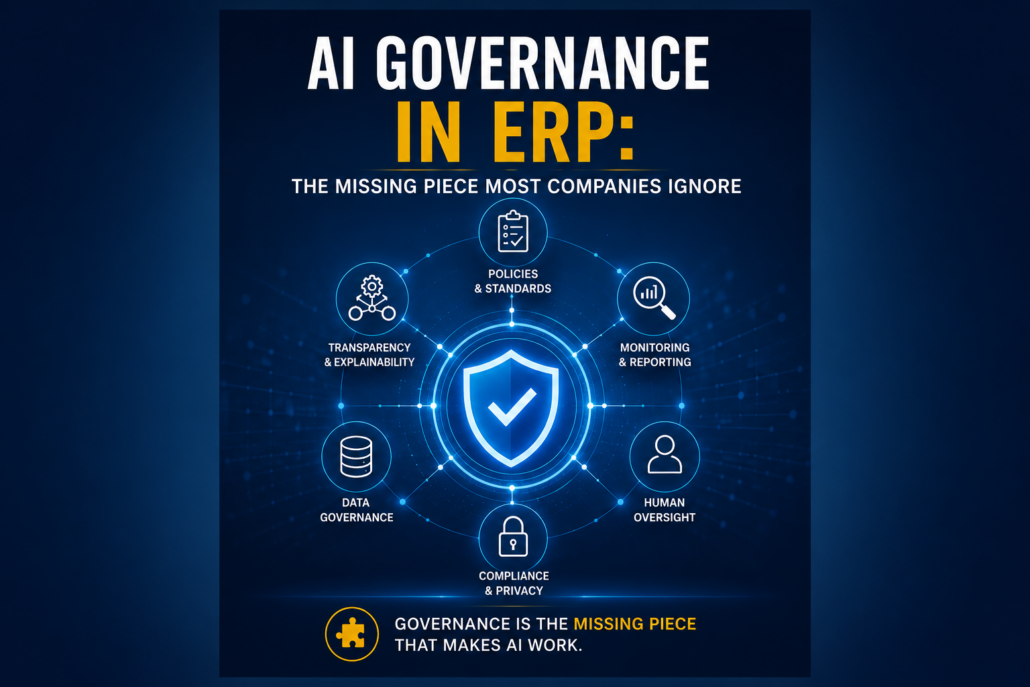
AI governance in ERP is often overlooked—but it’s critical to making AI work safely and effectively. While companies invest in AI capabilities, far fewer are putting the controls in place to manage risk, ensure accuracy, and build trust in AI-driven decisions.
What Is AI Governance in ERP?
AI governance in ERP refers to the policies, controls, and processes that ensure AI systems:
- Use accurate and approved data
- Produce reliable and explainable outputs
- Follow regulatory and internal compliance standards
- Are monitored and continuously improved
It’s not just an IT responsibility—it’s a cross-functional discipline involving leadership, operations, and data management.
Read More:
Why AI Governance Matters More Than Ever
As AI becomes embedded into ERP systems like SAP Business One, the stakes get higher.
Without governance, companies risk:
1. Bad Decisions at Scale
AI can amplify errors quickly if it’s trained on poor or inconsistent data.
The Role of Clean Data in AI Data Success
2. Lack of Trust in AI Outputs
If users don’t understand or trust AI recommendations, adoption stalls.
AI in ERP: What It Actually Does Today
3. Compliance and Regulatory Risk
AI-driven decisions can impact financial reporting, procurement, and customer data handling.
4. Shadow AI and Uncontrolled Usage
Departments may start using AI tools independently, outside IT oversight.
AI in ERP Systems Risks: Where AI Goes Wrong
Key Components of AI Governance in ERP
Effective AI governance doesn’t need to be overly complex—but it does need to be intentional.
1. Data Governance Foundation
AI is only as good as the data behind it.
- Standardized data definitions
- Clean, validated data sources
- Controlled access and ownership
2. Model Transparency and Explainability
Users should be able to understand:
- How AI arrived at a recommendation
- What data was used
- What assumptions were made
This is especially important in finance and operations.
3. Human Oversight
AI should support decisions—not replace accountability.
- Approval workflows
- Exception handling
- Defined escalation paths
AI recommendations for inventory and purchasing should always include human oversight. Learn how organizations combine governance with AI Inventory Management to improve decision-making while maintaining control.
4. Risk Management and Monitoring
AI models must be continuously evaluated for:
- Accuracy drift
- Bias or anomalies
- Changing business conditions
5. Clear Policies and Ownership
Define:
- Who owns AI systems
- Who is responsible for outcomes
- How issues are reported and resolved
Where Most ERP Projects Go Wrong with AI Governance
In our experience, companies don’t fail because of technology—they fail because of gaps in structure.
Common mistakes include:
- Treating AI as a plug-and-play feature
- Ignoring data readiness
- Leaving governance undefined until problems arise
- Assuming IT alone can manage AI risk
Top 10 Use Cases That Deliver Real ROI
How to Start Building AI Governance in Your ERP System
You don’t need a massive initiative to get started. Focus on practical steps:
Step 1: Define Use Cases First
Start with controlled, high-value scenarios—not broad AI deployment.
Step 2: Establish Data Standards
Align teams on what “clean” and “usable” data means.
Step 3: Assign Ownership
Every AI use case should have a business owner—not just IT.
Step 4: Implement Basic Controls
- Approval checkpoints
- Audit trails
- Performance tracking
Step 5: Evolve Over Time
Governance should grow as your AI capabilities expand.
AI Governance Is What Separates Success from Risk
AI in ERP isn’t just a technology upgrade—it’s a shift in how decisions are made.
Without governance:
- AI creates noise
- Risk increases
- Adoption slows
With governance:
- AI becomes reliable
- Teams trust the outputs
- Real ROI becomes possible
Good governance creates the foundation for successful AI adoption. Next, discover how businesses can use AI responsibly while increasing profitability in How AI Helps SAP Business One Users Increase Revenue and Profit.
Governance is a critical component of every successful AI initiative. For a complete roadmap to implementing AI responsibly alongside SAP Business One, read our AI for SAP Business One: The Complete Guide.
AI can recommend suppliers and purchasing quantities, but experienced buyers remain responsible for final approval. Learn how governance supports successful AI Purchasing strategies.
AI can recommend financial actions, but experienced finance professionals remain responsible for reviewing and approving important business decisions. See how AI Financial Management combines AI with human expertise.
AI governance becomes particularly important when artificial intelligence has access to customer, pricing, financial, or service information. AI Customer Service provides a practical example of why businesses need clear rules for data access, human review, and approved AI tools.
Continue the AI in ERP Systems Series
- AI in ERP: What It Actually Does Today
- Top 10 Use Cases That Deliver Real ROI
- AI in ERP Systems Risks: Where AI Goes Wrong
- Why Most ERP Systems Aren’t AI-Ready
- The Role of Clean Data in AI Success
- AI Governance in ERP: The Missing Piece (Current)
- AI vs Automation: Stop Confusing the Two
- Cloud ERP + AI: The Real Shift Happening in Business Software
- AI Agents in ERP: What They Actually Do
- AI Readiness Checklist for ERP Systems
- What is an ERP AI Copilot
If you’re exploring AI in SAP Business One, governance should be part of the conversation from day one.
Support One helps organizations implement AI in ERP the right way—starting with clean data, clear strategy, and practical governance. Contact us now for your free evaluation.
Talk with an expert about how AI can deliver real results in your ERP system.

