
AI-Ready ERP System: How to Prepare Your Business for AI
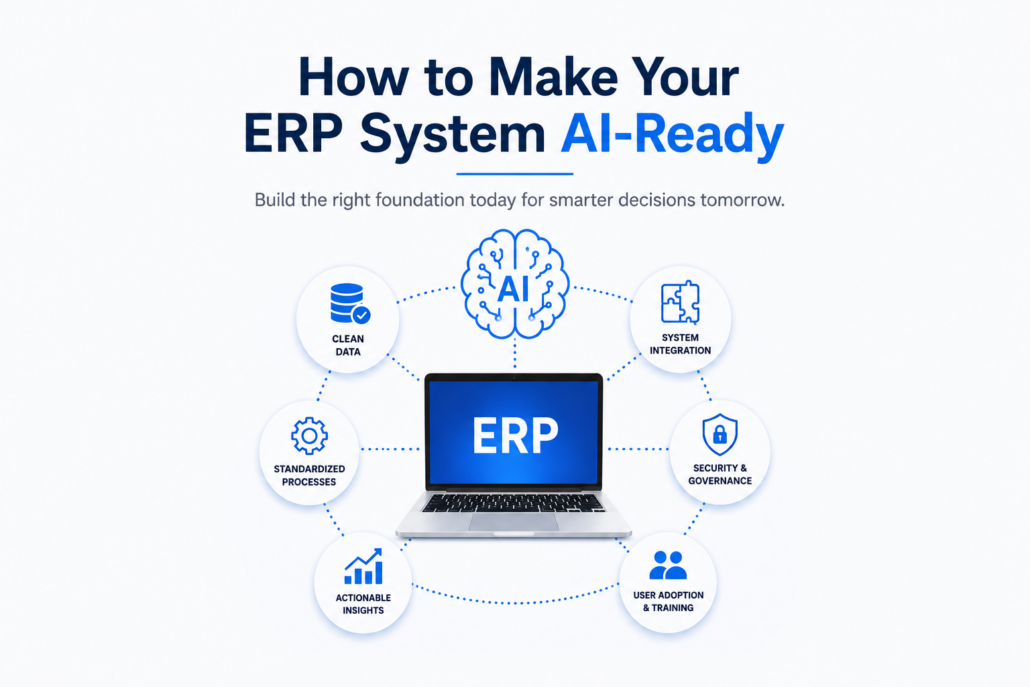
How to Make Your ERP System AI-Ready
Artificial Intelligence is changing how businesses use ERP software, but many companies are discovering their current systems are not prepared for the transition. Creating an AI-ready ERP system requires more than simply adding new AI tools. Businesses need clean data, standardized processes, strong integrations, and reliable governance to successfully support AI-driven automation and decision-making. From automated reporting to predictive forecasting and intelligent assistants, companies are hearing constant promises about how AI will transform ERP systems.
But there’s one major problem:
Most ERP systems are not truly ready for AI.
Many businesses are excited about AI tools, yet still struggle with disconnected processes, inconsistent data, manual workarounds, and outdated workflows. Adding AI on top of a poorly maintained ERP environment often creates more confusion instead of better decision-making.
The good news is that becoming “AI-ready” doesn’t necessarily require replacing your ERP system. In many cases, it means improving the foundation that already exists.
In this article, we’ll explore what it really means to make your ERP system AI-ready, the common obstacles businesses face, and the practical steps companies can take now to prepare for the future of AI-driven ERP.
What Makes an ERP System AI-Ready?
An AI-ready ERP system is not simply an ERP platform that includes AI marketing features.
Instead, it means your ERP environment has the structure, data quality, processes, and governance needed for AI tools to work effectively and safely.
AI systems depend heavily on:
- accurate data
- standardized processes
- reliable integrations
- strong security
- consistent user adoption
Without these elements, AI can produce inaccurate recommendations, unreliable forecasts, and misleading insights.
As we discussed in our earlier article, SAP ERP AI tools are already delivering measurable value in areas like forecasting, automation, and analytics — but only when the underlying ERP environment is properly maintained. See our related article:
AI in ERP: What It Actually Does Today
Another important factor is data quality. AI cannot “fix” bad ERP data. In fact, AI often exposes existing problems faster. That’s why clean ERP data is becoming one of the most important foundations for successful AI initiatives.
Read more about the Importance of Clean Data
Why Many ERP Systems Are Not AI-Ready
Many ERP systems were originally implemented years ago — long before AI became a serious business priority.
Over time, businesses often add:
- spreadsheets
- manual workarounds
- disconnected applications
- duplicate records
- inconsistent procedures
Eventually, the ERP system becomes harder to trust.
When AI is introduced into this environment, it may:
- analyze inaccurate data
- generate misleading insights
- automate flawed processes
- amplify reporting errors
- create compliance risks
This is one reason why many AI projects fail to deliver the expected ROI. Read our recent blog on the 7 Signs Your ERP System is Not Ready for AI.
According to Gartner, organizations often overestimate what AI can do while underestimating the importance of data governance and operational readiness.
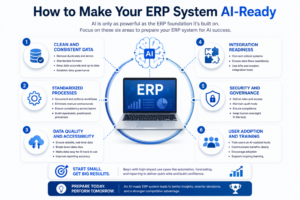
Core Requirements for an AI-Ready ERP System
1. Clean Data Is Essential for an AI-Ready ERP System
AI systems rely on historical ERP data to identify patterns, make predictions, and generate recommendations.
If your ERP data contains:
- duplicate vendors
- inconsistent item descriptions
- missing fields
- outdated records
- inaccurate inventory levels
…then AI results become unreliable.
This is one of the biggest reasons companies should focus on ERP data cleanup before investing heavily in AI tools. Read our recent blog on, Why Clean Data Matters More Than AI Tools.
Areas to Review:
- customer master data
- vendor records
- inventory accuracy
- chart of accounts consistency
- historical transaction quality
- reporting accuracy
Read more: IBM – What Is Data Governance?
2. Standardized Processes Improve ERP AI Readiness
AI works best when processes are predictable and repeatable.
If different employees:
- enter data differently
- bypass procedures
- rely on spreadsheets
- use inconsistent naming conventions
…AI systems may struggle to interpret the information correctly.
Standardization improves:
- automation accuracy
- forecasting reliability
- reporting consistency
- AI recommendations
Questions to Ask:
- Are workflows documented?
- Are approvals standardized?
- Are employees following the same procedures?
- Are manual workarounds common?
This becomes especially important for finance, inventory, purchasing, and operations.
3. Integration Readiness for AI-Driven ERP Systems
Modern AI tools often require access to multiple business systems, including:
- ERP
- CRM
- eCommerce
- reporting platforms
- warehouse systems
- AP automation tools
Disconnected systems create incomplete data sets, limiting AI effectiveness.
Companies preparing for AI should evaluate:
- API capabilities
- integration tools
- data synchronization
- real-time reporting access
Read more: Microsoft – What Are APIs?
4. Security and Governance in an AI-Ready ERP System
As AI becomes more involved in business processes, security and governance become even more important.
Businesses must consider:
- who can access AI-generated insights
- approval requirements
- financial controls
- audit trails
- compliance standards
- data privacy
AI should support decision-making — not eliminate oversight.
This is especially critical when AI is involved with:
- purchasing
- financial reporting
- customer data
- forecasting
- automated workflows
Read more: NIST AI Risk Management Framework
As AI becomes more integrated into ERP platforms, businesses must also evaluate how much they can trust AI systems inside operational workflows and decision-making processes.
5. User Training for Successful ERP AI Adoption
Even the best AI tools fail when employees do not trust or understand them.
Businesses should prepare users for:
- AI-assisted workflows
- automated recommendations
- conversational reporting
- predictive analytics
- new approval processes
Employee education is often overlooked during AI planning.
Successful AI adoption usually requires:
- change management
- process training
- clear governance
- realistic expectations
Cloud vs On-Premise ERP Systems and AI Readiness
Many businesses also wonder whether cloud ERP systems are automatically more AI-ready than on-premise systems.
The answer is: not always.
Cloud platforms may offer:
- easier integrations
- faster updates
- built-in AI features
- scalable infrastructure
However, even cloud ERP systems still depend on:
- clean data
- standardized processes
- strong governance
An on-premise ERP system with well-maintained processes may outperform a poorly managed cloud environment when it comes to AI readiness.
Read our article on Cloud ERP + AI: The Real Shift Happening in Business Software
Start with Small, Practical AI Projects
One of the biggest mistakes companies make is trying to implement AI everywhere at once.
Instead, businesses should begin with smaller, high-value use cases such as:
- AP automation
- inventory forecasting
- anomaly detection
- reporting assistants
- customer service automation
This allows organizations to:
- improve data quality gradually
- build internal confidence
- identify process issues
- measure ROI realistically
What AI Features in ERP Actually Deliver ROI?
Businesses that try to implement too many AI initiatives simultaneously often encounter operational and adoption problems that can slow long-term AI success. Biggest mistakes companies make with AI in ERP.
Businesses often achieve the fastest returns by focusing on proven AI applications that address specific operational challenges rather than pursuing broad AI initiatives.
AI Readiness Is More About Preparation Than Technology
One of the most important things businesses should understand is this:
AI success depends more on operational readiness than on the AI software itself.
Companies often focus heavily on:
- AI vendors
- AI features
- automation promises
…while ignoring the ERP foundation underneath.
The organizations seeing the best AI results are usually the ones that already have:
- disciplined processes
- clean data
- strong reporting
- user accountability
- leadership alignment
Building an AI-ready ERP system is not just about today’s opportunities—it is also about preparing for the future of AI in ERP and the new capabilities that will continue to emerge.
Final Thoughts
AI is changing the future of ERP systems, but successful AI adoption requires preparation long before new tools are activated.
Businesses that focus on:
- ERP data quality
- process standardization
- integrations
- governance
- user adoption
will be in a much stronger position to take advantage of AI as the technology continues to evolve.
The companies that prepare now will likely gain a significant operational advantage over competitors still struggling with disconnected systems and unreliable data.
At Support One, we help businesses improve ERP processes, reporting, data quality, and operational efficiency so they can prepare for the next generation of AI-driven business systems.
Schedule your free consultation to see if your ERP system is AI Ready.
Talk with an expert about how AI can deliver real results in your ERP system.

