
The Future of AI in ERP: What Businesses Should Do Now
The future of AI in ERP is becoming one of the most important topics for business leaders, ERP users, and software vendors alike. From intelligent automation and predictive analytics to AI-powered assistants and conversational interfaces, ERP platforms are evolving rapidly. But while the technology continues to advance, many organizations are still asking a practical question: What should we be doing today to prepare for the future of AI in ERP?
But while the technology continues to evolve, many businesses are still asking a more practical question:
What should we be doing today to prepare for the future of AI in ERP?
The answer is surprisingly simple. Most organizations do not need to chase every new AI trend. Instead, they should focus on strengthening the ERP foundation that will allow them to take advantage of future AI capabilities as they mature.
Throughout this AI in ERP series, we’ve explored readiness, data quality, governance, trust, ROI, and common implementation mistakes. A consistent theme has emerged: companies that prepare their ERP systems now will be far better positioned to benefit from future AI innovations.
Let’s look at where AI in ERP is heading and what businesses should do today to stay ahead. Businesses preparing for AI should first address existing ERP performance problems and data quality issues. Before implementing AI-driven inventory planning and forecasting tools, businesses should first address existing inventory accuracy challenges.
The Future of AI in ERP Is Already Taking Shape
Many AI capabilities that seemed futuristic just a few years ago are now becoming part of everyday ERP systems.
ERP vendors are increasingly embedding AI into:
- reporting and analytics
- forecasting
- purchasing
- inventory management
- customer service
- workflow automation
- financial processes
The future is not likely to be a completely autonomous ERP system making every business decision.
Instead, AI will increasingly act as an intelligent assistant that helps employees:
- access information faster
- identify opportunities
- reduce manual work
- improve decision-making
- automate repetitive tasks
According to Gartner’s AI Research Hub, organizations are increasingly focusing on practical AI applications that improve productivity and business outcomes rather than pursuing AI for its own sake.
Trend #1: Conversational ERP Will Change How Users Interact with Business Systems
One of the most exciting developments is the rise of conversational ERP.
Instead of navigating menus, reports, and dashboards, users will increasingly interact with ERP systems using natural language.
Imagine asking:
- “Show me customers with overdue invoices.”
- “What inventory items are below safety stock?”
- “Which products generated the highest margin last quarter?”
- “What purchase orders require approval today?”
and receiving immediate answers.
This shift has the potential to dramatically improve user adoption while reducing training requirements.
Many ERP vendors are already introducing AI assistants that move in this direction, and conversational ERP is likely to become one of the defining trends of the next decade.
Find out: What AI Features in ERP Actually Deliver ROI?
Trend #2: ERP Data Quality Will Become Even More Important
As AI becomes more deeply integrated into ERP systems, data quality will become even more critical.
AI systems depend on:
- accurate master data
- reliable transaction history
- consistent business processes
- integrated systems
Poor ERP data creates:
- inaccurate forecasts
- unreliable recommendations
- reporting errors
- reduced user trust
One of the biggest misconceptions is that AI can somehow fix bad ERP data automatically.
In reality, AI often exposes data quality issues faster than traditional reporting tools.
Organizations that invest in data quality today will be far better prepared for future AI capabilities.
AI tools are most effective when businesses have accurate data and connected systems. Integrations provide the foundation needed for better automation and intelligent decision-making.
As businesses prepare for AI-driven ERP capabilities, having accurate operational data becomes increasingly important. Solutions such as SAP Business One WMS help create the real-time warehouse visibility needed for better analytics, automation, and future AI initiatives.
AI delivers better insights when employees capture accurate mobile ERP data from the field, allowing businesses to automate processes and make faster operational decisions.
Read More:
Trend #3: Trust and Governance Will Become Competitive Advantages
As AI becomes more involved in business operations, governance will move from a technical issue to a business priority.
Organizations will need clear policies regarding:
- AI oversight
- approval workflows
- security
- compliance
- accountability
- auditability
Businesses that establish strong governance frameworks will be able to adopt AI faster and more confidently than competitors that struggle with operational controls.
According to the NIST AI Risk Management Framework, governance, transparency, and accountability are essential components of responsible AI adoption.
Recent Blogs:
Trend #4: Practical AI Will Win Over AI Hype
The early excitement around AI created unrealistic expectations in many organizations.
Some businesses expected AI to:
- eliminate employees
- fully automate decision-making
- instantly fix operational problems
- replace ERP expertise
The reality has been much more practical.
The highest-value AI projects today focus on:
- accounts payable automation
- inventory forecasting
- anomaly detection
- reporting assistance
- workflow optimization
Organizations that focus on solving specific business problems consistently achieve better results than those chasing the latest technology trends.
Check out:
Trend #5: ERP Readiness Will Shape the Future of AI in ERP
Perhaps the most important lesson from this series is that AI success depends heavily on ERP readiness.
Businesses with:
- standardized processes
- clean data
- strong reporting
- integrated systems
- disciplined governance
will adopt AI more successfully than organizations struggling with basic ERP challenges.
ERP readiness is quickly becoming a competitive advantage.
Companies that prepare now will have more flexibility as AI capabilities continue to evolve. Businesses preparing for AI should begin by automating business processes, ensuring they have accurate, consistent data that AI can analyze effectively.
Internal Link Suggestions
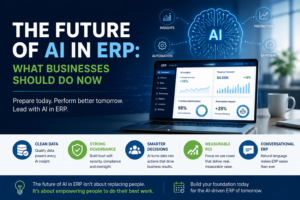
What Businesses Should Do Today to Prepare for the Future of AI in ERP
Rather than waiting for the next AI breakthrough, organizations should focus on building a strong foundation now.
1. Improve ERP Data Quality
Clean, consistent data remains the fuel that powers effective AI.
2. Standardize Business Processes
AI performs best when processes are documented and repeatable.
3. Reduce Spreadsheet Dependence
The more information that lives outside the ERP system, the less effective AI becomes.
4. Strengthen Governance
Establish clear policies around security, approvals, compliance, and AI oversight.
5. Invest in User Training
Employees who understand both ERP and AI will be better positioned to leverage future capabilities.
6. Start with Proven AI Use Cases
Focus on practical applications that deliver measurable value before expanding into more advanced AI initiatives.
Read More:
- What AI Features in ERP Actually Deliver ROI?
- Can You Trust AI Inside ERP Systems?
Businesses preparing for AI should evaluate their ERP support strategy and ensure they have access to experienced ERP consultants who understand both technology and business processes.
The Human Role in the Future of AI in ERP
Despite concerns that AI may eventually replace ERP users, the future is more likely to involve collaboration between people and technology.
AI excels at:
- analyzing large volumes of data
- identifying patterns
- generating recommendations
- automating repetitive tasks
Humans remain essential for:
- strategic thinking
- relationship management
- exception handling
- business judgment
- accountability
The organizations that thrive will be those that combine AI capabilities with human expertise.
According to McKinsey & Company AI Insights, companies generating the greatest value from AI are integrating it into existing business processes while maintaining strong human oversight.
Preparing for the Future of AI in ERP
The next generation of ERP systems will likely be:
- more intelligent
- more predictive
- more conversational
- more automated
- more integrated
But successful adoption will not depend primarily on technology.
It will depend on:
- ERP readiness
- process discipline
- data quality
- governance
- user adoption
Organizations that focus on these fundamentals today will be better prepared for whatever innovations emerge tomorrow. AI will create the most value for companies that already have clean data, optimized processes, and connected business systems. Improving your SAP Business One foundation is an important first step.
As AI becomes more integrated into business systems, companies must also consider new cybersecurity challenges and evaluate potential SAP Business One security risks.
Final Thoughts
The future of AI in ERP is not about replacing people or turning business systems into fully autonomous decision-makers.
It is about helping organizations:
- make better decisions
- reduce manual effort
- improve visibility
- strengthen forecasting
- operate more efficiently
Businesses that invest in ERP readiness today will be in the strongest position to take advantage of future AI innovations.
The companies that succeed will not necessarily be the first to adopt every new AI feature. They will be the ones with clean data, strong governance, disciplined processes, and a clear understanding of how AI supports business objectives.
At Support One, we help organizations improve ERP performance, reporting, governance, and operational efficiency so they can prepare for the next generation of ERP technologies.
Talk with an expert about how AI can deliver real results in your ERP system.

