
7 Signs Your ERP Is Not Ready for AI
Artificial Intelligence is transforming modern business software, but many companies are discovering their ERP systems are not ERP ready for AI. Poor data quality, disconnected systems, inconsistent processes, and weak governance can all prevent AI tools from delivering reliable automation and accurate insights. Before investing in AI technologies, businesses should first determine whether their ERP environment is truly prepared for AI adoption.
Is your ERP system actually ready for AI?
An AI-ready ERP system requires more than new software features. It depends on clean data, consistent processes, reliable integrations, and strong operational discipline. Without those foundations, AI tools may generate inaccurate insights, automate flawed processes, or create additional business risks.
In our previous article, “AI-Ready ERP System: How to Prepare Your Business for AI,” we explored the building blocks of AI readiness. In this article, we’ll look at seven warning signs that your ERP environment may not yet be prepared for successful AI adoption.
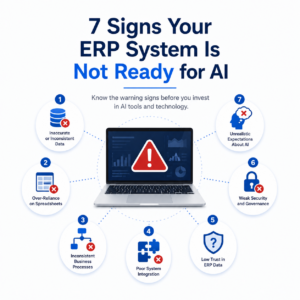
1. Poor Data Is a Sign Your ERP System Is Not Ready for AI
AI systems rely heavily on historical ERP data to identify patterns, generate forecasts, and automate decisions.
If your ERP system contains:
- duplicate customer records
- inconsistent item descriptions
- outdated inventory data
- missing fields
- inaccurate financial information
…then AI tools may produce unreliable recommendations.
One of the biggest misconceptions about AI is that it can somehow “fix” poor data automatically. In reality, AI often exposes bad data faster than humans do.
For example:
- inaccurate inventory data can create forecasting errors
- duplicate vendors can affect purchasing automation
- inconsistent product naming can confuse AI-driven reporting
This is why data cleanup is often one of the most important first steps in ERP AI readiness. Read our recent blog on, Why Clean Data Matters more than AI Tools.
Read More:
2. Spreadsheet Dependence Shows Your ERP System Is Not Ready for AI
Spreadsheets are not inherently bad. However, when employees constantly export ERP data into separate spreadsheets to complete daily tasks, it often signals deeper process and reporting problems.
Common examples include:
- manual inventory tracking
- offline forecasting
- shadow accounting
- disconnected sales reporting
- spreadsheet-based approvals
When critical business information lives outside the ERP system, AI tools lose visibility into the full operational picture.
This creates:
- incomplete data sets
- inconsistent reporting
- unreliable analytics
- limited automation opportunities
An AI-ready ERP system depends on centralized, trustworthy information.
3. Inconsistent Processes Mean Your ERP System Is Not Ready for AI
AI works best in environments with structured and repeatable workflows.
If employees handle the same task differently across departments or locations, AI systems may struggle to identify patterns accurately.
Examples include:
- inconsistent purchasing approvals
- different data entry methods
- undocumented workflows
- manual workarounds
- inconsistent inventory procedures
Without standardized processes, automation becomes much harder to trust.
According to Gartner, organizations often underestimate how much operational consistency impacts successful AI adoption. Standardized workflows are essential for businesses that want an ERP environment that is truly ERP ready for AI.
4. Weak Integrations Suggest Your ERP System Is Not Ready for AI
Modern AI tools often require data from multiple business systems, including:
- ERP
- CRM
- eCommerce
- warehouse management
- reporting platforms
- AP automation software
Disconnected systems create data silos that limit AI effectiveness.
Signs of poor integration readiness include:
- duplicate data entry
- delayed synchronization
- inconsistent reporting between systems
- manual imports and exports
- limited API support
The stronger your integrations, the more useful AI-driven insights become.
If your ERP system is not ready for AI, even advanced automation tools may struggle to deliver accurate results or meaningful business value.
Read More:
Microsoft – API Design Overview
5. Low User Trust Is a Warning Your ERP System Is Not Ready for AI
If employees regularly question ERP reports or rely on “their own numbers,” AI adoption becomes much more difficult.
AI systems depend on trust in the underlying data.
Warning signs include:
- multiple versions of reports
- conflicting KPIs
- departments using separate tracking methods
- frequent reporting disputes
- lack of confidence in dashboards
When trust in ERP data is low, trust in AI-generated recommendations will likely be even lower.
This often becomes a cultural issue as much as a technical one.
If employees already distrust ERP reporting, businesses may also struggle to trust AI-generated recommendations and automation inside ERP systems.
6. Weak Governance Means Your ERP System Is Not Ready for AI
AI introduces new operational and compliance risks if governance is not clearly defined.
Businesses should carefully evaluate:
- user permissions
- approval processes
- audit trails
- compliance requirements
- data access controls
This becomes especially important when AI tools begin supporting:
- financial workflows
- purchasing decisions
- reporting automation
- customer communications
AI should support human decision-making — not eliminate oversight entirely.
Read more: NIST AI Risk Management Framework
7. Unrealistic Expectations Show Your ERP System Is Not Ready for AI
One of the biggest warning signs is unrealistic expectations.
Some businesses assume AI will immediately:
- fix inefficient workflows
- clean up data problems
- eliminate manual processes
- improve reporting accuracy
- solve operational bottlenecks
But AI is not a shortcut around poor ERP management.
Companies that achieve the best AI results usually focus first on:
- process improvement
- data accuracy
- user accountability
- system integration
- operational discipline
AI enhances strong operations. It rarely rescues weak ones. Unrealistic expectations are also one of the biggest mistakes companies make when implementing AI inside ERP systems.
AI Readiness Is a Business Strategy — Not Just a Technology Upgrade
Many businesses approach AI as a software project when it is really an operational readiness initiative.
An AI-ready ERP system requires:
- reliable data
- standardized workflows
- integrated systems
- strong governance
- employee trust
- realistic expectations
The organizations preparing these foundations today will likely gain the greatest advantage as ERP AI capabilities continue to evolve.
Businesses should recognize that when an ERP system is not ready for AI, technology investments alone will rarely solve deeper operational and data challenges.
Organizations that address these readiness challenges today will be far better positioned to take advantage of the future of AI in ERP as new technologies become available.
Final Thoughts
AI is creating exciting opportunities for ERP systems, but successful AI adoption depends heavily on the quality of the ERP environment underneath it.
If your business is experiencing several of the warning signs above, the best next step may not be buying more AI software. It may be improving the ERP foundation first.
Businesses that focus on:
- cleaner data
- better processes
- stronger reporting
- improved integrations
- governance and training
Companies that become ERP ready for AI today will be in a much stronger position to benefit from future AI-driven ERP innovations. Before investing in advanced AI capabilities, businesses should understand which AI features actually generate measurable operational benefits.
At Support One, we help businesses improve ERP processes, reporting, data quality, and operational efficiency to prepare for the next generation of AI-enabled business systems.

Talk with an expert about how AI can deliver real results in your ERP system.

