
How AI Improves Manufacturing and Production with SAP Business One
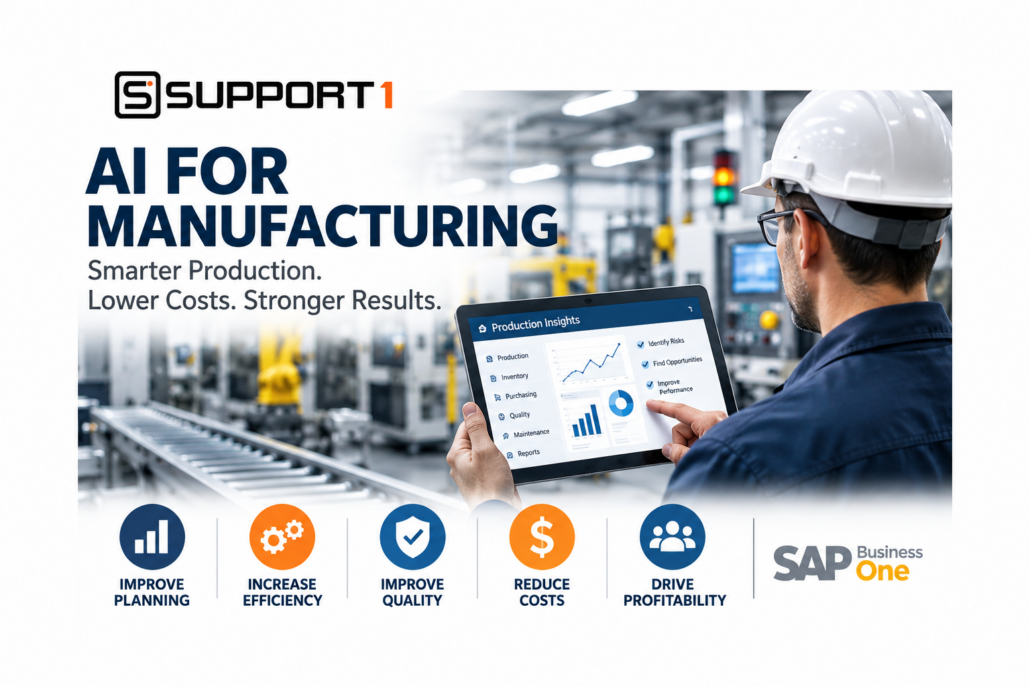
AI for Manufacturing Turns Production Data into Better Decisions
AI for manufacturing can help manufacturers use production, inventory, purchasing, sales, and financial data to make better decisions about what to produce, when to produce it, what materials will be required, and where problems may occur.
For SAP Business One users, that opportunity is particularly interesting.
SAP Business One can bring together information involving:
- Sales orders and forecasts
- Bills of materials
- Production orders
- Inventory
- Components and raw materials
- Purchasing
- Warehouses
- Resources
- Production costs
- Finished goods
- Customer demand
Traditionally, employees use reports, queries, dashboards, spreadsheets, and experience to interpret this information.
AI adds another possibility.
Instead of simply asking:
What production orders are open?
A production manager could potentially ask:
Which open production orders are most likely to be delayed because of material shortages, purchasing delays, or competing production requirements?
Instead of:
How much Product A did we manufacture last month?
Ask:
Why did the average production cost of Product A increase during the last three months, and which components or production activities contributed most to the increase?
The difference is important.
Traditional reporting tells you what happened. AI can help investigate why it happened, what deserves attention, and what may happen next.
SAP Business One provides production functionality for managing bills of materials, production orders, component requirements, resources, and production-related transactions.
SAP Business One Production Overview
Read More: Our Complete Practical Guide on AI for SAP Business One
Why AI in Manufacturing Is Different from Traditional Automation
Manufacturers have been automating processes for decades.
Machines can perform repetitive tasks.
Production systems can generate work orders.
Barcode scanners can record material movement.
Rules can trigger purchasing or inventory actions.
Software can calculate material requirements.
These capabilities can dramatically improve manufacturing operations, but automation and AI aren’t the same thing.
Automation generally follows predetermined instructions.
For example:
When inventory falls below the reorder point, create an alert.
AI can potentially evaluate a broader collection of information:
Product A is likely to fall below required inventory within nine days because demand has increased 18%, three large sales orders are scheduled to ship next week, and a critical component has recently experienced longer supplier lead times.
Automation performs a predefined action.
AI helps employees interpret information and decide which action makes sense.
The two can work together.
AI identifies the issue. Automation helps execute the response.
That’s why manufacturers shouldn’t approach artificial intelligence as a replacement for the automation they already have.
The greater opportunity may be using AI to make those processes smarter and more responsive.
Additional Reading: AI vs. Automation in ERP Systems Stop confusing the two.
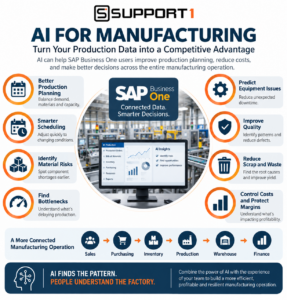
See how AI for manufacturing can turn SAP Business One data into smarter production planning, fewer errors, lower costs, and better manufacturing decisions.
10 Ways AI for Manufacturing Can Improve Production
1. AI for Manufacturing Can Improve Production Planning
Production planning requires balancing multiple variables.
Manufacturers may need to consider:
- Customer demand
- Open sales orders
- Inventory availability
- Finished-goods inventory
- Raw materials
- Components
- Supplier lead times
- Production capacity
- Existing production orders
- Delivery commitments
A change in one area can affect everything else.
Suppose sales receives a large customer order.
Can production make it?
Are the required materials available?
Will fulfilling that order affect other customer commitments?
Do components need to be purchased?
Will another production order need to move?
These questions often require employees to examine information from several places.
AI for manufacturing could help bring those signals together.
For example:
Customer ABC placed an order for 2,000 units of Product A. Current finished-goods inventory can fulfill 600 units. Producing the remaining quantity will require Components X, Y, and Z. Component Y is currently short by 350 units, with the next purchase order expected Tuesday.
Now the planner has an actionable starting point.
AI isn’t creating a perfect production plan automatically.
It’s helping the planner understand the factors affecting the decision.
McKinsey has identified planning, scheduling, performance management, quality, and maintenance among areas where AI and advanced analytics can create value in manufacturing operations.
McKinsey Manufacturing Insights
2. AI Production Management Can Improve Scheduling
Production planning determines what needs to be produced.
Scheduling determines when and in what sequence the work should happen.
That can become complicated quickly.
A manufacturer may have:
- Multiple production orders
- Limited equipment
- Shared resources
- Different material requirements
- Customer deadlines
- Setup requirements
- Different production times
- Changing priorities
A schedule that looked reasonable Monday morning might be outdated by Monday afternoon.
Perhaps a supplier delivery is late.
A customer increases an order.
A machine becomes unavailable.
A component fails inspection.
An urgent production order appears.
AI can help production planners evaluate changing conditions.
For example:
Production Orders 1051 and 1054 both require Resource A tomorrow morning. Order 1054 has the earlier customer commitment, while Order 1051 can move to Wednesday without affecting its scheduled delivery date.
Or:
Moving Production Order 1062 ahead of Order 1060 could reduce a material shortage later this week because all required components for 1062 are currently available.
The production manager still makes the decision.
But instead of manually comparing dozens of orders, AI can help identify the conflicts that deserve attention.
AI Can Help Production Schedules Respond to Change
This may be one of AI’s most useful manufacturing capabilities.
The perfect production schedule rarely survives contact with reality.
AI can potentially help answer:
What changed, what does it affect, and what should we consider doing about it?
That makes AI useful not only for creating plans but also for continually reevaluating them as conditions change.
3. AI for Manufacturing Can Identify Material Shortages Earlier
Few things disrupt production faster than discovering that a critical component isn’t available when employees are ready to use it.
The information may technically exist in the ERP system.
But recognizing the problem early enough can require connecting:
- Production orders
- Bills of materials
- Inventory
- Committed inventory
- Purchase orders
- Expected receipt dates
- Supplier lead times
- Other production requirements
- Sales demand
AI can potentially analyze these relationships and flag risks before production stops.
For example:
Five production orders scheduled during the next two weeks require Component B. Current inventory and confirmed purchase orders leave a projected shortage of 420 units beginning September 14.
Or:
Component C currently has sufficient inventory, but three upcoming production orders will consume 87% of available stock before the next scheduled receipt.
Or:
Supplier ABC’s recent deliveries of Component D have averaged four days later than the lead time currently stored in the system. Review next week’s production requirements for potential risk.
These are much more useful than simply seeing:
Component B: 750 units on hand.
The question isn’t only what do we have?
It’s:
Will we have what production needs when production needs it?
Purchasing AI can help analyze suppliers, purchase requirements, lead times, and expected receipts.
Production AI can evaluate how those purchasing conditions may affect the manufacturing schedule.
AI production management can help identify these material risks earlier, giving purchasing and production teams more time to respond.
4. AI Production Management Can Identify Production Bottlenecks
Manufacturing bottlenecks aren’t always obvious.
Management may know that production is running behind without immediately knowing why.
Potential causes could include:
- Material shortages
- Equipment availability
- Labor constraints
- Excessive setup time
- Rework
- Quality problems
- Scheduling conflicts
- Waiting for upstream processes
- Warehouse delays
- Supplier problems
AI can analyze production history and look for recurring patterns.
For example:
Production orders involving Product Group B take an average of 16% longer than planned. Most of the additional time occurs after Operation 2, where orders frequently wait before the next production step.
Or:
Production delays are concentrated on orders requiring Component X. Seventy-two percent of delayed orders during the last quarter experienced a component availability problem.
Or:
Friday production orders have a significantly higher average completion time than orders started Tuesday through Thursday.
The AI hasn’t solved the problem.
It has narrowed the investigation.
That can save managers from spending hours comparing reports and spreadsheets looking for a pattern.
Look for the Cause, Not Just the Symptom
Suppose a production report shows:
On-time production completion fell from 94% to 86%.
That’s important.
But it doesn’t tell management what to do.
AI could help investigate:
What changed during the same period?
Perhaps:
- Supplier performance declined.
- One component experienced repeated shortages.
- A particular product mix increased.
- Production orders became larger.
- Setup frequency increased.
- One resource became a recurring constraint.
This is where AI can become more valuable than another dashboard.
Dashboards identify the symptom. AI can help investigate the cause.
5. AI for Manufacturing Can Connect Customer Demand to Production
Production doesn’t begin on the factory floor.
It begins with demand.
Customer orders, forecasts, seasonality, promotions, product trends, and changes in buying behavior can all affect what manufacturers need to produce.
This creates a natural connection between AI for Sales, AI Inventory Management, and production.
Suppose AI detects:
Customer demand for Product A has increased 22% during the last eight weeks, while finished-goods inventory has declined 18%.
That’s useful.
But production needs to know what it means operationally.
AI could potentially take the analysis further:
If the current demand trend continues, finished-goods inventory will fall below normal requirements within three weeks. Producing an additional 1,200 units would require 3,600 units of Component B, which currently has a projected purchasing shortage.
Now several departments can see the same business problem:
Sales sees increasing demand.
Inventory sees declining availability.
Production sees additional manufacturing requirements.
Purchasing sees component demand.
Finance can evaluate the cost and margin implications.
This is where connected SAP Business One data becomes particularly valuable.
AI doesn’t have to analyze each department independently.
It can help employees understand how a change in one part of the business affects another.
Effective AI production management can help planners evaluate demand, inventory, material availability, production orders, and customer commitments together
Where SAP Business One Fits into AI Production Management
SAP Business One can provide much of the business context needed for practical manufacturing analysis.
Depending on how a company uses the system, that information may include:
Sales Orders
What have customers ordered?
Inventory
What finished goods, raw materials, and components are available?
Bills of Materials
What materials are required to produce an item?
Production Orders
What is currently planned or in production?
Resources
What production resources are required?
Purchasing
What components have been ordered and when are they expected?
Warehouses
Where are materials and finished products located?
Financials
What does production cost and how does it affect profitability?
SAP Business One supports multiple bill-of-material types and production orders that can capture components, quantities, warehouses, issue methods, and other production information.
The value of AI production management increases when this information is accurate, connected, and available for analysis.
Consider the difference between asking:
Which production orders are late?
and:
Which production orders are at risk of being late during the next seven days, what factors are creating the risk, and which customer orders could be affected?
The first is a report.
The second requires understanding relationships across the business.
That’s where AI becomes interesting.
AI for Manufacturing Does Not Require a “Smart Factory”
When manufacturers hear about AI, they may immediately think about:
- Robots
- Computer vision
- Autonomous production lines
- Digital twins
- Predictive-maintenance sensors
- Machine-learning engineers
- Massive enterprise technology investments
Those technologies are real, and some manufacturers can benefit significantly from them.
But they aren’t the only definition of AI for manufacturing.
A small or midsize manufacturer can begin with much more practical questions:
Which production orders are most at risk this week?
Which components could create material shortages?
Why are certain products consistently taking longer to manufacture?
Which production costs have increased unexpectedly?
Which products are generating the most scrap or rework?
What changed in our production performance last month?
Which customer demand changes could affect next month’s production requirements?
Those questions can potentially be investigated using information a business already collects.
That makes the starting point much more practical:
You don’t necessarily need a smarter factory first.
You need better ways to understand the information your factory already produces.
IBM similarly describes AI in manufacturing as encompassing applications such as predictive maintenance, quality control, supply-chain optimization, demand forecasting, and process optimization—not simply robotics.
Start with the Production Problem, Not the AI
This is the same principle we’ve followed throughout this series.
Don’t begin with:
How can we put AI into our factory?
Begin with:
What’s preventing us from manufacturing more efficiently?
Maybe it’s:
- Material shortages
- Poor scheduling
- Excessive downtime
- Production delays
- Quality problems
- Scrap
- Increasing costs
- Poor visibility
- Changing customer demand
Then ask:
Could better analysis of the information we already have help us solve this problem?
If the answer is yes, AI may be worth exploring.
The objective isn’t to become an “AI-powered manufacturer.”
The objective is to become a better manufacturer.
Part 2: Practical AI for Manufacturing Applications
6. AI for Manufacturing Can Help Predict Equipment Problems
Equipment downtime can disrupt an entire production schedule.
When an important machine unexpectedly becomes unavailable, the consequences can extend beyond maintenance:
- Production orders may be delayed.
- Employees may need to be reassigned.
- Materials may sit waiting.
- Customer orders may ship late.
- Overtime may increase.
- Production may move to less-efficient equipment.
- Other production orders may need to be rescheduled.
Traditional preventive maintenance typically relies on predefined schedules.
For example:
Inspect Machine A every 500 operating hours.
That’s valuable because maintenance happens before a known service interval is exceeded.
Predictive maintenance takes the concept further.
AI can potentially analyze historical equipment performance and other operating information to identify patterns that may indicate a developing problem.
Depending on the equipment and systems involved, that information might include:
- Machine operating hours
- Temperature
- Vibration
- Pressure
- Cycle times
- Error codes
- Maintenance history
- Production output
- Quality results
- Unplanned downtime
AI might identify:
Machine A’s average cycle time has increased 7% during the last three weeks, while vibration readings have also increased. Similar patterns preceded two previous maintenance events.
That doesn’t mean the machine will definitely fail.
It tells maintenance and production managers that the equipment deserves attention.
SAP Business One May Be Only Part of the Predictive Maintenance Picture
This is an important distinction.
SAP Business One can provide valuable business and production context, but sophisticated predictive maintenance may also require machine, sensor, IoT, maintenance, or manufacturing-system data.
For example, SAP Business One might tell us:
Machine A is required for six production orders scheduled next week.
A connected equipment-monitoring system might tell us:
Machine A is showing unusual operating behavior.
Together, those facts become considerably more useful:
Machine A is showing an elevated maintenance risk and is required for six production orders next week. Review maintenance requirements and production scheduling before Monday.
That’s an excellent example of why ERP integration can become increasingly important as manufacturers adopt more advanced AI.
7. AI Production Management Can Improve Quality
Quality problems are expensive.
They can create:
- Scrap
- Rework
- Production delays
- Returns
- Credits
- Warranty costs
- Additional inspection
- Customer complaints
- Lost customer confidence
Many manufacturers already track some form of quality information, although where that information lives varies considerably.
It might be recorded in:
- SAP Business One
- An add-on
- A manufacturing system
- Quality-management software
- Spreadsheets
- Inspection systems
- Machine systems
- Paper records
The more consistently quality information is captured, the more opportunity AI has to identify patterns.
Suppose a manufacturer records production defects by:
- Product
- Production order
- Component
- Supplier
- Machine
- Shift
- Date
- Defect type
AI could potentially ask:
What factors appear most frequently when Product A fails final inspection?
It might discover:
Sixty-three percent of Product A quality failures during the last six months occurred on production orders using Component B from Supplier XYZ.
Or:
Defect rates for Product Group C increase significantly when production runs exceed 2,500 units.
Or:
Rework involving Product D is concentrated on production completed during the final two hours of the second shift.
Those findings don’t necessarily establish the cause.
They identify where management should investigate.
AI production management can turn historical production data into practical information employees can investigate.
AI Can Help Find Relationships People May Not Think to Look For
Traditional reports usually answer questions someone has already decided to ask.
For example:
Show defects by product.
AI analysis can potentially explore relationships across multiple variables.
Maybe the issue isn’t the product.
Maybe it’s:
Product + supplier.
Or:
Product + machine.
Or:
Product + production-run size.
Or:
Component + shift + machine.
AI can help identify these combinations and bring unusual patterns to management’s attention.
That’s where AI production management can become more than another manufacturing report.
8. AI for Manufacturing Can Help Reduce Scrap and Waste
Scrap is another area where small improvements can have a significant financial impact.
A manufacturer might lose material because of:
- Setup problems
- Incorrect production quantities
- Quality failures
- Machine issues
- Operator errors
- Material problems
- Process variation
- Damaged components
- Rework
- Overproduction
A report can show:
Scrap increased 9% last quarter.
AI can help ask the next question:
Why?
For example:
Seventy-one percent of the increase in scrap came from Products A, C, and F. All three use Component X, and the increase began shortly after the most recent supplier change.
Or:
Scrap rates are 14% higher on production runs below 500 units than on larger production runs.
Or:
Product B generates significantly more setup scrap when produced immediately after Product D.
Now management has something specific to investigate.
The objective isn’t simply to reduce the scrap number on a report.
It’s to understand which processes, products, materials, or operating conditions are contributing to the waste.
AI Can Also Help Identify Overproduction
Waste isn’t limited to material that gets thrown away.
Manufacturing products earlier or in larger quantities than necessary can tie up:
- Cash
- Materials
- Warehouse space
- Labor
- Production capacity
Finished products may then sit in inventory waiting for demand.
Inventory AI can help analyze demand, stock levels, and future requirements.
Production AI can use those signals to help determine whether planned production aligns with actual business needs.
9. AI for Manufacturing Can Help Understand Production Costs and Margins
Manufacturers don’t simply need to produce products efficiently.
They need to produce them profitably.
Production costs can change because of:
- Raw-material prices
- Labor
- Resource costs
- Scrap
- Rework
- Production quantities
- Setup requirements
- Purchasing changes
- Freight
- Energy
- Product mix
- Production efficiency
Sometimes those changes happen gradually.
A product that was highly profitable a year ago may have become significantly less profitable without anyone immediately noticing the underlying cause.
By connecting operational and financial information, AI production management can help manufacturers understand how production decisions affect costs and margins.
This is where connected ERP information can become particularly valuable.
Imagine asking:
Which manufactured products experienced the largest decline in gross margin during the last six months?
AI might identify the products.
Then ask:
What factors contributed most to the change?
The analysis might find:
Product A’s gross margin declined from 31% to 24%. Approximately half of the decline is associated with increased Component B cost, while the remainder is associated with higher scrap and lower average production-run quantities.
That gives management several areas to investigate.
Purchasing can review component cost.
Production can investigate scrap.
Sales can evaluate pricing.
Finance can evaluate profitability.
Management can determine the appropriate response.
This is another example of AI helping employees see a business problem across departmental boundaries.
Production Efficiency and Financial Performance Are Connected
A production manager may see:
Average production time increased 8%.
Finance may see:
Manufacturing cost increased.
Sales may see:
Gross margin declined.
Those aren’t necessarily three separate problems.
They may be three views of the same problem.
AI can potentially help connect them.
This is where our AI Financial Management article provides a natural next step for readers interested in the financial side of the analysis.
10. AI Production Management Can Improve Manufacturing Analytics
Manufacturers already measure production performance in many ways. AI production management can make this analysis more conversational by allowing managers to investigate production performance with natural-language questions
Depending on the business, common metrics may include:
- Production output
- Schedule attainment
- Production cycle time
- Downtime
- Scrap
- Rework
- Yield
- Material usage
- Production cost
- Resource utilization
- On-time completion
- Quality performance
Dashboards and business intelligence can make these metrics much easier to monitor.
But AI creates an opportunity to go from:
What happened?
to:
Why did it happen, what deserves attention, and what should we investigate next?
Suppose a dashboard shows:
Production output decreased 11% last month.
A manager could ask AI:
What factors contributed most to the decline?
The response might identify:
Approximately 60% of the decrease was concentrated in Product Group B. Those production orders experienced more material shortages and longer average completion times than the previous three-month average.
Then ask:
Which components created the most shortages?
Then:
Are purchase-order lead times for those components changing?
Then:
Which suppliers are involved?
A static report would normally require the employee to move through several reports or filters.
AI can potentially make the investigation more conversational.
From Manufacturing Reports to Manufacturing Questions
This is one of the AI applications I think could be particularly useful for small and midsize manufacturers.
They don’t necessarily need another 50 reports.
They need an easier way to interrogate the information they already have.
Instead of:
Run the production variance report.
Imagine asking:
Which five production issues had the greatest financial impact last quarter?
Or:
Which manufactured products consistently take longer to complete than planned?
Or:
Which component shortages caused the most production delays?
Or:
Which products have experienced increasing costs without a corresponding increase in selling price?
Or simply:
What changed in production this month that management should know about?
This is a natural evolution of Business Intelligence for SAP Business One.
Business intelligence helps organize and visualize information.
AI can help employees investigate that information through natural-language questions and follow-up analysis.
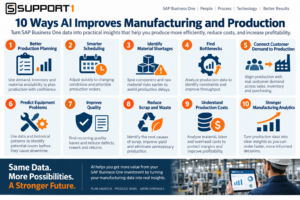
10 practical ways AI for manufacturing can help SAP Business One users plan smarter, reduce production problems, control costs, and improve profitability.
How AI for Manufacturing Connects the Entire Business
Manufacturing may happen on the production floor, but production decisions affect nearly every part of the company.
Consider a simple example.
AI identifies increasing demand for Product A.
That one change could affect:
Sales
Customers are ordering more Product A.
Inventory
Finished-goods inventory is declining faster than expected.
Production
Additional production orders may be required.
Purchasing
More raw materials and components may be needed.
Warehouse
Additional materials must be received, stored, picked, and moved to production.
Finance
Material requirements, production costs, cash flow, revenue, and margins may change.
Customer Service
Employees need to know whether customer delivery commitments can still be met.
This is why the AI series we’ve been building fits together so naturally.
The most valuable question may not be:
How can AI improve production?
It may eventually become:
How can AI help us understand the impact of a business change across the entire company?
SAP Business One can provide a common business-data foundation for many of those relationships.
AI can potentially help employees interpret them.
Read More: How AI Improves Warehouse Operations
Practical AI for Manufacturing Prompts
One of the easiest ways to understand the potential of AI for manufacturing is to imagine the questions a production manager would actually like answered.
Here are practical examples.
Daily Production Priorities
Review today’s open production orders, component availability, customer commitments, and expected purchase receipts. Identify the five production issues that deserve the most attention today and explain why.
Production Scheduling
Review production orders scheduled for the next two weeks. Identify scheduling conflicts, material shortages, or other conditions that could delay completion.
Material Availability
Which production orders scheduled during the next 30 days are at risk because required components may not be available when needed?
Purchasing Risk
Identify components required for upcoming production where supplier performance, purchase-order timing, or current inventory creates the greatest risk.
Production Bottlenecks
Analyze production completion times during the last six months. Which products, resources, components, or processes are most frequently associated with delays?
Quality
Analyze quality problems during the last year. Identify recurring patterns involving products, components, suppliers, production orders, or time periods.
Scrap
Which products generated the highest scrap cost during the last six months, and what factors appear most strongly associated with that scrap?
Production Costs
Which manufactured products experienced the largest increase in production cost during the last six months? Explain which materials or production factors contributed most to the change.
Margin Analysis
Identify manufactured products where production costs are increasing faster than selling prices and rank them by potential margin risk.
Customer Demand
Which products have experienced the greatest change in customer demand during the last 90 days, and how could those changes affect production requirements during the next 60 days?
Management Review
If you were the production manager reviewing our SAP Business One information this morning, what are the five things you would investigate first and why?
That final prompt is deliberately open-ended.
A manager may know exactly what report to run.
AI creates another possibility:
Tell me what I should be looking at.
Better AI Production Management Prompts Need Better Context
As we saw with warehouse operations, the quality of the question matters.
Consider:
Which production orders should we run first?
That’s probably not enough information.
What determines priority?
- Customer delivery date?
- Material availability?
- Production efficiency?
- Customer importance?
- Setup requirements?
- Machine availability?
- Product profitability?
- Warehouse capacity?
- Existing commitments?
AI needs to understand the rules and constraints that matter to the business.
A more useful prompt might be:
Review production orders scheduled during the next seven days. Prioritize orders with complete material availability and customer delivery commitments within ten days. Flag orders where a component shortage could prevent completion.
That’s much better.
But even then, a production manager may know something AI doesn’t:
Machine B will be unavailable Wednesday afternoon.
Or:
Customer ABC agreed yesterday to move its delivery date.
Or:
Component X passed inventory inspection but can’t actually be used.
The more relevant business context AI receives, the more useful the analysis can become.
AI for Manufacturing Works Best with Human Expertise
Manufacturing contains enormous amounts of knowledge that may never appear in a database.
Experienced employees know things like:
- Which machine is temperamental
- Which product is difficult to run
- Which supplier’s materials require extra attention
- Which setup takes longer than the standard
- Which customer will accept a delivery change
- Which component can be substituted
- Which production sequence works better in practice
- Which quality problem looks minor but usually becomes serious
AI doesn’t eliminate that knowledge.
Ideally, it makes that expertise more powerful.
Suppose AI identifies:
Product A takes 14% longer to manufacture than the standard production time.
An experienced production manager may immediately know:
That’s because the standard hasn’t been updated since we changed the packaging process.
AI found the discrepancy.
The employee explained it.
Now the company can correct the underlying information.
That improves both the production process and the data AI will use in the future.
AI Finds Patterns. People Understand the Factory.
That’s the relationship we should be aiming for.
Don’t Automate Every AI Recommendation
Suppose AI identifies:
Production Order 1075 should move ahead of Production Order 1072.
Should the ERP automatically reschedule both orders?
Not necessarily.
The recommendation might be correct according to the available data.
But perhaps:
- Materials are physically staged for 1072.
- A customer was verbally promised an earlier delivery.
- Employees have already completed setup.
- A machine will be unavailable later.
- A supervisor knows something the system doesn’t.
A better starting approach is:
AI recommends.
Employees review.
Automation executes approved actions where appropriate.
As confidence grows and companies understand which recommendations are consistently reliable, some low-risk processes may become more automated.
But human oversight is particularly important when AI recommendations affect customer commitments, production schedules, purchasing, inventory, or financial decisions.
The Goal Is Better Production, Not More Technology
It’s easy to get distracted by sophisticated manufacturing technology.
But most manufacturers care about much simpler outcomes:
- Produce the right products.
- Have materials available when needed.
- Complete production on time.
- Reduce downtime.
- Improve quality.
- Reduce scrap.
- Control costs.
- Protect margins.
- Use employees and equipment efficiently.
- Deliver what customers were promised.
AI is useful only if it helps accomplish those goals.
That’s why a good manufacturing AI strategy doesn’t begin by asking:
Which AI platform should we buy?
It begins with:
What manufacturing problem is costing us the most time, money, capacity, or customer satisfaction?
Then determine whether better data, better processes, automation, AI—or some combination of them—can solve it.
Part 3: Building a Practical AI for Manufacturing Strategy
Best Practices for AI for Manufacturing
The potential applications of AI for manufacturing can make it tempting to start with the technology.
That is usually backward.
A manufacturer doesn’t need an “AI strategy” simply because artificial intelligence is receiving attention. It needs a business strategy that identifies where better information, analysis, automation, and AI could improve production.
A practical approach starts with the problems manufacturers already understand.
Where are we losing time?
Where are we losing money?
What regularly disrupts production?
Which decisions require employees to spend hours gathering information?
Where do problems repeatedly surprise us?
Those questions can help identify where AI may actually produce value.
Start AI for Manufacturing with One Measurable Problem
Don’t begin with:
We want to implement AI in manufacturing.
Begin with something specific:
Material shortages regularly delay production.
Or:
Scrap on Product Group A has increased significantly.
Or:
We can’t reliably determine which production orders are at risk.
Or:
Production costs are increasing, but we don’t know why.
A clearly defined problem makes it much easier to determine:
- What information is required
- Whether that information exists
- Whether the data is reliable
- Whether AI is actually appropriate
- What employees need from the system
- How success will be measured
Suppose material shortages are the problem.
The company might establish a goal:
Reduce production delays caused by material shortages by 25% during the next six months.
Now there is something to measure.
AI could potentially help identify shortages earlier, but the project has a business objective independent of the technology.
That’s important.
The goal isn’t successful AI.
The goal is fewer production delays.
Make Sure Your Manufacturing Data Is Ready for AI
This may be one of the most important sections of the entire article.
AI can analyze information quickly.
It cannot make inaccurate information accurate simply by analyzing it faster.
For manufacturers using SAP Business One, useful AI production management may depend on information involving:
- Item master data
- Bills of materials
- Inventory quantities
- Component availability
- Warehouses
- Production orders
- Resource information
- Purchase orders
- Supplier lead times
- Sales orders
- Production costs
- Finished-goods inventory
If that information is incomplete, inconsistent, or outdated, AI recommendations can be misleading.
Imagine asking:
Which production orders are at risk because of material shortages?
If bills of materials are incorrect, inventory transactions aren’t current, or supplier lead times haven’t been maintained, the answer may be wrong.
Or ask:
Which products have become less profitable to manufacture?
If production costs aren’t captured consistently, the analysis may point management in the wrong direction.
AI Can Expose Data Problems
There is a positive side to this.
AI analysis may help companies discover data-quality issues they didn’t realize they had.
For example:
Product A’s actual production time has exceeded its standard time by approximately 18% for the last nine months.
Perhaps production has become less efficient.
Or perhaps the standard is outdated.
Either way, the discrepancy deserves investigation.
The process of preparing for AI can therefore improve the ERP environment itself.
That’s one reason we view clean ERP data as a foundational step toward AI readiness.
Give AI Production Management the Right Business Context
Accurate data is only part of the equation.
AI also needs to understand the rules and constraints affecting production.
For example, AI might analyze historical production activity and recommend:
Run Product A before Product B because this sequence historically produces higher throughput.
But the production manager may know:
Product B must run first because of today’s customer commitment.
Or AI might recommend:
Increase the production quantity of Product C because demand has increased.
But finance may know:
Product C has become significantly less profitable because of rising component costs.
Or warehouse management may know:
We don’t have space for another 5,000 finished units.
Each recommendation may be reasonable when viewed from one perspective.
The business decision requires broader context.
This is why the most useful manufacturing AI may eventually need to understand information across sales, inventory, purchasing, production, warehouse, and finance.
Measure Whether AI for Manufacturing Is Actually Working
Before implementing an AI application, establish a baseline.
Depending on the problem, manufacturers might measure:
Production schedule attainment
How frequently is production completed according to plan?
Material-related delays
How many production orders are delayed because components aren’t available?
Production cycle time
How long does it take to complete production?
Scrap rate
How much material is lost during production?
Rework
How frequently does production require additional work?
Quality performance
How frequently do products fail inspection or require correction?
Downtime
How much production capacity is lost because equipment is unavailable?
Production cost
How much does it actually cost to manufacture the product?
On-time completion
How frequently are production orders completed when expected?
Gross margin
Are manufactured products producing the expected financial return?
Measure the current result.
Implement the change.
Then measure again.
If AI identifies material shortages three weeks earlier but production delays don’t decline, something else may be preventing employees from acting on the information.
That’s useful to know.
AI should be judged by business results, not by how impressive its answers appear.
Common AI for Manufacturing Mistakes
Buying AI Before Identifying the Manufacturing Problem
This is probably the mistake I would most like small and midsize manufacturers to avoid.
A vendor demonstrates an impressive AI platform.
Management becomes excited.
The company purchases the technology.
Then employees ask:
What exactly are we supposed to do with it?
Reverse the process.
Identify the problem first.
Then determine what technology is appropriate.
Sometimes that technology will be AI.
Sometimes it will be automation, better reporting, barcode scanning, an integration, improved ERP configuration, or simply fixing a broken process.
Trying to Implement Too Much AI at Once
The use cases we’ve covered in this article include:
- Production planning
- Scheduling
- Material availability
- Bottleneck detection
- Demand planning
- Predictive maintenance
- Quality
- Scrap reduction
- Cost analysis
- Manufacturing analytics
That doesn’t mean you should implement all ten.
Choose one or two applications where:
- The problem matters financially.
- Reliable information exists.
- Employees understand the process.
- Results can be measured.
- Risk is manageable.
A successful small project builds knowledge and confidence.
A massive project creates complexity before the company has learned how AI fits into its operations.
Using AI with Poor Production Data
If production employees don’t trust the ERP data, AI won’t solve that problem.
In fact, AI may make it more visible.
Suppose AI repeatedly warns about component shortages that don’t actually exist because inventory transactions aren’t being recorded correctly.
Employees will quickly stop trusting the recommendations.
And once employees lose confidence in the system, adoption becomes much more difficult.
Fix the underlying information first.
Reliable AI begins with reliable business data.
Assuming Every AI Recommendation Is Correct
AI can be wrong.
It can misunderstand the question.
It can analyze incomplete information.
It can identify correlation without understanding the underlying cause.
It may not know about events occurring outside the systems it can access.
Suppose AI identifies:
Supplier ABC is responsible for the majority of recent quality problems.
That deserves investigation.
It doesn’t necessarily prove the supplier caused the problem.
Maybe the supplier provides the component used in the company’s most difficult product.
Maybe inspection procedures changed.
Maybe a machine problem appeared during the same period.
AI can identify patterns.
Employees still need to determine what those patterns actually mean.
Don’t Give AI More Manufacturing Data Than It Needs
One of the advantages of ERP is that large amounts of business information are connected.
That also creates responsibility.
An AI application may not need unrestricted access to everything in SAP Business One.
A production-analysis application might require:
- Production orders
- Bills of materials
- Inventory
- Purchasing
- Resource information
It may not need:
- Employee payroll information
- Bank information
- Every financial transaction
- Unrelated customer information
Access should be appropriate to the application.
The principle is simple:
Give AI the information it needs to perform the task—not everything simply because it’s available.
AI Governance Matters in Manufacturing
As manufacturers expand their use of artificial intelligence, questions about governance become increasingly important.
Companies should establish policies covering areas such as:
- Which AI tools employees may use
- What business information may be submitted
- Which systems AI can access
- Who can see AI-generated information
- How recommendations are reviewed
- Which decisions require human approval
- How confidential information is protected
- Who is responsible when AI influences a business decision
The National Institute of Standards and Technology’s AI Risk Management Framework provides organizations with a voluntary framework for incorporating trustworthiness considerations into the design, development, use, and evaluation of AI systems.
NIST AI Risk Management Framework
For manufacturers, human oversight becomes particularly important when AI recommendations could affect:
- Production schedules
- Customer commitments
- Product quality
- Inventory
- Purchasing
- Equipment
- Safety
- Financial decisions
Is Your Manufacturing Operation Ready for AI?
Before selecting an AI product, ask some practical questions.
Do We Trust Our SAP Business One Data?
If employees routinely export information to spreadsheets because they don’t trust what the ERP says, address that first.
Are Our Bills of Materials Accurate?
Production analysis depends heavily on understanding what is actually required to manufacture products.
Is Inventory Accurate?
AI can’t reliably predict material shortages when the underlying inventory quantities are wrong.
Are Production Transactions Recorded Consistently?
Incomplete production history makes pattern analysis less reliable.
Are Supplier Lead Times Realistic?
If the system says seven days but the supplier routinely takes fourteen, production-risk analysis will be misleading.
Can We Measure Production Performance?
If you can’t measure the process before implementing AI, it will be difficult to prove that AI improved it.
Do We Have a Specific Problem Worth Solving?
“Use AI” isn’t a measurable objective.
“Reduce material-related production delays” is.
Do We Know Who Will Use the AI Recommendations?
Technology has little value if nobody owns the resulting decision.
Do We Have Appropriate AI Governance?
Employees should understand what information can be used, which tools are approved, and when human review is required.
If several answers are “no,” that doesn’t mean the company isn’t ready for AI.
It tells management where AI readiness work should begin.
Successful AI production management depends on reliable data, consistent manufacturing processes, appropriate governance, and employees who understand how production actually works.
Frequently Asked Questions About AI for Manufacturing
What Is AI for Manufacturing?
AI for manufacturing is the use of artificial intelligence to analyze manufacturing and business information to help improve production planning, scheduling, material availability, quality, maintenance, cost control, and operational decision-making.
AI can work alongside ERP, manufacturing systems, automation, sensors, and other technologies.
How Can AI Help Production Planning?
AI can potentially analyze customer demand, inventory, bills of materials, production orders, purchasing, supplier lead times, and other information to help planners identify material shortages, scheduling conflicts, and production risks.
The production planner should remain responsible for reviewing and acting on recommendations.
Can AI Predict Production Delays?
AI may be able to identify conditions historically associated with production delays and flag upcoming orders that share similar risk factors.
For example, it could identify orders affected by material shortages, purchasing delays, resource conflicts, or unusually long production times.
It cannot guarantee that a delay will occur.
Can AI Help Reduce Manufacturing Scrap?
Potentially.
AI can analyze scrap and production history to identify patterns involving products, components, suppliers, machines, production quantities, or other factors.
Employees can then investigate whether those patterns reveal opportunities for process improvement.
Can AI Improve Manufacturing Quality?
Yes, particularly when quality information is captured consistently.
AI can help identify recurring patterns involving defects, products, components, suppliers, machines, production orders, and other variables.
More advanced quality applications may also use computer vision, sensors, or specialized manufacturing systems.
Can AI Help with Predictive Maintenance?
Yes, but sophisticated predictive maintenance usually requires machine-condition information in addition to ERP data.
Sensor, IoT, maintenance, or equipment-monitoring information may need to be combined with production and business data.
SAP Business One can provide useful production context, but it may be only one part of the solution.
Can AI for Manufacturing Work with SAP Business One?
Yes. SAP Business One can provide valuable information involving sales orders, inventory, bills of materials, production orders, resources, purchasing, warehouses, and financials.
The specific AI capabilities available depend on the company’s systems, integrations, data quality, security requirements, and business objectives.
Does AI Replace Manufacturing Automation?
No.
Automation is particularly effective at performing predefined, repeatable processes.
AI is useful for analyzing information, recognizing patterns, predicting potential outcomes, and supporting decisions.
The two technologies can complement one another.
Will AI Replace Production Managers?
AI can help production managers analyze more information and identify issues faster, but manufacturing still requires significant human experience and judgment.
Production managers understand customers, employees, equipment, materials, processes, and exceptions that may never be fully represented in the data.
The better model is Human + AI, not Human vs. AI.
Do Small Manufacturers Need a Data Science Team to Use AI?
Not necessarily.
Some advanced manufacturing applications require specialized expertise, but practical AI applications are becoming increasingly accessible.
For many small and midsize manufacturers, the more important first steps are having reliable data, clearly defined problems, appropriate security, and employees who understand the business process.
What Is the Best First AI Manufacturing Project?
Look for a problem that is:
- Repetitive
- Measurable
- Financially meaningful
- Supported by reliable data
- Well understood by employees
Material shortages, production delays, cost variances, scrap analysis, and production-performance analysis can all be reasonable areas to investigate.
The best project will depend on the business.
How Support One Helps Manufacturers Prepare for AI
For SAP Business One users, preparing for AI doesn’t necessarily start with purchasing an AI application.
It starts by understanding the environment you already have.
Support One can help manufacturers evaluate questions such as:
Are we using SAP Business One effectively today?
Can we trust our ERP data?
Are our production, inventory, purchasing, and sales processes properly connected?
Where are employees relying on spreadsheets or manual workarounds?
What information is missing?
Which processes could benefit from automation?
Where could AI realistically produce measurable value?
In some cases, the next step may involve AI.
In others, it may be:
- Cleaning ERP data
- Improving production processes
- Updating bills of materials
- Improving inventory accuracy
- Integrating disconnected systems
- Improving warehouse processes
- Adding automation
- Improving reporting and analytics
- Making better use of existing SAP Business One functionality
All of those improvements can help create a stronger foundation for AI later.
AI Readiness Is Business Readiness
Companies sometimes think AI readiness means having the newest technology.
It doesn’t.
A manufacturer with clean data, well-defined processes, connected systems, and employees who understand the business may be far more AI-ready than a company with sophisticated technology and unreliable information.
That’s why our approach starts with the business.
The Future of AI for Manufacturing Is Human + AI
Manufacturing will continue to become more intelligent.
AI will become better at:
- Forecasting production requirements
- Identifying material risks
- Optimizing schedules
- Detecting unusual production behavior
- Predicting maintenance needs
- Finding quality patterns
- Reducing waste
- Understanding production costs
- Identifying profitability risks
- Helping employees investigate operational problems
Automation will continue to handle repetitive processes.
Sensors will provide more information about equipment.
Mobile systems will put more information into employees’ hands.
Robotics will become practical for more manufacturers.
But manufacturing will still depend on people who understand the reality of the operation.
People know:
- What the customer really needs
- What the machine actually sounds like
- Which supplier can be trusted in an emergency
- Which employee has the right experience
- Which production schedule works better in practice
- Which quality problem deserves immediate attention
- Which exception doesn’t fit neatly into a database
AI can analyze enormous amounts of information.
People understand what that information means in the real world.
Effective AI production management combines the speed of artificial intelligence with the experience and judgment of the people who understand the factory.
AI finds the pattern. People understand the factory.
That’s the combination manufacturers should be working toward.
Ready to Explore AI for Manufacturing?
You don’t need an autonomous factory to start preparing for artificial intelligence.
You need:
- Reliable SAP Business One data
- Clearly understood manufacturing processes
- Connected business information
- A specific problem worth solving
- A way to measure the result
- Appropriate AI governance
- Employees involved in the decision
Then you can determine where AI, automation, integration, or better use of SAP Business One could make the biggest difference.
Schedule Your Complimentary AI Readiness Review
Support One can review how you’re using SAP Business One today, discuss your manufacturing and production challenges, and help identify practical opportunities for AI, automation, data improvement, and process optimization. Schedule your AI Readinee Review today.

Let’s Schedule Your AI Readiness Review.
