
AI vs Automation in ERP: Stop Confusing the Two
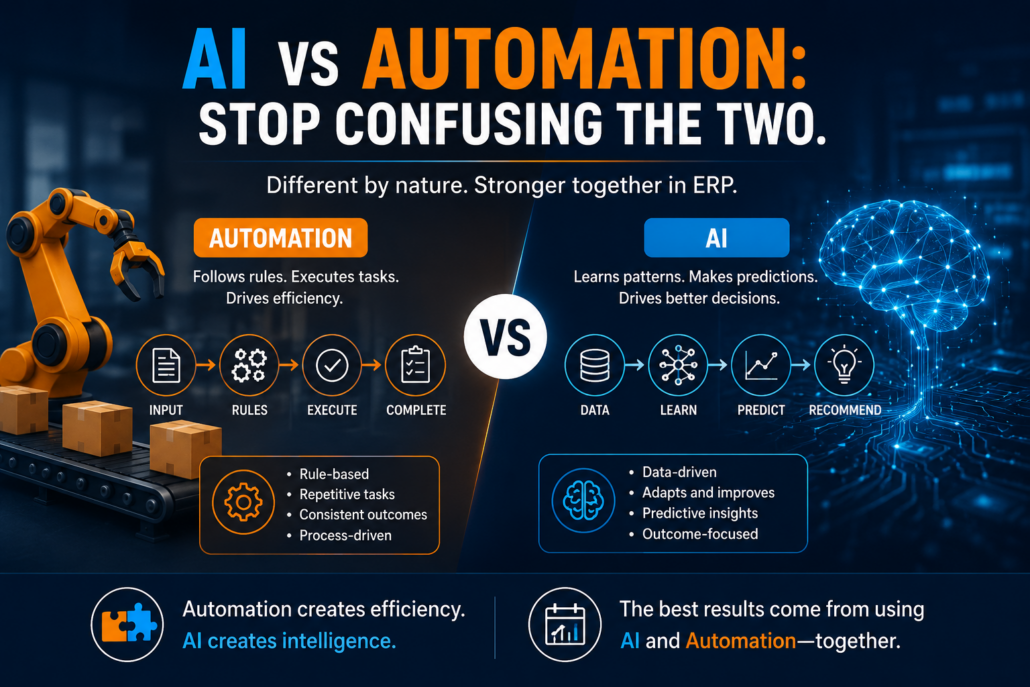
AI vs automation in ERP is one of the most misunderstood topics in business technology today.
AI vs automation in ERP is an important distinction for businesses exploring artificial intelligence. Although the terms are often used interchangeably, AI and automation solve different problems. Understanding the difference can help SAP Business One users choose the right technology, avoid unnecessary investments, and identify where the two can work together.
But understanding the difference matters.
Because if you confuse automation with AI, you risk:
- Overestimating what your ERP can actually do
- Investing in the wrong tools
- Creating unrealistic expectations internally
The reality is this:
Automation follows rules. AI learns, predicts, and adapts.
And in modern ERP systems, both play important—but very different—roles.
What is Automation in ERP?
Automation in ERP refers to tasks and workflows that follow predefined rules and processes.
The system performs actions automatically based on triggers or conditions.
Examples include:
- Automatically sending invoices
- Routing approvals based on dollar thresholds
- Reordering inventory when stock reaches minimum levels
- Posting recurring journal entries
- Sending payment reminders
Automation improves:
- Efficiency
- Speed
- Consistency
- Accuracy
But automation does not “think” or make decisions beyond the rules it’s been given.
- IBM overview of business automation: IBM Business Automation
What Is AI in ERP?
AI in ERP goes beyond rule-based processes.
Instead of simply following instructions, AI analyzes patterns, identifies relationships, and generates predictions or recommendations.
Examples include:
- Predicting inventory shortages before they happen
- Detecting unusual financial transactions
- Forecasting demand trends
- Recommending purchasing decisions
- Identifying customer churn risks
AI systems improve over time as they process more data.
That’s the key difference.
A good example of true AI is the Ask AI functionality introduced with SAP Business One FP 2608, which lets users interact with business data using natural-language questions.
👉 Read more:
- Microsoft overview of AI in business applications: Microsoft AI Business Applications
AI vs Automation in ERP: What’s the Difference?
Here’s a practical comparison:
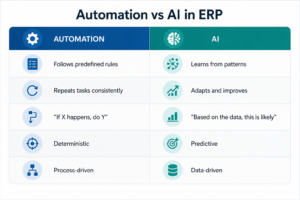
Comparing how traditional ERP automation differs from AI-driven capabilities.
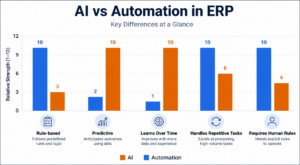
Why Companies Confuse AI vs Automation in ERP
Part of the confusion comes from marketing.
Many ERP vendors now label almost any advanced feature as “AI.”
In reality:
- Workflow approvals are usually automation
- Scheduled reports are automation
- Auto-generated alerts are often automation
AI becomes involved when the system starts:
- Predicting outcomes
- Identifying anomalies
- Generating recommendations
- Adapting based on data patterns
AI in ERP: What It Actually Does Today
Why Automation Still Matters
Automation is not “less valuable” than AI.
In fact, many companies should focus on automation before advanced AI initiatives.
Why?
Because automation:
- Delivers faster ROI
- Requires cleaner process discipline
- Is easier to implement
- Reduces manual workload immediately
For many SAP Business One customers, automation provides the quickest operational wins.
Top 10 Use Cases That Deliver Real ROI
The Real Problem: Companies Try AI Before They’re Ready
One of the biggest ERP mistakes today is trying to implement AI on top of:
- Poor processes
- Dirty data
- Inconsistent workflows
- Limited governance
AI amplifies existing problems.
Automation at least forces organizations to standardize workflows first.
Why Most ERP Systems Aren’t AI-Ready
The Role of Clean Data in AI Success
How AI vs Automation in ERP Work Together
The best ERP strategies combine both.
For example:
Automation Handles the Process
- Invoice enters system
- Approval workflow triggers
- Payment routing begins
AI Enhances the Decision-Making
- Flags suspicious invoices
- Predicts cash flow impact
- Detects duplicate vendors
- Suggests payment timing optimization
That’s where modern ERP systems are headed.
Customer service demonstrates the difference between AI and automation particularly well. Automation can move a service process forward, while AI Customer Service can analyze customer history, identify urgency, summarize information, and help employees determine what to do next.
Warehousing demonstrates how the two technologies can work together. AI warehouse management can identify which bins may need replenishment or which orders deserve priority, while automation and mobile warehouse tools can help employees execute those decisions consistently.
Manufacturing shows how these technologies can complement each other. AI for manufacturing can identify material risks, scheduling problems, or production bottlenecks, while automation can help employees execute approved actions consistently.
Supply chain management is a good example of the difference between AI and automation: AI for Supply Chain Management can identify patterns and exceptions, while automation can carry out defined actions once the right decision is made.
Field service provides a good example of the difference between AI and automation: AI for Field Service Management can identify patterns and recommend actions, while automation can carry out defined workflows such as notifications or job updates.
AI Without Governance Creates Risk
As companies adopt more AI capabilities, governance becomes essential.
Automation follows fixed rules.
AI introduces:
- Probabilities
- Predictions
- Recommendations
- Risk of incorrect outputs
That’s why organizations need:
- Oversight
- Data controls
- Monitoring
- Human review processe
AI Governance in ERP: The Missing Piece Most Companies Ignore
What SAP Business One Customers Should Focus On First
For most mid-sized businesses, the smartest path looks like this:
Step 1: Improve Processes
Fix workflow inefficiencies first.
Step 2: Automate Repetitive Tasks
Target:
- AP approvals
- Order processing
- Reporting
- Inventory alerts
Step 3: Clean and Standardize Data
AI depends on reliable ERP data.
Step 4: Add AI Strategically
Focus on:
- Forecasting
- Anomaly detection
- Predictive analytics
- Decision support
AI vs Automation in ERP: The Bottom Line
Automation and AI are not competitors.
They’re complementary technologies.
Automation creates efficiency.
AI creates intelligence.
But companies that skip foundational process discipline often struggle to get value from either.
The organizations seeing the best results today are the ones combining:
- Clean data
- Standardized workflows
- Strong governance
- Practical automation
- Targeted AI use cases
AI and automation often work best together. See how they combine to improve business performance in How AI Helps SAP Business One Users Increase Revenue and Profit.
Want to see how AI and automation work together across every department? Our AI for SAP Business One: The Complete Guide includes practical examples, implementation strategies, and real-world business use cases.
Continue the AI in ERP Systems Series
- AI in ERP: What It Actually Does Today
- Top 10 Use Cases That Deliver Real ROI
- AI in ERP Systems Risks: Where AI Goes Wrong
- Why Most ERP Systems Aren’t AI-Ready
- The Role of Clean Data in AI Success
- AI Governance in ERP: The Missing Piece Most Companies Ignore
- AI vs Automation in ERP: Stop Confusing the Two (Current)
- Cloud ERP + AI: The Real Shift Happening in Business Software
- AI Agents in ERP: What They Actually Do
- AI Readiness Checklist for ERP Systems
- What is an ERP AI Copilot
AI in ERP starts with strong processes and practical automation.
Support One helps SAP Business One customers improve workflows, clean data, and prepare for AI adoption the right way.
Talk with an expert about how AI can deliver real results in your ERP system.

