
How AI Improves Demand Forecasting with SAP Business One
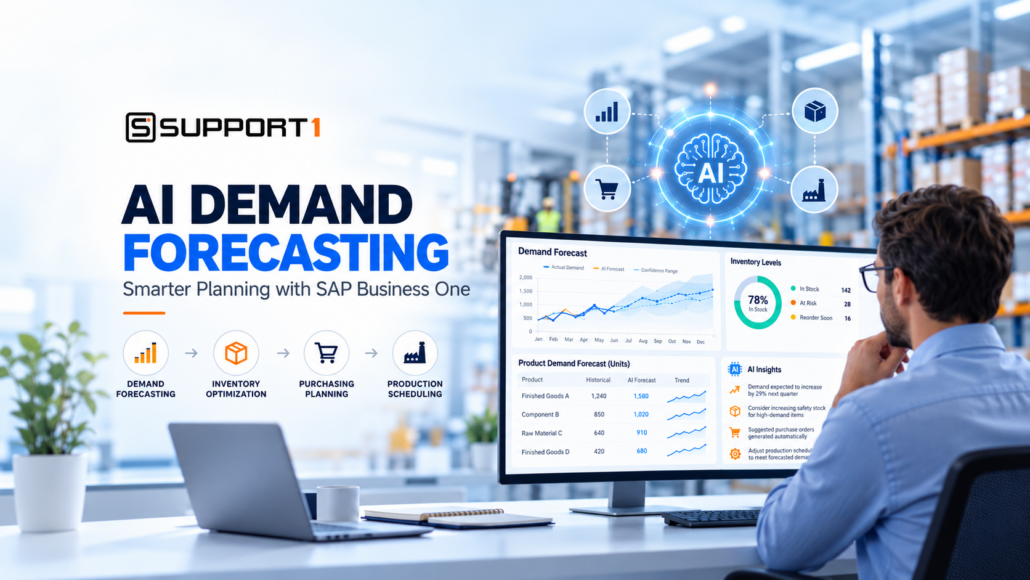
How AI Improves Demand Forecasting
AI for demand forecasting can help businesses analyze sales history, customer behavior, seasonality, inventory, and open orders to improve planning. For SAP Business One users, AI demand forecasting can make it easier to identify changing demand patterns earlier and use that information to support better inventory, purchasing, and production decisions.
Sales needs to know what customers are likely to buy. Inventory teams need to know what to stock. Purchasing needs to know what to order. Manufacturing needs to know what to produce. Finance needs to understand the effect on cash flow and working capital.
When forecasts are wrong, the consequences can spread quickly.
Too little inventory can create shortages, missed sales, production delays, and unhappy customers. Too much inventory ties up cash, increases storage costs, and raises the risk of slow-moving or obsolete stock.
AI for demand forecasting can help businesses analyze historical demand, recognize patterns, identify changes earlier, and improve the information planners use to make decisions.
For SAP Business One users, the opportunity is especially practical because much of the underlying information—sales history, open orders, inventory, purchasing, items, customers, and production activity—may already exist in the ERP system.
The goal is not to eliminate human forecasting.
It is to help planners make better forecasts with better information.
What Is AI for Demand Forecasting?
AI for demand forecasting uses artificial intelligence to analyze historical and current business information in order to identify patterns that may help estimate future demand.
Traditional forecasting often relies on historical averages, spreadsheets, seasonal assumptions, or manually adjusted projections.
Those methods can still be useful.
AI adds another layer by helping analyze larger amounts of information and detect relationships that may be difficult to spot manually.
Depending on the data available, AI may help examine factors such as:
- historical sales
- customer buying patterns
- seasonality
- open sales orders
- item demand
- inventory levels
- promotional activity
- geographic differences
- changing order frequency
- unusual increases or decreases in demand
This can help businesses move beyond a single forecast number.
Instead of only asking:
“How much will we sell next month?”
planners can begin asking:
- Which products are showing stronger-than-normal demand?
- Which customers are ordering more or less frequently?
- Which seasonal patterns are changing?
- Which items may create shortages if current trends continue?
- Which products appear to be slowing down?
- Where should we investigate before changing purchasing or production plans?
That is where AI demand forecasting can become especially useful.
The value comes from helping people understand the signals behind the forecast.
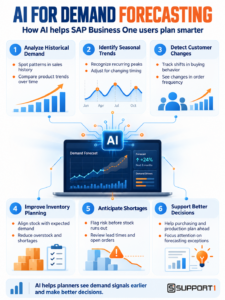
AI for demand forecasting helps SAP Business One users identify demand patterns earlier, improve inventory planning, anticipate shortages, and make better purchasing and production decisions.
Why Demand Forecasting Is a Strong AI Opportunity
Demand is rarely perfectly predictable.
Customers change buying habits.
Large orders appear unexpectedly.
Seasonal patterns shift.
New products grow faster than expected.
Other products gradually decline.
Supplier delays or production constraints can make those changes even more difficult to manage.
That makes forecasting a strong application for AI because forecasting is fundamentally about finding patterns in information.
AI can help planners review more variables at once and identify changes that deserve attention.
But it is important to keep expectations realistic.
AI does not eliminate uncertainty.
A forecast is still an estimate of what may happen in the future.
Unexpected economic changes, lost customers, new competitors, supply disruptions, weather events, and other outside factors may not be visible in ERP data.
The practical advantage of AI is not perfect prediction.
It is helping planners recognize meaningful patterns earlier and make more informed decisions.
A useful way to think about it is:
AI does not make the future certain. It can help make the signals easier to see.
1. Analyze Historical Demand Patterns
Historical sales information is one of the most important foundations for demand forecasting.
Businesses already collect valuable information such as:
- quantities sold
- order frequency
- product mix
- customer activity
- seasonal changes
- geographic patterns
- year-over-year changes
The challenge is turning that information into something useful.
Traditional reports can show what happened.
AI can help planners investigate how the patterns are changing.
For example, an item may have sold approximately the same annual quantity for several years.
At first glance, demand may appear stable.
But a closer analysis might show that customers are now placing larger orders less frequently, or that demand is shifting toward different months of the year.
Those changes may affect how inventory should be stocked or when purchasing needs to occur.
AI for demand forecasting can help identify those patterns without requiring planners to manually compare dozens of reports.
This does not mean historical demand should automatically dictate future demand.
History is a starting point.
AI can help planners understand that history more quickly and determine where additional investigation is needed.
2. Identify Seasonal Trends
Many businesses experience seasonal demand.
Some products sell more during specific months.
Others may be affected by weather, holidays, customer budgeting cycles, construction seasons, or industry-specific buying patterns.
The difficulty is that seasonality is not always consistent.
A peak that happened in March last year may occur in February this year.
A seasonal increase may become stronger over time.
Or a product that once had a clear seasonal pattern may begin selling more evenly throughout the year.
AI can help analyze multiple years of demand and identify whether those seasonal patterns are changing.
For example, a distributor may normally increase inventory before a predictable spring sales period.
AI analysis could help determine:
- when demand typically begins increasing
- how large the increase has been historically
- whether the peak is arriving earlier
- which customers drive the seasonal demand
- which items experience the greatest increase
That can help inventory and purchasing teams prepare more effectively.
For manufacturers, the same information can help production planners understand when finished-goods demand is likely to increase and when raw-material requirements may rise.
The goal is not simply to recognize that a product is seasonal.
It is to understand how the seasonal pattern is changing.
3. Detect Changes in Customer Buying Behavior
Demand forecasting becomes more useful when businesses look beyond products and examine customers.
A total sales number may remain relatively stable even while customer behavior is changing underneath it.
For example:
One large customer may be reducing purchases.
Several smaller customers may be increasing orders.
A customer may be ordering more frequently but in smaller quantities.
Another may be buying a different mix of products.
These changes can affect future demand even if overall sales have not changed dramatically yet.
AI can help identify patterns such as:
- increasing purchase frequency
- declining order volume
- changes in average order size
- changes in product mix
- customers returning after long periods of inactivity
- customers whose demand is becoming less consistent
This can help planners identify where forecasts may need adjustment.
It can also create useful information for sales teams.
If a major customer has gradually reduced purchases over several months, that may be both a forecasting signal and a sales opportunity that deserves attention.
This is where demand forecasting begins to connect with AI for Sales.
Better forecasting is not only about predicting products.
It is also about understanding the customers creating the demand.
4. Improve Inventory Planning
One of the biggest reasons businesses forecast demand is to make better inventory decisions.
Inventory planning requires a balance.
Too little inventory can cause:
- stockouts
- delayed customer orders
- expedited purchasing
- lost sales
- production interruptions
Too much inventory can create:
- excess working capital
- higher storage costs
- slow-moving stock
- obsolete inventory
- increased carrying costs
AI can help planners compare expected demand with current inventory conditions.
That analysis may include:
- stock on hand
- committed inventory
- open sales orders
- historical demand
- purchase orders
- supplier lead times
- production requirements
For example, an item may appear adequately stocked based on average monthly demand.
But if demand has recently increased and the supplier lead time has also become longer, the existing stock level may no longer provide enough protection.
AI can help identify that situation earlier.
The opposite can also happen.
A company may continue replenishing an item based on old assumptions even though demand has been declining.
AI can help highlight where inventory policies may no longer match current buying patterns.
This connects directly with AI Inventory Management, but demand forecasting focuses on the future demand signal that helps drive those inventory decisions.
Demand forecasting is only one part of the planning process, and AI for Supply Chain Management can help connect forecast signals with inventory, purchasing, suppliers, production, and fulfillment.
5. Anticipate Potential Shortages
A shortage often becomes expensive only after the business has run out of options.
By the time an item reaches zero inventory, the company may need to:
- expedite freight
- buy from a more expensive supplier
- reschedule production
- delay a customer order
- transfer inventory between locations
- disappoint the customer
A better approach is to identify shortage risk earlier.
AI demand forecasting can help compare expected demand with current and incoming supply.
Potential inputs may include:
- current inventory
- recent demand
- open sales orders
- incoming purchase orders
- supplier lead times
- production requirements
- demand trends
For example, a product may currently have enough stock for normal demand.
But if sales are accelerating while the next purchase order is still several weeks away, AI can help flag the item for review before the shortage occurs.
That does not mean every warning will become an actual shortage.
Some customers may delay orders. Demand may slow. A supplier may deliver early.
The purpose is not certainty.
It is early visibility.
A planner who sees a potential problem several weeks in advance usually has more options than one who discovers it tomorrow.
That can mean better purchasing decisions, fewer emergencies, and more reliable customer service.
Better Forecasts Improve More Than Sales
These first five applications show why demand forecasting affects much more than the sales forecast.
Demand influences:
- inventory
- purchasing
- production
- warehouse activity
- customer service
- cash flow
That is why improving forecasting can have benefits across the entire organization.
AI can help businesses understand what demand has looked like, identify how it is changing, and highlight where current plans may need attention.
6. Reduce Excess Inventory and Slow-Moving Stock
Forecasting is often associated with preventing shortages, but it can be just as valuable for identifying when a business is carrying too much inventory.
Excess inventory ties up working capital, increases storage costs, and raises the risk that products will become slow-moving or obsolete.
AI can help planners compare current stock levels with changing demand patterns.
Potential signals include:
- declining sales
- lower order frequency
- reduced customer activity
- excess stock relative to recent demand
- repeated over-ordering
- seasonal demand that did not materialize
- products with unusually long inventory coverage
For example, a distributor may continue buying an item based on a long-established replenishment pattern even though customer demand has been declining for several months.
Traditional reports may show the inventory balance.
AI can help highlight that the balance is becoming increasingly out of line with current demand.
That gives planners time to respond.
They may decide to reduce future purchase quantities, adjust reorder points, investigate alternative uses, or work with sales to move excess stock.
AI for demand forecasting can therefore support both sides of inventory planning:
- preventing shortages
- preventing unnecessary buildup
The goal is not perfect inventory.
It is better alignment between what the business carries and what customers are likely to need.
7. Improve Purchasing Forecasts
Purchasing decisions depend heavily on expected demand.
Buy too late and the business risks shortages.
Buy too early and cash may be tied up unnecessarily.
Buy too much and inventory may sit for months.
AI can help purchasing teams use demand information more effectively by connecting expected usage with other factors such as:
- current stock
- open purchase orders
- supplier lead times
- minimum order quantities
- historical purchasing patterns
- recent demand changes
- production requirements
For example, a buyer may normally place a monthly order for a particular item.
If AI analysis shows that demand has been increasing and supplier lead times are getting longer, the normal purchasing pattern may no longer be sufficient.
The opposite can also happen.
If demand is declining, continuing to order the same quantity can create excess stock.
This is where AI demand forecasting can help purchasing teams move from routine replenishment toward more informed planning.
AI does not need to place the order automatically to provide value.
Helping a buyer understand which items require review and why can already improve purchasing decisions.
This connects directly with AI for Purchasing and the broader supply chain process.
8. Connect Demand Forecasting to Production Planning
For manufacturers, demand forecasting is closely tied to production planning.
A forecast does not simply indicate how many finished goods may be needed.
It can also affect:
- raw-material requirements
- production schedules
- labor planning
- capacity
- bills of materials
- warehouse activity
- purchasing
AI can help connect expected demand with production requirements so planners can see potential issues earlier.
For example, demand may be increasing for a finished product.
That sounds positive.
But if the required raw materials have long lead times, or if production capacity is already constrained, the business may not be able to respond quickly.
AI can help planners identify that relationship before the problem becomes urgent.
The same is true when demand declines.
If production plans remain unchanged while customer demand slows, the business may end up producing unnecessary inventory.
That can create additional storage costs and tie up cash.
AI for demand forecasting can help manufacturers better align what they produce with what customers are likely to buy.
This does not mean AI should automatically change production schedules.
Experienced production planners still need to consider real-world constraints that may not be visible in the data.
The value comes from giving them better signals earlier.
9. Compare Forecasts with Actual Results
A forecast is only useful if the business learns from it.
One of the most important forecasting practices is comparing what was expected with what actually happened.
AI can help analyze forecast accuracy over time.
Questions might include:
- Which products were consistently over-forecast?
- Which items were repeatedly under-forecast?
- Which customers created the largest forecast errors?
- Which seasonal assumptions were wrong?
- Which product groups are the hardest to predict?
- Are forecasts becoming more or less accurate over time?
This can help planners improve the forecasting process itself.
For example, a company may discover that one product family is consistently forecast too high.
That could indicate an outdated assumption, a declining market, or a change in customer behavior.
Another product may repeatedly exceed forecasts.
That could signal growth that needs to be reflected in inventory, purchasing, or production plans.
AI can help identify those patterns and make forecast reviews more efficient.
Instead of treating each forecast as a one-time prediction, the business can use each cycle as feedback.
That creates a continuous improvement process.
Forecast → Actual Results → Analysis → Better Forecast
Over time, that can make planning more disciplined and more responsive to change.
10. Identify Forecasting Exceptions That Need Attention
Not every forecast needs the same level of review.
Some products may have stable, predictable demand.
Others may be highly volatile.
Some may have large inventory balances.
Others may be strategically important or difficult to replace.
AI can help planners focus on the exceptions.
Instead of reviewing hundreds or thousands of items one by one, AI can help identify cases such as:
- demand increasing faster than expected
- demand dropping sharply
- unusually high forecast error
- low inventory combined with rising demand
- excess inventory combined with declining demand
- long supplier lead times
- important customer orders outside normal patterns
- production requirements that no longer match demand
This can make forecasting more manageable.
A planner may not need to review every item every day.
A better approach is to focus on the small number of items where the conditions have changed enough to require attention.
A useful principle is:
Do not make planners review everything. Show them what changed and what deserves attention.
This is one of the strongest uses of AI in forecasting.
The value is not just producing a prediction.
It is helping employees decide where to look first.
It’s important to remember, reliable forecasting starts with reliable information, which is why clean data for AI in ERP systems is so important before businesses depend heavily on AI-assisted planning.
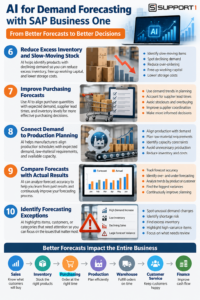
AI demand forecasting can help businesses reduce excess inventory, improve purchasing and production planning, compare forecasts with actual results, and focus on the exceptions that need attention.
How SAP Business One Fits into AI Demand Forecasting
SAP Business One can provide much of the operational information needed to support demand analysis.
Depending on how the system is configured and used, that information may include:
- sales history
- open sales orders
- customer records
- item master data
- inventory balances
- purchase orders
- supplier information
- production activity
- warehouse transactions
- pricing
- financial information
That gives SAP Business One users a valuable data foundation.
AI can help employees analyze relationships across that information more quickly.
For example, instead of reviewing separate sales, inventory, and purchasing reports, planners may be able to investigate questions such as:
- Which items have rising demand and low available inventory?
- Which products have declining demand but high stock levels?
- Which customers are buying significantly more or less than usual?
- Which purchase requirements may need to change based on recent demand?
- Which production plans may be out of alignment with customer demand?
That does not mean SAP Business One automatically includes every advanced predictive forecasting capability.
More sophisticated machine-learning forecasts, external market analysis, weather-based forecasting, or highly specialized optimization may require additional tools, integrations, models, or partner-developed solutions.
The important point is that SAP Business One can provide much of the trusted transactional information those applications need.
Ask AI and Natural-Language Demand Analysis
Newer SAP Business One AI capabilities also make conversational analysis increasingly relevant.
Instead of always starting with a predefined report, users can increasingly begin with a business question.
For demand planning, examples might include:
- Which items have shown the largest increase in demand during the past six months?
- Which customers are ordering less frequently than last year?
- Which products have high inventory and declining sales?
- Which items may experience shortages if current demand continues?
- Which product groups have the greatest seasonal variation?
This can help planners investigate demand trends more quickly.
AI-generated queries can also make it easier to turn natural-language requests into more structured ERP analysis.
The important limitation remains the same:
AI can only work with the information available to it.
If item history is inconsistent, customer records are duplicated, or inventory data is inaccurate, the analysis will be less reliable.
That is why clean ERP data remains essential.
From Forecasting to Better Planning
The second half of these use cases shows that demand forecasting should not be treated as a standalone sales exercise.
Demand affects:
- inventory
- purchasing
- production
- warehouse planning
- customer service
- working capital
AI can help businesses connect those areas more effectively.
The strongest value comes not from producing a single number for future demand, but from helping employees understand:
- what is changing
- where risk is increasing
- which assumptions may be wrong
- which products need attention
- what downstream decisions may need to change
Practical AI Prompts for Demand Forecasting
One of the easiest ways to begin using AI for demand forecasting is to start with the questions planners already ask.
Useful prompts might include:
Which products have shown the largest increase in demand over the past six months?
Which items have declining sales but high inventory levels?
Which customers are buying significantly more or less than they did last year?
Which products have the strongest seasonal patterns?
Which items are most likely to create shortages if current demand continues?
Which purchase requirements should be reviewed based on recent changes in demand?
Which production plans appear out of alignment with current sales trends?
Which products had the largest forecast errors during the past quarter?
These prompts can help planners move from static reports toward more conversational analysis.
The usefulness of the answers will still depend on the quality of the underlying data and the information available to the AI system.
The goal is not to ask AI to predict the future with certainty.
It is to help planners identify important changes earlier and investigate them faster.
Best Practices for Using AI in Demand Forecasting
AI can improve forecasting, but the best results usually come from combining technology with disciplined planning.
Start with a Specific Forecasting Problem
Do not begin with:
“Can AI forecast demand?”
Begin with a more focused question such as:
- We frequently run out of fast-moving items.
- We carry too much slow-moving inventory.
- Purchasing plans do not react quickly enough to demand changes.
- Production plans are based on outdated assumptions.
- Forecast accuracy varies significantly by product group.
A specific problem gives the AI project a clear purpose.
Use Reliable Historical Data
Forecasting depends heavily on history.
If sales records are incomplete, item numbers have changed, customer records are duplicated, or inventory transactions are inaccurate, the resulting analysis will be less reliable.
Important information may include:
- sales history
- customer history
- item master data
- inventory
- open orders
- purchasing
- production
- lead times
Clean data does not guarantee a perfect forecast.
But poor data almost guarantees a weak one.
Compare Forecasts with Actual Results
Forecasting should be treated as a learning process.
After each forecasting period, compare:
- forecast demand
- actual demand
- inventory impact
- purchasing impact
- production impact
Then investigate where the forecast was wrong.
This feedback loop can help improve planning over time.
Keep Human Judgment in the Process
Experienced planners understand business context that may not appear in the data.
They may know that:
- a customer is about to launch a new product
- a large order was a one-time event
- a supplier is having problems
- a promotion is planned
- a competitor has entered the market
AI may not know those things unless the information is available to it.
That is why human judgment remains essential.
Use AI to Highlight Exceptions
One of the most practical uses of AI demand forecasting is identifying where actual conditions no longer match assumptions.
Instead of asking planners to review every item, use AI to help surface products, customers, or categories that deserve attention.
That can save time and improve focus.
Measure Business Results
A successful forecasting initiative should improve something measurable.
Possible metrics include:
- forecast accuracy
- stockout frequency
- inventory turns
- excess inventory
- expedited purchases
- production disruptions
- on-time delivery
- working capital
The goal is not to create a more sophisticated forecast.
The goal is to improve decisions.
Organizations developing more formal AI controls can also use the NIST AI RMF Playbook for practical guidance on governance, measurement, and risk management.
Common Mistakes to Avoid
AI can improve demand forecasting, but several mistakes can reduce the value.
Expecting Perfect Predictions
No forecasting model can predict every future event.
Unexpected customer changes, economic conditions, weather, competitors, supplier problems, and other external factors can affect demand.
AI should help manage uncertainty, not pretend to eliminate it.
Using Too Little Historical Data
Short or inconsistent sales histories can make patterns difficult to identify.
New products are especially challenging because there may not be enough history to support reliable forecasting.
In those cases, planners may need to rely more heavily on judgment, comparable products, or external information.
Ignoring One-Time Events
A large unusual order can distort historical demand.
So can a temporary shortage, promotion, customer project, or acquisition.
If those events are treated as normal demand, future forecasts may be misleading.
Treating All Products the Same
Some items are stable.
Others are seasonal.
Some have sporadic demand.
Others are highly volatile.
Forecasting methods should reflect those differences rather than applying the same assumptions to every item.
Automating Purchasing or Production Too Quickly
A forecast can help support decisions, but businesses should be cautious about allowing AI to automatically change purchase orders or production plans without review.
Decision support is often the best place to start.
Ignoring Forecast Accuracy
If nobody compares the forecast with actual results, the business loses the opportunity to improve.
Forecasting should be continuously evaluated.
Frequently Asked Questions About AI for Demand Forecasting
What Is AI for Demand Forecasting?
AI for demand forecasting uses artificial intelligence to analyze historical and current business information to identify patterns that may help estimate future demand.
It can help businesses examine sales history, customer behavior, seasonality, inventory, open orders, and other information more efficiently.
How Can AI Help SAP Business One Users Forecast Demand?
SAP Business One can provide much of the operational data used in demand analysis, including sales history, customers, items, inventory, purchase orders, and production activity.
AI can help employees analyze that information, identify trends and exceptions, and investigate how changing demand may affect inventory, purchasing, and production.
Can AI Predict Inventory Shortages?
AI can help identify conditions that may increase shortage risk by comparing expected demand with current inventory, open purchase orders, lead times, and other supply information.
It cannot guarantee that a shortage will occur, but it can help planners identify potential problems earlier.
Is AI Demand Forecasting Better Than Traditional Forecasting?
AI can improve forecasting by analyzing larger amounts of information and identifying patterns more quickly.
That does not mean traditional forecasting methods are no longer useful.
Historical averages, seasonal assumptions, planner experience, and business knowledge can still be valuable.
The strongest approach often combines AI analysis with established forecasting methods and human judgment.
Does SAP Business One Include Advanced Predictive Forecasting?
SAP Business One provides the business data and reporting foundation needed for demand analysis, and newer AI capabilities can support more conversational and flexible analysis.
More advanced predictive forecasting may require additional AI tools, integrations, models, or partner-developed solutions.
Getting Started with AI for Demand Forecasting
Businesses do not need to rebuild their planning process to start experimenting with AI.
A practical first step is to choose one forecasting problem with good historical data.
For example:
- a product family with frequent shortages
- a group of slow-moving items
- a seasonal product category
- a customer segment with changing demand
- a production line affected by unpredictable orders
Then ask:
What historical information do we already have?
Is the data reliable?
How is the forecast created today?
Who adjusts it?
How accurate has it been?
What decisions depend on it?
Could AI help identify changes earlier or reduce the time required to review the data?
Start with one area.
Measure the result.
Then expand if the process improves.
For a broader look at practical AI opportunities across SAP Business One, see our Practical AI for SAP Business One: The Complete Guide.
How Support One Can Help
For SAP Business One users, demand forecasting is closely connected to inventory, purchasing, production, sales, warehouse activity, and financial planning.
Support One can help businesses evaluate whether the ERP environment is ready to support AI-assisted forecasting by reviewing:
- data quality
- sales and inventory history
- reporting
- purchasing processes
- production information
- integrations
- AI readiness
- governance and controls
The objective is not to promise perfect forecasts.
It is to help businesses use SAP Business One data more effectively and identify where AI can improve planning and decision-making.
Better Forecasts Lead to Better Decisions
Demand forecasting affects far more than sales.
It influences inventory.
Inventory affects purchasing.
Purchasing affects production.
Production affects fulfillment.
And all of those decisions affect cash flow and customer service.
AI for demand forecasting can help businesses identify changing patterns earlier, reduce planning blind spots, and focus attention on the products and customers that deserve the most attention.
But AI does not remove uncertainty.
It gives planners another tool for understanding it.
AI does not make the future certain. It helps make the signals easier to see.
Demand forecasting is one of many practical applications businesses can explore, and our Top 10 AI in ERP Systems Use Cases article covers additional opportunities across sales, finance, inventory, operations, and decision-making.
Ready to Explore AI Demand Forecasting with SAP Business One?
Support One can help you evaluate your ERP data, forecasting process, and current SAP Business One environment to identify practical opportunities for AI.
Schedule Your Complimentary AI Readiness Review to determine where AI could help improve forecasting, inventory, purchasing, and production planning.

Questions about using AI in SAP Business On? Let’s talk
