
AI Readiness Checklist for ERP Systems
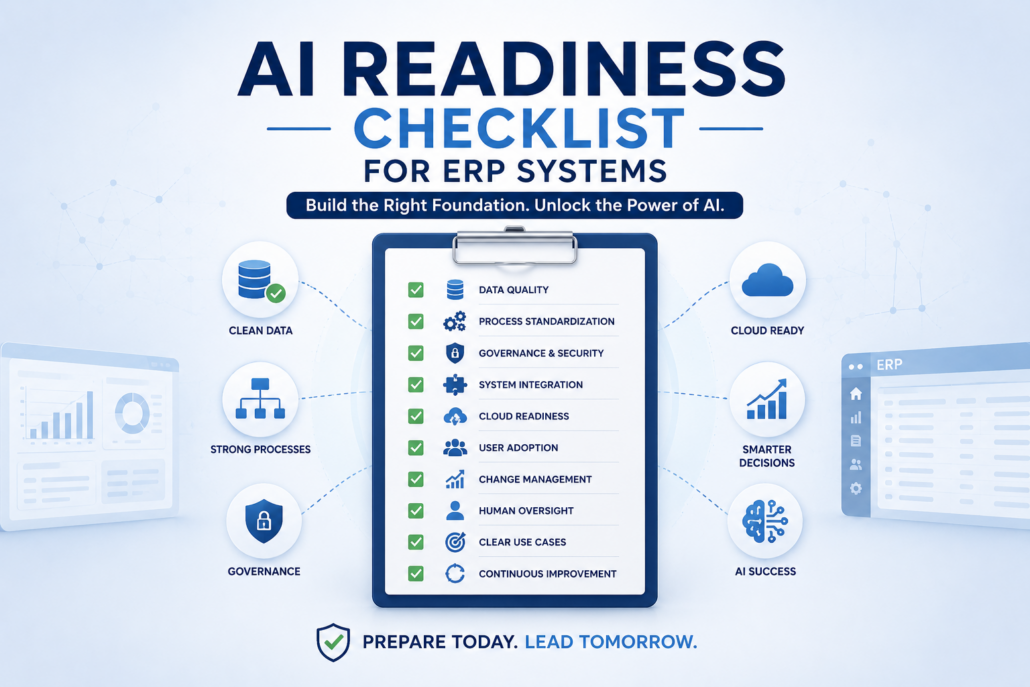
AI Readiness Checklist for ERP Systems
AI readiness checklist for ERP systems is becoming an increasingly important topic as more companies explore AI-driven automation, forecasting, analytics, and decision support.
But many organizations are asking the wrong question.
Instead of asking:
“How fast can we implement AI?”
They should first ask:
“Is our ERP environment actually ready for AI?”
Because successful AI adoption depends far more on operational readiness than on buying new technology.
In fact, many ERP AI projects struggle because companies try to layer AI onto:
- poor data quality
- inconsistent workflows
- weak governance
- disconnected systems
- outdated operational processes
The reality is simple:
AI can amplify operational strengths—but it also amplifies operational weaknesses.
That’s why organizations need a practical framework for evaluating ERP AI readiness before moving forward.
Why ERP AI Readiness Matters
AI systems rely heavily on:
- data quality
- process consistency
- workflow structure
- governance
- user adoption
Without those foundations, AI recommendations become unreliable and difficult to trust.
ERP AI readiness is not just about software capabilities.
It’s about whether the organization has the operational discipline necessary to support intelligent systems effectively.
Why Most ERP Systems Aren’t AI-Ready
AI Readiness Checklist for ERP Systems
Use this checklist to evaluate whether your ERP environment is prepared for practical AI adoption.
1. Is Your ERP Data Clean and Consistent?
This is the most important requirement.
AI systems depend on reliable ERP data to generate:
- predictions
- recommendations
- insights
- automation decisions
Warning signs include:
- duplicate customer records
- inconsistent naming conventions
- incomplete inventory data
- outdated vendor information
- disconnected spreadsheets outside the ERP system
If your data quality is inconsistent, AI outputs will also be inconsistent.
One of the most important items on any AI readiness checklist is ensuring your ERP data is accurate, complete, and consistent. Read Clean Data for AI in ERP Systems to learn why data quality determines AI success.
2. Are Your Business Processes Standardized?
AI performs best in structured environments.
If departments follow different workflows for:
- approvals
- purchasing
- inventory management
- customer service
- financial processes
…it becomes much harder for AI systems to identify meaningful patterns.
Standardized workflows improve:
- automation reliability
- forecasting accuracy
- operational visibility
- AI decision support
AI vs Automation in ERP: Stop Confusing the Two
3. Do You Have Strong ERP Governance?
Governance is often overlooked during AI discussions.
Organizations need clear policies around:
- data ownership
- user permissions
- approval controls
- AI-generated recommendations
- compliance oversight
Without governance, AI can introduce:
- inconsistent decisions
- operational confusion
- compliance risks
- security concerns
AI Governance in ERP: The Missing Piece Most Companies Ignore
4. Is Your ERP System Integrated Across the Business?
AI becomes more valuable when it can analyze data across:
- finance
- inventory
- purchasing
- operations
- sales
- customer service
Disconnected systems limit AI visibility and reduce the quality of insights.
Organizations still relying heavily on:
- spreadsheets
- siloed applications
- manual exports
may struggle to achieve meaningful ERP AI results.
5. Are You Using the Cloud Strategically?
Most ERP AI innovation is happening in cloud environments because cloud platforms provide:
- scalable infrastructure
- faster updates
- easier AI integration
- improved connectivity
That doesn’t mean every company must move entirely to the cloud immediately.
But organizations evaluating long-term AI strategies should understand how cloud ERP platforms are accelerating AI adoption.
Cloud ERP + AI: The Real Shift Happening in Business Software
6. Do Employees Trust the ERP System?
This is one of the most underestimated readiness factors.
If users already distrust ERP data or workflows, they are unlikely to trust AI-generated recommendations.
Common warning signs:
- employees bypassing ERP processes
- shadow spreadsheets
- manual workarounds
- inconsistent data entry practices
AI adoption depends heavily on user confidence and operational discipline.
7. Can Your Organization Handle Change Management?
AI adoption changes how employees interact with ERP systems.
Organizations need:
- user training
- communication plans
- workflow education
- operational alignment
Without strong change management, even technically successful AI projects can struggle with adoption.
Read More: Prosci Change Management Overview
8. Are You Chasing Hype or Solving Real Problems?
This may be the most important question on the list.
Successful ERP AI initiatives usually start with:
- a specific operational problem
- measurable business goals
- practical workflow improvements
Examples include:
- improving forecast accuracy
- reducing invoice processing time
- detecting anomalies
- automating repetitive tasks
- improving inventory planning
Organizations that pursue AI simply because competitors are talking about it often struggle to generate ROI.
Top 10 Use Cases That Deliver Real ROI
9. Do You Have Human Oversight Processes?
AI systems should support decision-making—not eliminate accountability.
Organizations still need:
- approval workflows
- escalation procedures
- exception management
- monitoring and auditing
Even advanced AI agents require human oversight.
AI Agents in ERP: What They Actually Do
10. Are You Prepared for Continuous Improvement?
AI readiness is not a one-time project.
ERP AI systems require ongoing:
- data management
- workflow optimization
- governance refinement
- monitoring
- user feedback
The organizations seeing the best AI results treat readiness as an ongoing operational strategy—not a single implementation milestone.
How to Assess ERP AI Readiness
What AI-Ready ERP Systems Have in Common
Organizations that are successfully adopting ERP AI capabilities usually share several characteristics:
- clean and structured data
- standardized workflows
- operational discipline
- strong governance
- executive alignment
- realistic expectations
Most importantly, they focus on solving business problems first—not chasing technology trends.
The Bottom Line
AI readiness for ERP systems is about far more than technology.
It requires:
- clean data
- standardized processes
- governance
- integration
- user trust
- operational discipline
AI can create tremendous business value—but only when the ERP environment is prepared to support it effectively.
The companies that invest in readiness first are far more likely to achieve long-term success with AI adoption.
FAQ: AI Readiness Checklist for ERP Systems
What makes an ERP system AI-ready?
An AI-ready ERP system typically has:
- clean and consistent data
- standardized workflows
- integrated business processes
- governance controls
- reliable user adoption
AI systems depend on structured operational environments to generate accurate recommendations and insights.
Why is clean data important for ERP AI?
AI systems rely heavily on ERP data for forecasting, automation, and analytics.
If ERP data is inconsistent or incomplete, AI recommendations become less reliable and potentially misleading.
That’s why data quality is one of the most important AI readiness factors.
Does moving to the cloud automatically make ERP AI-ready?
No.
Cloud ERP platforms make AI adoption easier by improving scalability and integration, but cloud infrastructure alone does not solve:
- poor data quality
- inconsistent workflows
- governance gaps
- user adoption problems
Operational readiness still matters most.
What are the biggest signs an ERP system is not ready for AI?
Common warning signs include:
- duplicate records
- disconnected spreadsheets
- inconsistent workflows
- weak governance
- poor user adoption
- manual workarounds outside the ERP system
These issues often reduce AI reliability and effectiveness.
Continue the AI in ERP Systems Series
- AI in ERP: What It Actually Does Today
- Top 10 Use Cases That Deliver Real ROI
- AI in ERP Systems Risks: Where AI Goes Wrong
- Why Most ERP Systems Aren’t AI-Ready
- The Role of Clean Data in AI Success
- AI Governance in ERP: The Missing Piece Most Companies Ignore
- AI vs Automation in ERP: Stop Confusing the Two
- Cloud ERP + AI: The Real Shift Happening in Business Software
- AI Agents in ERP: What They Actually Do
- AI Readiness Checklist for ERP Systems (Current)
- What is an ERP AI Copilot
AI success starts with ERP readiness.
Support One helps SAP Business One customers improve data quality, optimize workflows, strengthen governance, and prepare for practical AI adoption. Contact us for your Free AI Readiness Evaluation.
Talk with an expert about how AI can deliver real results in your ERP system.

