
AI in ERP Systems Risks: Where AI Goes Wrong
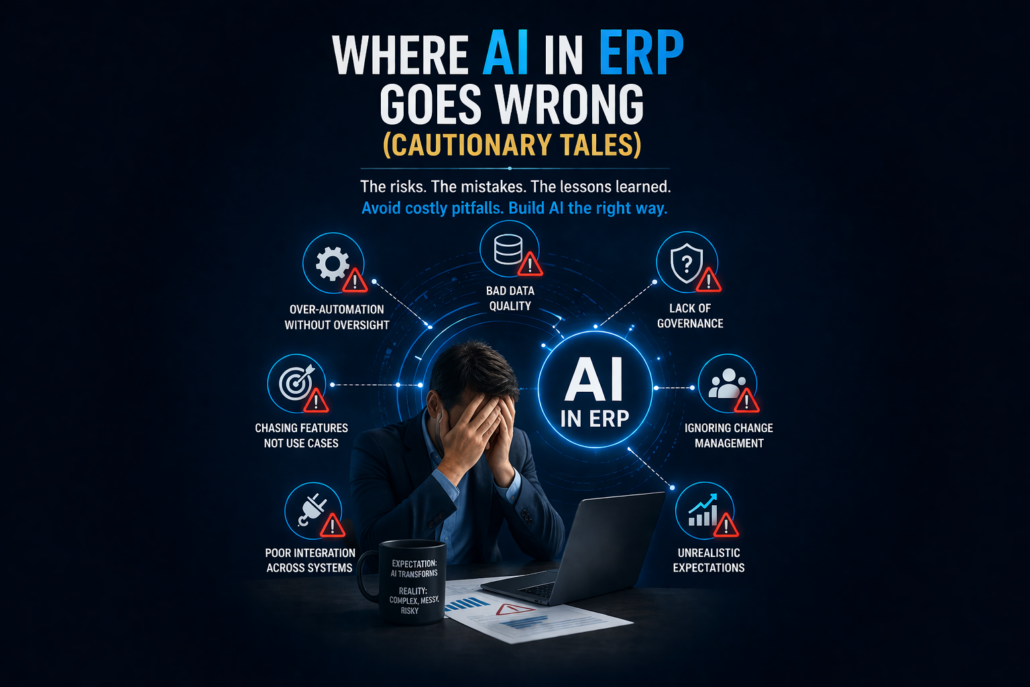
AI in ERP systems risks are becoming a growing concern as more companies rush to adopt AI without a clear strategy.
In our previous posts, we explored what AI in ERP systems actually does and the top use cases delivering real ROI. But there’s another side to this story—one that’s often overlooked.
Because while AI can deliver real value inside ERP, it can also create real problems when implemented incorrectly.
And right now, many organizations are learning that the hard way. In our earlier post on what AI in ERP systems actually does today, we looked at how AI is being used in real environments.
AI in ERP Systems Risks: When Systems Aren’t Ready
AI adoption is accelerating across industries—but ERP environments aren’t always ready for it. While there are many AI in ERP systems use cases that deliver real ROI, not all implementations are successful.
Most ERP systems:
- Contain inconsistent or incomplete data
- Have fragmented processes
- Rely on manual workarounds
When AI is layered on top of that, it doesn’t fix those issues—it magnifies them.
Industry analysts consistently point out that AI success depends heavily on data quality and system readiness.
ERP Trends that leaders should plan for in 2026
1. AI in ERP Systems Risks: Bad Data Leads to Bad Decisions
This is the most common—and most dangerous—failure point.
AI relies entirely on ERP data. If that data is:
- Incomplete
- Duplicated
- Outdated
Then AI produces:
- Inaccurate forecasts
- Misleading insights
- Poor recommendations
AI doesn’t “know” your data is wrong—it assumes it’s correct.
👉 Real risk:
You don’t just get bad decisions—you get them faster and with more confidence.
2. Over-Automation Without Oversight
One of the biggest promises of AI is automation.
But when companies automate too much, too quickly:
- Processes lose visibility
- Exceptions go unnoticed
- Errors scale rapidly
AI should support decision-making—not replace human oversight.
Organizations that succeed with AI maintain clear control points and review processes.
3. AI in ERP Systems Risks: Lack of Governance
This is where things are starting to break down for many companies.
Without governance:
- Who validates AI outputs?
- Who owns the data?
- Who is accountable for decisions?
AI governance is quickly becoming a critical requirement—not a “nice to have.”
👉 Key takeaway:
If no one owns the outcome, AI becomes a risk multiplier.
4. Chasing Features Instead of Use Cases
Many ERP vendors are rapidly adding AI features.
The problem?
Companies adopt them without asking:
- What problem does this solve?
- What metric will improve?
- How will we measure ROI?
This leads to:
- Low adoption
- Wasted investment
- Confusion across teams
The most successful companies start with specific use cases—not features.
What AI in ERP Systems actually does today
5. Ignoring Change Management
AI changes how people work—not just systems.
Without proper adoption:
- Users don’t trust AI recommendations
- Teams revert to old processes
- Value never materializes
Even the best AI tools fail if people don’t use them.
👉 Reality:
AI implementation is as much about people as it is about technology.
6. Poor Integration Across Systems
ERP systems rarely operate in isolation.
When AI is introduced:
- Data must flow across systems
- Integrations must be reliable
- Context must be preserved
Without proper integration:
- Insights are incomplete
- Decisions are disconnected
- ROI is limited
External reference:
Unlocking Enterprise AI – Why Orchestration is the next frontier
7. Unrealistic Expectations (The “AI Will Fix It” Trap)
This one shows up everywhere.
Companies assume AI will:
- Clean their data
- Fix broken processes
- Replace manual work entirely
It won’t.
AI enhances well-run systems—it doesn’t repair poorly managed ones.
Common Patterns Behind AI in ERP Systems Risks
If you step back, a pattern emerges.
The biggest AI in ERP systems risks are not technical—they’re foundational:
- Poor data quality
- Lack of process discipline
- Weak governance
- Misaligned expectations
AI simply exposes these issues faster.
The Companies Getting It Right
The organizations seeing success with AI in ERP systems take a different approach:
They:
- Start with clean, structured data
- Focus on 1–2 high-value use cases
- Build governance into their strategy
- Maintain human oversight
They treat AI as a capability to manage—not a feature to deploy.
Many of the failures stem from poor data quality—highlighting the importance of clean data for AI in ERP systems.
Final Thought
AI in ERP systems risks are real—but they are also avoidable.
The difference comes down to preparation. Many of these failures come down to a lack of AI in ERP systems readiness.
👉 Before you implement AI, ask:
- Is our data ready?
- Are our processes consistent?
- Do we have governance in place?
Because AI doesn’t just improve your ERP system.
It amplifies whatever is already there—good or bad
AI can deliver real value in your ERP—but only when it’s implemented with the right foundation. While there are many AI in ERP systems use cases that deliver real ROI, not every implementation succeeds—and that’s where the risks begin. Another common issue is that many ERP environments simply aren’t ready for AI—something we’ll explore in our next article.
Continue the AI in ERP Systems Series
- AI in ERP: What It Actually Does Today
- Top 10 Use Cases That Deliver Real ROI
- Where AI in ERP Goes Wrong (Current)
- Why Most ERP Systems Aren’t AI-Ready
- The Role of Clean Data in AI Success
- The Role of Clean Data in AI Success
- AI Governance in ERP: The Missing Piece
- AI vs Automation: Stop Confusing the Two
- Cloud ERP + AI: The Real Shift Happening in Business Software
- AI Agents in ERP: What They Actually Do
- AI Readiness Checklist for ERP Systems
- What is an ERP AI Copilot
👉 If you’re exploring AI, let’s talk about how to avoid the common pitfalls and identify the right starting point for your business.
Talk with an expert about how AI can deliver real results in your ERP system.

