
Cloud ERP + AI: The Real Shift Happening in Business Software
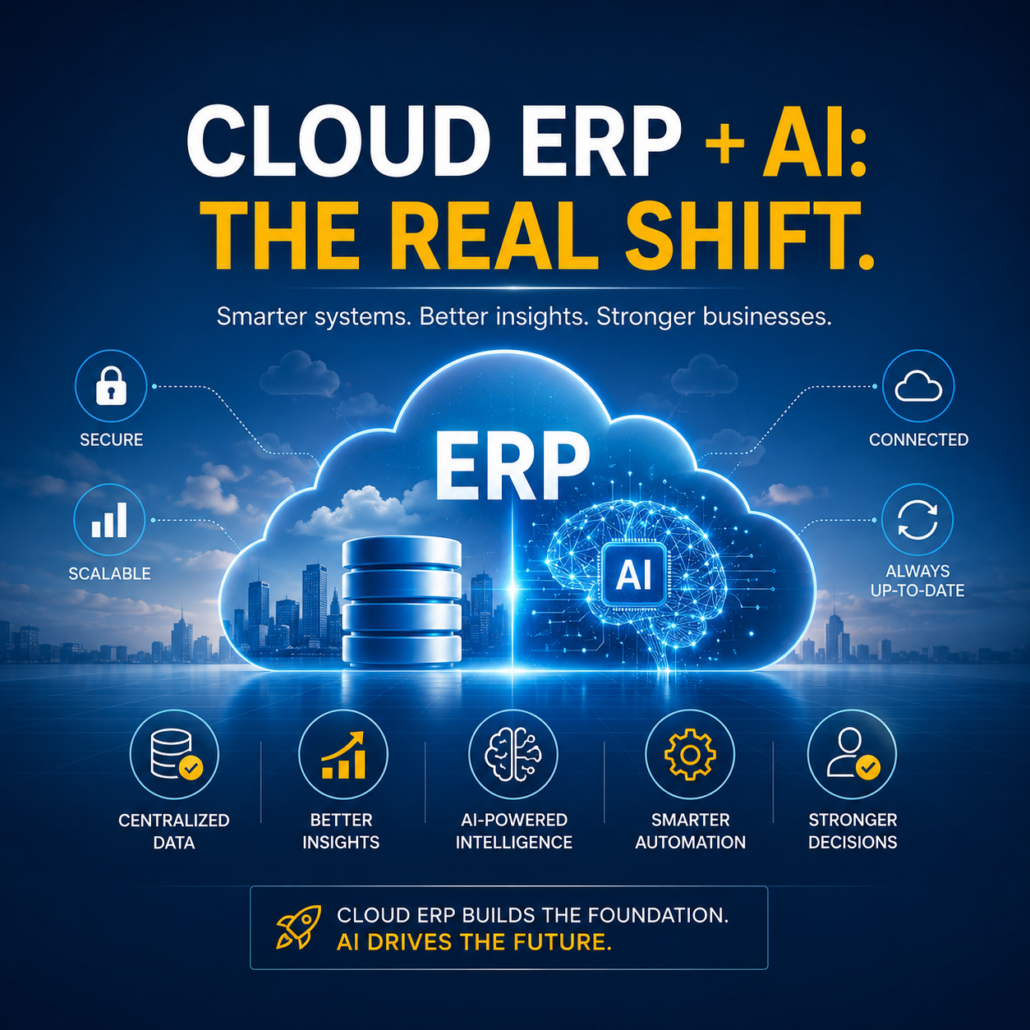
Cloud ERP and AI are changing how businesses operate—and the shift is happening faster than many organizations realize.
For years, ERP discussions focused on:
- On-premise vs cloud
- Cost savings
- Remote access
- Infrastructure management
But today, the conversation is evolving.
The real transformation is happening because cloud ERP platforms make AI far more practical, scalable, and accessible than traditional ERP environments ever could.
And that’s beginning to reshape how businesses handle:
- Operations
- Forecasting
- Reporting
- Automation
- Decision-making
Why AI and Cloud ERP Are Closely Connected
AI requires:
- Large amounts of data
- Processing power
- Continuous updates
- Integration across systems
Traditional on-premise ERP systems often struggle to support those demands efficiently.
Cloud ERP platforms, on the other hand, are designed for:
- Scalability
- Connectivity
- Real-time data access
- Faster innovation cycles
That’s why most modern AI development in ERP is happening in the cloud.
AI in SAP Business One: What It Means for the Future of ERP
What Makes Cloud ERP Better for AI?
The advantage isn’t just that cloud systems are online.
It’s that cloud ERP environments create the foundation AI needs to work effectively.
1. Centralized Data
AI performs best when data is consolidated and accessible.
Cloud ERP systems make it easier to:
- Connect departments
- Standardize information
- Eliminate data silos
- Create a single source of truth
The Role of Clean Data in AI Success
2. Continuous Updates
AI tools evolve rapidly.
Cloud ERP vendors can continuously deliver:
- AI enhancements
- Security updates
- Predictive features
- New integrations
Without requiring large upgrade projects.
3. Greater Computing Power
AI workloads can require significant processing resources.
Cloud infrastructure allows companies to scale without investing heavily in on-premise hardware.
Amazon Web Services AI and Cloud Computing
4. Easier Integration with AI Services
Cloud ERP systems connect more easily with:
- AI copilots
- Analytics platforms
- Machine learning services
- Automation tools
- External data sources
That flexibility accelerates innovation.
This Isn’t Just About Automation Anymore
In the past, ERP modernization focused heavily on workflow automation.
But AI introduces a much larger shift.
ERP systems are moving from:
- Transaction processing
to - Intelligent decision support systems
That means ERP platforms are becoming more proactive instead of reactive.
Examples include:
- Predicting demand fluctuations
- Detecting operational anomalies
- Forecasting cash flow risks
- Recommending purchasing actions
- Prioritizing customer issues automatically
AI vs Automation in ERP: Stop Confusing the Two
Why Mid-Sized Businesses Should Pay Attention
Many mid-sized companies assume AI is primarily for large enterprises.
That’s changing quickly.
Cloud ERP platforms are lowering the barrier to entry by making AI tools:
- Easier to deploy
- More affordable
- Less infrastructure-dependent
- More integrated into everyday workflows
For SAP Business One customers, this creates new opportunities to:
- Improve operational visibility
- Increase efficiency
- Enhance forecasting
- Reduce manual analysis
Without building a massive internal AI team.
The Hidden Challenge: Moving to the Cloud Doesn’t Automatically Make You AI-Ready
This is where many organizations get confused.
Cloud ERP creates the environment for AI—but it doesn’t solve foundational business problems automatically.
If your organization still struggles with:
- Poor data quality
- Inconsistent processes
- Duplicate records
- Weak governance
- Lack of user adoption
AI will still produce unreliable results.
Cloud infrastructure alone is not the answer.
Why Most ERP Systems Aren’t AI-Ready
Security and Governance Matter Even More in the Cloud
As ERP systems become more connected and AI-driven, governance becomes increasingly important.
Organizations need clear policies around:
- Data access
- AI-generated recommendations
- Compliance
- User permissions
- Monitoring and oversight
The combination of cloud ERP and AI creates incredible potential—but also increases the importance of governance discipline.
NIST AI Risk Management Framework
What the Future Looks Like
The future of ERP is not just cloud-based.
It’s intelligent, connected, and increasingly predictive.
Over the next several years, cloud ERP systems will likely become:
- More conversational
- More autonomous
- More predictive
- More integrated with AI copilots and assistants
Users will spend less time:
- Searching for information
- Building manual reports
- Performing repetitive analysis
And more time:
- Reviewing insights
- Making decisions
- Managing exceptions
- Improving strategy
How Businesses Should Prepare Now
The companies that benefit most from AI in cloud ERP won’t necessarily be the biggest.
They’ll be the organizations that:
- Standardize processes
- Improve data quality
- Strengthen governance
- Build operational discipline
- Adopt AI strategically instead of chasing hype
That foundation matters far more than simply buying new technology.
The Bottom Line
Cloud ERP and AI are not separate trends anymore.
They are becoming deeply interconnected.
Cloud platforms provide the scalability and flexibility AI requires.
AI provides the intelligence and predictive capabilities businesses increasingly expect from ERP systems.
But success still depends on fundamentals:
- Clean data
- Strong processes
- Governance
- Realistic implementation strategies
The companies that understand that balance will be in the strongest position moving forward.
Continue the AI in ERP Systems Series
- AI in ERP: What It Actually Does Today
- Top 10 Use Cases That Deliver Real ROI
- AI in ERP Systems Risks: Where AI Goes Wrong
- Why Most ERP Systems Aren’t AI-Ready
- The Role of Clean Data in AI Success
- AI Governance in ERP: The Missing Piece Most Companies Ignore
- AI vs Automation in ERP: Stop Confusing the Two
- Cloud ERP + AI: The Real Shift Happening in Business Software (Current)
- AI Agents in ERP: What They Actually Do
- AI Readiness Checklist for ERP Systems
- What is an ERP AI Copilot
AI readiness starts with more than technology.
Support One helps SAP Business One customers improve processes, strengthen data quality, and prepare for the future of cloud ERP and AI.
Talk with an expert about how AI can deliver real results in your ERP system.

