
AI Agents in ERP: What They Actually Do
AI Agents in ERP: What They Actually Do
AI agents in ERP are quickly becoming one of the biggest topics in business technology. Terms like agentic AI ERP, AI copilots in ERP, and autonomous ERP are appearing everywhere—but many companies still aren’t sure what these technologies actually do.
Some organizations assume AI agents mean ERP systems are about to run themselves automatically.
That’s not reality—at least not yet.
Today’s AI agents are designed to assist users, improve workflows, and support decision-making inside ERP systems like SAP Business One. They can automate tasks, surface insights, and respond dynamically to business conditions, but they still require human oversight and strong governance.
What Are AI Agents in ERP and Agentic AI?
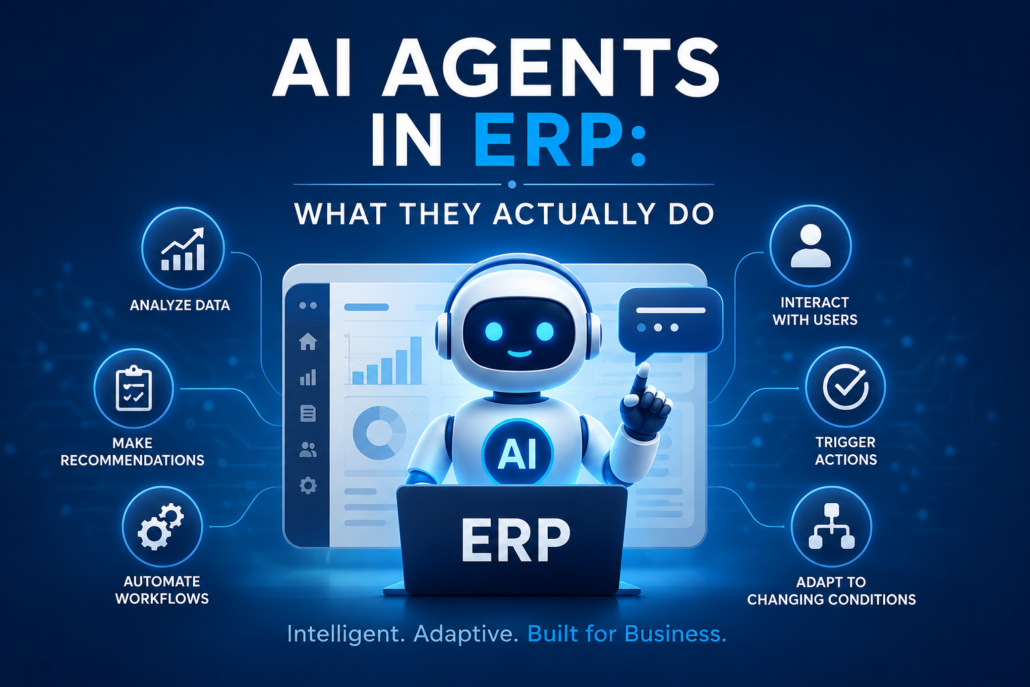
AI agents in ERP are AI-driven systems that can:
- Analyze data
- Make recommendations
- Trigger actions
- Complete workflows
- Interact with users
- Respond to changing conditions
Unlike traditional automation, AI agents are more adaptive and context-aware.
Instead of following only fixed rules, they can:
- Interpret requests
- Learn from patterns
- Prioritize actions
- Handle more dynamic scenarios
Think of them as intelligent assistants operating inside business workflows. IBM Overview of AI Agents
How AI Agents Are Different from Traditional Automation
Traditional ERP automation works like this:
“If X happens, do Y.”
AI agents go further:
“Based on the data, context, and priorities, this is likely the best next action.”
That distinction matters.
Traditional automation:
- Follows rules
- Handles repetitive tasks
- Requires predefined workflows
AI agents:
- Adapt to changing conditions
- Use contextual understanding
- Make recommendations dynamically
- Can interact conversationally
AI vs Automation in ERP: Stop Confusing the Two
AI Agents vs AI Copilots in ERP
AI agents and AI copilots are often discussed together, but they are not the same thing.
An AI copilot is primarily designed to assist users during tasks. It helps employees interact with the ERP system more efficiently by answering questions, generating reports, summarizing information, or helping users navigate workflows.
For example, an ERP copilot might help a user:
- Find overdue invoices
- Generate a sales summary
- Retrieve inventory data
- Create reports using natural language prompts
AI agents go a step further.
Instead of simply assisting users, AI agents can actively monitor workflows, make recommendations, trigger actions, and respond dynamically to changing business conditions.
Examples include:
- Escalating delayed approvals automatically
- Identifying unusual purchasing activity
- Recommending reorder quantities
- Prioritizing operational exceptions
In simple terms:
- AI copilots help users work faster
- AI agents help workflows operate smarter
Many modern ERP platforms are beginning to combine both capabilities, allowing users to interact conversationally with ERP systems while also benefiting from intelligent workflow automation behind the scenes.
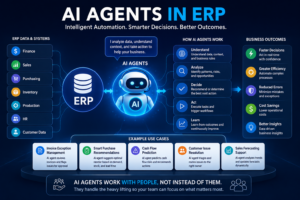
What ERP AI Agents Actually Do Inside ERP Systems
Right now, most ERP AI agents focus on supporting workflows—not fully replacing employees.
Here are the most practical use cases emerging today.
1. Workflow Assistance
AI agents can monitor workflows and help users manage tasks more efficiently.
Examples:
- Prioritizing approvals
- Escalating delayed invoices
- Identifying bottlenecks
- Suggesting next actions
Instead of users searching for issues manually, the AI agent surfaces them proactively.
2. Conversational ERP Interaction
This is one of the fastest-growing areas.
Users can ask:
- “What customers have overdue balances?”
- “Show inventory at risk this month.”
- “Which purchase orders are delayed?”
The AI agent interprets the request and retrieves information without requiring users to navigate multiple ERP screens.
3. Predictive Recommendations
AI agents can analyze patterns and suggest actions before problems escalate.
Examples include:
- Predicting inventory shortages
- Recommending reorder timing
- Identifying unusual spending patterns
- Forecasting customer payment delays
4. Exception Management
ERP teams spend huge amounts of time dealing with exceptions.
AI agents help identify:
- Transactions outside normal patterns
- Duplicate invoices
- Inventory anomalies
- Pricing inconsistencies
This allows users to focus attention where it matters most.
5. Task Automation with Intelligence
This is where AI agents differ from simple automation.
Instead of blindly following rules, AI agents may:
- Adjust recommendations dynamically
- Learn from previous actions
- Prioritize tasks differently based on urgency or context
That creates more flexibility in complex workflows.
What AI Agents Are NOT Doing Yet
There’s still a significant gap between today’s ERP AI tools and fully autonomous business systems.
Most AI agents today:
- assist users rather than replace them
- support workflows instead of owning decisions
- require governance, monitoring, and approval controls
Despite the hype around “autonomous ERP,” human oversight remains essential.
AI Governance in ERP: The Missing Piece Most Companies Ignore
Why AI Agents Depend on Clean ERP Data
AI agents are only as reliable as the ERP data they access.
If your ERP contains:
- duplicate records
- inconsistent naming conventions
- missing information
- outdated workflows
…the AI agent’s recommendations become less reliable.
Strong ERP data management is critical because AI systems depend on accurate, consistent information to generate meaningful insights and recommendations.
The Role of Clean Data in AI Success
The Biggest Risks with AI Agents in ERP
While AI agents can create major efficiency gains, they also introduce new operational and governance challenges.
1. Incorrect Recommendations
AI predictions are probabilistic, not guaranteed.
2. Over-Automation
Companies may trust AI outputs too quickly without sufficient review.
3. Governance Gaps
Organizations often lack clear policies around:
- AI approvals
- Responsibility
- Monitoring
- Escalation paths
4. User Trust Issues
If users don’t understand how recommendations are generated, adoption suffers.
Read more on managing risk: NIST AI Risk Management Framework
Why Cloud ERP Is Accelerating AI Agents
Most AI agent development is happening in cloud ERP environments because cloud systems provide:
- Scalable computing power
- Real-time data access
- Faster updates
- Easier AI integrations
That’s one reason cloud ERP adoption is increasingly tied to AI strategies.
Cloud ERP + AI: The Real Shift Happening in Business Software
What SAP Business One Customers Should Focus On
For most mid-sized businesses, the smartest approach is practical—not experimental.
Focus on:
- Process improvement
- Workflow automation
- Clean data
- Governance
- Targeted AI use cases
AI agents should support operations—not create unnecessary complexity.
The goal isn’t to chase hype.
It’s to improve decision-making and operational efficiency in measurable ways.
The Bottom Line
AI agents in ERP are becoming practical tools for improving workflows, surfacing insights, and supporting faster decision-making.
But successful adoption depends on more than just technology.
Organizations still need:
- clean ERP data
- strong governance
- well-defined processes
- realistic implementation strategies
The companies seeing the best results are using AI agents to enhance operations—not replace operational discipline.
FAQ: AI Agents in ERP
What is agentic AI in ERP?
Agentic AI in ERP refers to AI systems that can independently analyze information, make recommendations, and take actions within business workflows based on goals and context.
Unlike traditional automation, agentic AI is more adaptive and capable of handling changing conditions. Instead of simply following predefined rules, it can evaluate data patterns, prioritize tasks, and suggest the best next action.
In ERP systems, agentic AI may help with:
- Workflow prioritization
- Inventory recommendations
- Financial anomaly detection
- Forecasting and planning
- Exception management
However, most ERP AI agents today still require human oversight and governance controls.
Are AI copilots the same as AI agents?
Not exactly.
AI copilots and AI agents are related, but they serve different purposes.
AI Copilots
AI copilots are primarily assistive tools that help users interact with systems more efficiently.
Examples include:
- Answering questions
- Generating reports
- Summarizing data
- Assisting with navigation
- Providing recommendations
Copilots are designed to enhance user productivity rather than operate independently.
AI Agents
AI agents go a step further by actively managing or executing parts of workflows.
They may:
- Trigger actions automatically
- Monitor business conditions
- Prioritize tasks
- Respond dynamically to events
- Handle exceptions
In simple terms:
- Copilots assist users
- Agents act on behalf of workflows
Many modern ERP platforms are beginning to combine both capabilities.
Can ERP systems become autonomous?
Partially—but not completely.
ERP systems are becoming more autonomous in areas like:
- Workflow routing
- Inventory optimization
- Predictive forecasting
- Automated recommendations
- Exception detection
AI agents can already automate portions of operational decision-making.
However, fully autonomous ERP systems remain unrealistic for most businesses because organizations still need:
- Human oversight
- Governance controls
- Approval processes
- Compliance management
- Strategic decision-making
For the foreseeable future, ERP AI will likely function as a decision-support and workflow-enhancement tool rather than a fully self-operating business system.
What is intelligent ERP automation?
Intelligent ERP automation combines traditional workflow automation with AI-driven analysis and decision-making.
Traditional automation follows fixed rules, such as “If X happens, do Y”.
Intelligent automation adds AI capabilities such as:
- Pattern recognition
- Predictive insights
- Context awareness
- Dynamic recommendations
- Continuous learning
Examples include:
- Predicting invoice approval delays
- Detecting unusual purchasing activity
- Recommending inventory adjustments
- Prioritizing customer service issues automatically
The goal of intelligent ERP automation is not just faster processing—but smarter operational decision-making.
Over the next several years, ERP vendors will likely expand AI agents into more proactive and semi-autonomous operational roles.
Continue the AI in ERP Systems Series
- AI in ERP: What It Actually Does Today
- Top 10 Use Cases That Deliver Real ROI
- AI in ERP Systems Risks: Where AI Goes Wrong
- Why Most ERP Systems Aren’t AI-Ready
- The Role of Clean Data in AI Success
- AI Governance in ERP: The Missing Piece Most Companies Ignore
- AI vs Automation in ERP: Stop Confusing the Two
- Cloud ERP + AI: The Real Shift Happening in Business Software
- AI Agents in ERP: What They Actually Do (Current)
- AI Readiness Checklist for ERP Systems
- What is an ERP AI Copilot
AI agents can improve ERP workflows—but only when built on strong operational foundations.
Support One helps SAP Business One customers improve processes, strengthen data quality, and prepare for practical AI adoption.
Talk with an expert about how AI can deliver real results in your ERP system.

