
What Is an ERP AI Copilot?
What Is an ERP AI Copilot?
What is an ERP AI copilot? ERP AI copilots are quickly becoming one of the most talked-about developments in business software as companies explore new ways to improve productivity, simplify ERP workflows, and access business insights more efficiently.
Major ERP vendors like SAP and Microsoft are investing heavily in AI copilots designed to help users interact with ERP systems more efficiently using conversational AI, automation, and real-time business insights.
But many companies still aren’t sure:
- what an ERP AI copilot actually does
- how it differs from AI agents
- whether it delivers real business value
- or if it’s mostly marketing hype
The reality is that ERP AI copilots are not replacing ERP systems—or employees.
Instead, they are designed to help users:
- access information faster
- reduce manual tasks
- improve decision-making
- interact with ERP systems more naturally
And for many organizations, they may become one of the most practical forms of AI adoption in the near future.
What Is an ERP AI Copilot?
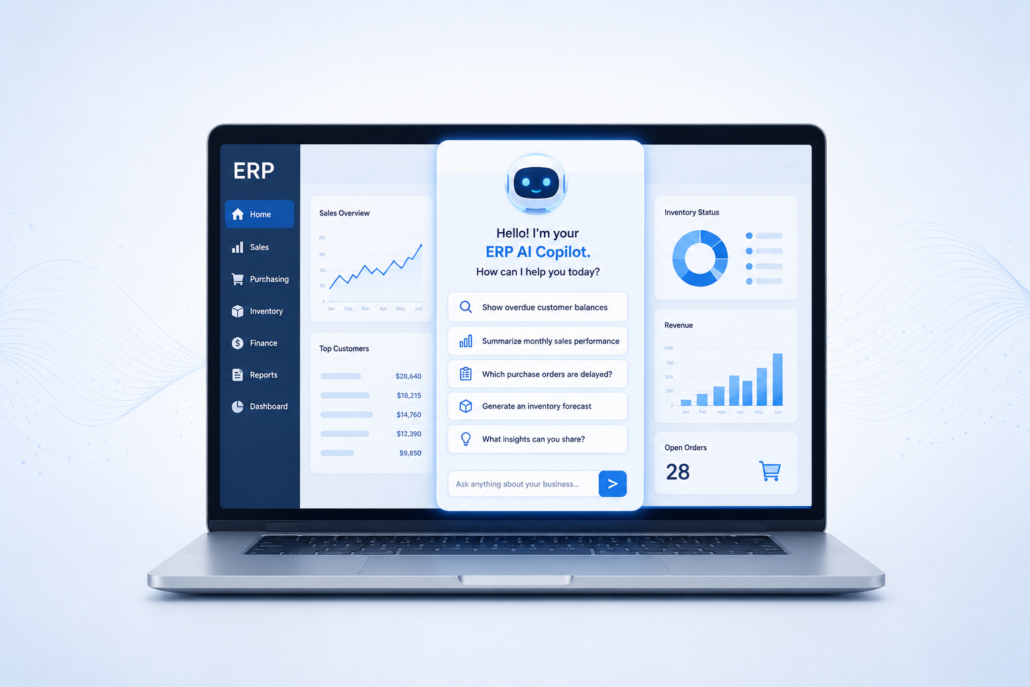
An ERP AI copilot is an AI-powered assistant integrated into an ERP system that helps users complete tasks, retrieve information, generate insights, and navigate workflows using conversational interactions.
Instead of manually searching through menus, reports, and dashboards, users can interact with the ERP system using natural language.
Examples include:
- “Show overdue customer balances.”
- “Summarize monthly sales performance.”
- “Which purchase orders are delayed?”
- “Generate an inventory forecast.”
The AI copilot interprets the request and retrieves relevant ERP data or recommendations.
Think of it as a conversational layer on top of the ERP system.
Learn more about Microsoft Copilot for Business
Why ERP AI Copilots Are Gaining Attention
Traditional ERP systems can be powerful—but also complex.
Many users struggle with:
- navigating menus
- building reports
- locating information
- understanding workflows
- extracting insights quickly
ERP AI copilots aim to simplify that experience.
Instead of requiring users to know:
- where data is stored
- which report to run
- how to filter information
…the copilot helps retrieve information conversationally.
This lowers friction and improves accessibility across the organization.
What ERP AI Copilots Actually Do
Today’s ERP AI copilots typically focus on improving productivity and user efficiency.
Common capabilities include:
1. Conversational ERP Search
Users can ask questions in plain language rather than navigating multiple ERP screens.
Examples:
- “What invoices are overdue?”
- “Which products are below minimum inventory?”
- “What were last quarter’s sales trends?”
This is one of the fastest-growing ERP AI use cases.
AI Agents in ERP: What They Actually Do
2. Report Generation and Summaries
ERP AI copilots can help generate:
- sales summaries
- operational reports
- financial overviews
- inventory snapshots
- customer activity insights
Some copilots can also summarize large datasets into more readable explanations.
3. Workflow Assistance
Copilots can guide users through:
- approvals
- purchasing workflows
- reporting tasks
- operational processes
This can help reduce training complexity for newer ERP users.
4. Recommendations and Insights
Some ERP AI copilots provide:
- forecasting suggestions
- operational alerts
- anomaly detection
- trend identification
- workflow recommendations
These capabilities often combine AI analytics with conversational interfaces.
5. Productivity Improvement
ERP AI copilots help reduce:
- repetitive searches
- manual reporting
- administrative workload
- time spent locating information
The goal is not to replace ERP users—but to help them work more efficiently.
ERP AI Copilots vs AI Agents
ERP AI copilots and AI agents are related technologies, but they serve different purposes.
ERP AI Copilots
Primarily assist users by:
- answering questions
- retrieving information
- summarizing data
- guiding workflows
Copilots are focused on improving user productivity.
AI Agents
Go further by:
- monitoring workflows
- triggering actions
- responding dynamically
- prioritizing operational tasks
- managing exceptions
AI agents are more workflow-oriented and semi-autonomous.
Why ERP AI Copilots Depend on Clean Data

