
CRM Integration for SAP Business One
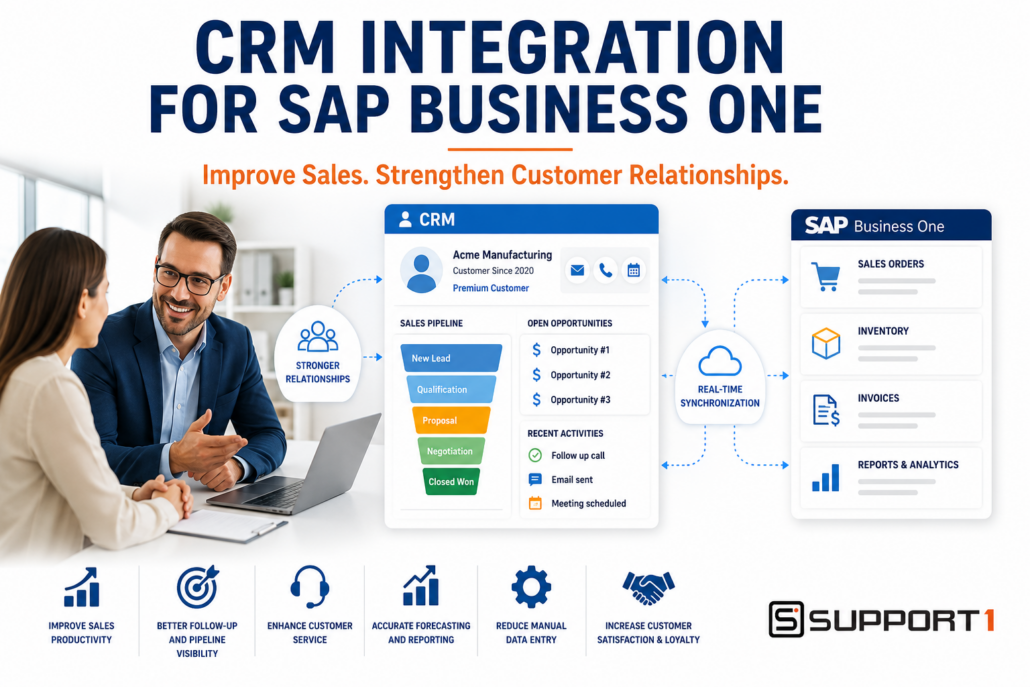
CRM Integration for SAP Business One: Improve Sales and Customer Relationships
CRM Integration for SAP Business One helps businesses improve sales productivity, strengthen customer relationships, and eliminate duplicate data entry by connecting customer relationship management software directly with their ERP system. Many growing companies still manage customer information in separate CRM and ERP systems, forcing employees to enter the same data multiple times and making it difficult to maintain a complete view of each customer.
By integrating your CRM with SAP Business One, customer information, sales opportunities, quotes, orders, and activities remain synchronized across both systems. The result is improved collaboration, better customer service, more accurate sales forecasting, and a stronger return on your ERP investment.
What Is CRM Integration for SAP Business One?
CRM Integration for SAP Business One synchronizes customer information between your customer relationship management (CRM) software and your ERP system.
Instead of maintaining separate databases, an integrated solution automatically shares information such as:
- Customer accounts
- Contact information
- Sales opportunities
- Quotes
- Sales orders
- Activities
- Customer communications
- Purchase history
Whether your organization uses HubSpot, Salesforce, Zoho CRM, or another CRM platform, SAP Business One integration helps create a single source of truth for customer information.
Related Reading: The Real ROI of SAP Business One Integrations
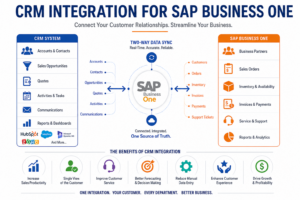
CRM Integration for SAP Business One synchronizes customer data, sales activities, and business information between your CRM and ERP, improving productivity, customer service, forecasting, and overall business performance.
Why Disconnected CRM and ERP Systems Create Problems
When CRM and ERP systems are not connected, employees often spend valuable time searching for information or manually updating records.
Common challenges include:
- Duplicate customer records
- Manual data entry
- Lost sales opportunities
- Poor communication between departments
- Inaccurate sales forecasts
- Delayed customer responses
- Reporting inconsistencies
- Limited visibility into customer activity
As businesses grow, these issues become increasingly costly and difficult to manage.
1. Improve Sales Productivity
Sales representatives should spend their time building relationships and closing business—not entering customer information into multiple systems.
Integrated CRM solutions provide immediate access to:
- Customer history
- Quotes
- Previous orders
- Current pricing
- Product availability
- Open invoices
With accurate information readily available, sales teams can respond faster and serve customers more effectively.
Related Reading: SAP Business One Automation: Save Time, Reduce Costs, and Improve Efficiency
Sales teams benefit even more from CRM integration when customer information is available outside the office. Mobile ERP for SAP Business One provides secure access to customer records, opportunities, and sales information while meeting with clients.
2. Create a Single Customer Record
One of the greatest advantages of CRM integration is creating a complete view of every customer.
Sales, accounting, operations, and customer service teams all work from the same information, including:
- Contact information
- Sales history
- Orders
- Invoices
- Payments
- Support activity
- Communications
This improves collaboration while reducing confusion caused by inconsistent records.
Customer relationships extend beyond contact information. Document Management for SAP Business One gives sales and service teams immediate access to contracts, proposals, invoices, and customer correspondence directly from the ERP system.
3. Improve Customer Service
Customer service representatives can quickly answer questions because they have access to complete customer information.
They can immediately view:
- Open orders
- Shipment status
- Outstanding invoices
- Previous purchases
- Service history
- Customer communications
Providing faster, more informed responses improves customer satisfaction and strengthens long-term relationships.
Related Reading: SAP Business One Field Service: Improve Productivity and Customer Satisfaction
4. Improve Sales Forecasting
Sales managers depend on accurate information to make informed business decisions.
Integrated CRM systems help organizations:
- Track opportunities
- Monitor sales pipelines
- Forecast revenue
- Measure conversion rates
- Identify growth opportunities
Management gains better visibility into future sales while improving planning and resource allocation.
5. Reduce Manual Data Entry
Without integration, employees often enter the same information multiple times.
CRM integration automatically synchronizes:
- New customer records
- Sales opportunities
- Quotes
- Sales orders
- Customer updates
- Contact information
Reducing manual data entry saves time while minimizing costly errors.
Related Reading: The Benefits of Automating Mundane Tasks and Process Optimization in ERP Systems
6. Improve Customer Experience
Customers benefit when employees have immediate access to accurate information.
Integrated CRM systems help businesses provide:
- Faster responses
- Personalized service
- Better follow-up
- Consistent communication
- Accurate order information
These improvements build stronger customer relationships and encourage repeat business.
By combining Shipping Integration for SAP Business One with CRM integration, businesses can automatically share shipment status and tracking information with sales and customer service teams, improving communication throughout the order lifecycle.
EDI Integration for SAP Business One enhances customer relationships by ensuring trading partners receive accurate order confirmations, shipment notifications, and invoices without delays or manual intervention.
CRM Integration for SAP Business One Is Part of a Complete ERP Strategy
The greatest return on investment comes when CRM integration works together with other business systems. Connecting customer relationship management with eCommerce, payment processing, warehouse management, barcode scanning, field service, and automation creates a connected business where information flows seamlessly from the first customer interaction through order fulfillment and ongoing support.
Businesses investing in digital transformation often combine CRM Integration for SAP Business One with eCommerce Integration for SAP Business One, Payment Processing for SAP Business One, and SAP Business One Automation to improve efficiency across every department.
CRM data integrated with Business Intelligence for SAP Business One provides sales managers with dashboards that reveal customer activity, sales trends, pipeline performance, and growth opportunities.
CRM and AI
Artificial intelligence is beginning to enhance CRM by helping businesses:
- Prioritize sales opportunities
- Predict customer buying behavior
- Recommend next actions
- Personalize customer communications
- Generate email drafts
- Summarize customer interactions
Organizations with integrated CRM and ERP systems will be better positioned to take advantage of these evolving AI capabilities.
Related Reading: What AI Features in ERP Actually Deliver ROI?
Choosing the Right CRM Integration for SAP Business One
Not every CRM integration provides the same capabilities.
When evaluating a CRM solution, consider:
- Native SAP Business One integration
- Two-way synchronization
- Mobile access
- Sales pipeline management
- Marketing automation
- Customer service capabilities
- Reporting and dashboards
- Scalability
- Ease of implementation
- Ongoing support
If your organization is running an older version of SAP Business One, it may also be worth evaluating whether an ERP upgrade should be part of your CRM strategy. Newer ERP versions often provide stronger integration capabilities and improved support for modern CRM platforms.
Related Reading: ERP Upgrade Problems: Causes and Solutions
Related Reading: How to Choose the Right SAP Business One Support Partner
Conclusion: Why CRM Integration for SAP Business One Delivers ROI
Manual customer management slows sales, creates duplicate work, and limits visibility across the organization.
CRM Integration for SAP Business One connects customer information, sales opportunities, orders, and communications into a single integrated system. Businesses benefit from improved sales productivity, stronger customer relationships, better forecasting, reduced administrative work, and greater operational efficiency.
Whether your goal is increasing sales, improving customer service, or eliminating manual processes, CRM integration delivers measurable business value while maximizing your SAP Business One investment.
Ready to Connect Your CRM with SAP Business One?
Support One helps businesses evaluate CRM solutions that integrate seamlessly with SAP Business One. Whether you’re implementing a CRM for the first time or connecting an existing platform to your ERP system, our team can help you choose the right solution for your business.
Learn Why Businesses Are Choosing Support One for SAP Business One Support and discover how we help organizations optimize sales, improve customer relationships, and maximize the value of their ERP investment.
Schedule a CRM Integration Consultation to learn how integrating your CRM with SAP Business One can improve sales performance, customer service, and long-term business growth.

Let’s talk about CRM Integrations for SAP Business One

