
AI Financial Management: Improve Cash Flow & Profit

How AI Improves Financial Management: Better Cash Flow, Faster Reporting, and Smarter Decisions
Introduction
AI financial management is transforming how manufacturers and distributors manage cash flow, improve financial reporting, strengthen forecasting, and make better business decisions. Finance leaders are under increasing pressure to provide faster insights, improve profitability, manage rising costs, and support strategic growth. Artificial intelligence helps finance teams analyze ERP data more efficiently, identify trends, and deliver meaningful business insights that improve decision-making across the organization.
Finance has always been one of the most data-intensive departments in any business. Controllers, CFOs, accounting managers, and business owners review thousands of transactions every month while trying to answer important questions such as:
- Are we meeting our profitability goals?
- Why did margins decrease?
- Which customers are paying late?
- Where are expenses increasing?
- What will our cash flow look like next quarter?
Traditional ERP systems like SAP Business One provide accurate financial information, but they typically require users to search through reports, spreadsheets, and dashboards to identify meaningful trends.
Artificial intelligence changes that process.
Instead of simply reporting what happened, AI analyzes financial data, recognizes patterns, explains why changes occurred, and recommends actions that help finance leaders make better business decisions.
It is important to remember that AI does not replace accountants, controllers, or CFOs. It enhances their expertise by reducing the time required to gather information while providing deeper insights into financial performance.
If you’re new to practical AI in ERP, we recommend starting with our AI for SAP Business One: The Complete Guide, which explains how manufacturers and distributors are using artificial intelligence across every department.
Why AI Financial Management Is More Important Than Ever
Financial management has become significantly more complex over the past several years.
Finance departments are expected to provide real-time business insights while navigating:
- Inflation
- Rising labor costs
- Higher material costs
- Supply chain disruptions
- Tariffs
- Cash flow uncertainty
- Margin pressure
- Economic volatility
Business leaders can no longer wait until month-end to understand financial performance.
They need answers today.
Questions such as:
- Why are gross margins declining?
- Which customers represent the greatest credit risk?
- Which products generate the highest profits?
- How will upcoming purchases affect cash flow?
- Where should we reduce expenses?
have become everyday management discussions.
Finance professionals spend a significant portion of their time gathering information rather than interpreting it.
Artificial intelligence changes that balance.
Rather than spending hours producing reports, finance teams can spend more time analyzing business performance and helping leadership make strategic decisions.
According to Deloitte, organizations are increasingly using AI to improve financial forecasting, automate repetitive accounting tasks, strengthen planning, and support executive decision-making.
What AI Financial Management Actually Does
Many people assume AI automatically manages a company’s finances.
That’s not how successful organizations use artificial intelligence.
Think of it this way.
– ERP records financial transactions.
– AI interprets financial transactions.
SAP Business One remains your financial system of record.
Artificial intelligence becomes the intelligent financial advisor.
Instead of reviewing dozens of reports, AI analyzes years of financial history in seconds to identify trends, exceptions, and opportunities that deserve attention.
AI financial management can help organizations:
- Forecast cash flow
- Analyze profitability
- Improve budgeting
- Detect unusual financial activity
- Prioritize collections
- Optimize vendor payments
- Summarize financial performance
- Identify cost-saving opportunities
- Improve forecasting accuracy
- Support executive decision-making
Rather than replacing finance professionals, AI allows them to spend more time solving business problems and less time preparing reports.
Microsoft describes this as augmenting human expertise—allowing finance professionals to focus on strategy while AI handles repetitive analysis.
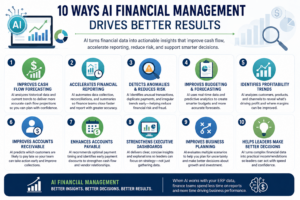
Discover 10 practical ways AI financial management helps manufacturers and distributors improve cash flow, accelerate financial reporting, optimize forecasting, reduce financial risk, and make better business decisions with SAP Business One.
10 Ways AI Financial Management Improves Business Performance
1. AI Financial Management Improves Cash Flow Forecasting
Cash flow remains one of the most important indicators of business health.
Even profitable companies can experience financial difficulties if cash inflows and outflows are poorly managed.
Traditional cash flow forecasting often relies on spreadsheets and historical averages.
AI provides a more dynamic approach by analyzing:
- Customer payment history
- Accounts receivable aging
- Accounts payable schedules
- Sales trends
- Purchasing activity
- Seasonal demand
- Inventory investment
- Historical cash movement
Instead of simply reporting current cash balances, AI forecasts future cash flow using continuously updated ERP data.
Finance leaders gain earlier visibility into potential shortages, allowing them to make proactive decisions regarding purchasing, financing, and collections.
2. AI Financial Management Accelerates Financial Reporting
Preparing financial reports consumes valuable time every month.
Controllers often spend days:
- Reconciling accounts
- Reviewing transactions
- Building spreadsheets
- Explaining variances
- Preparing executive summaries
AI helps automate much of this analytical work.
Instead of manually searching for significant changes, AI identifies unusual activity and automatically summarizes important financial trends.
For example, AI might report:
Gross margin declined 2.3% primarily because raw material costs increased while sales pricing remained unchanged.
Instead of discovering that information manually, finance teams receive immediate business insight.
This reduces reporting time while improving the quality of executive discussions.
3. AI Financial Management Detects Financial Anomalies
One of AI’s greatest strengths is identifying patterns that humans may overlook.
Finance departments process thousands—or even millions—of financial transactions every year.
AI continuously monitors those transactions for unusual activity, including:
- Duplicate vendor payments
- Unexpected expense increases
- Revenue fluctuations
- Inventory valuation changes
- Margin erosion
- Unusual journal entries
- Payment irregularities
- Purchasing anomalies
Rather than searching through reports after problems occur, finance teams receive alerts when unusual financial activity deserves attention.
This proactive approach improves financial controls while reducing business risk.
4. AI Financial Management Improves Budget Forecasting
Budgets should evolve as business conditions change.
Unfortunately, many organizations still rely on annual budgets created months before market conditions shift.
AI continuously analyzes:
- Revenue trends
- Operating expenses
- Sales forecasts
- Purchasing activity
- Inventory levels
- Labor costs
- Seasonal demand
Instead of relying solely on historical assumptions, finance leaders receive updated forecasting recommendations throughout the year.
This allows management to make more informed decisions regarding:
- Hiring
- Capital investments
- Inventory purchases
- Pricing strategies
- Cash management
Organizations become more agile because financial planning reflects current business conditions rather than outdated assumptions.
Better sales intelligence can also strengthen financial planning. AI for Sales can help identify changes in customer demand, improve sales forecasts, and give finance teams better visibility into potential future revenue and margin.
5. AI Financial Management Identifies Profitability Trends
Not every customer contributes equally to profitability.
Neither does every product.
AI analyzes financial performance across multiple dimensions, including:
- Customers
- Product lines
- Sales territories
- Industries
- Distribution channels
- Vendors
- Projects
Instead of simply reporting revenue, AI identifies where profits are actually being generated.
Examples include:
- Customers requiring excessive service
- Low-margin product lines
- High-performing sales territories
- Products with increasing profitability
- Regions with declining margins
These insights help executives allocate resources more effectively while improving long-term profitability.
If increasing profitability is one of your business goals, our article SAP Business One ROI: 10 Ways to Increase Profitability explores additional strategies for improving financial performance while maximizing the value of your ERP investment.
AI Doesn’t Replace Finance Professionals
Artificial intelligence can analyze financial transactions faster than any person.
It cannot replace the experience of a controller, CFO, accountant, or business owner.
The most successful organizations use AI financial management to provide better insights while allowing finance professionals to focus on strategy, planning, compliance, and business leadership.
Coming Up in Part 2
In the next section, we’ll explore five additional ways AI financial management improves business performance, including accounts receivable, accounts payable, executive dashboards, strategic planning, and decision-making. We’ll also explain how AI works with SAP Business One, share practical AI prompts for finance leaders, and include another executive callout box that readers can immediately apply to their own organizations.
Part 2
In Part 1, we explored how AI financial management helps organizations improve cash flow forecasting, accelerate financial reporting, detect anomalies, improve budgeting, and identify profitability trends.
These capabilities provide tremendous value on their own, but AI can also help finance teams improve collections, optimize payments, strengthen executive reporting, and make better strategic decisions.
6. AI Financial Management Improves Accounts Receivable
For many manufacturers and distributors, cash flow isn’t limited by sales—it is limited by collections.
Late customer payments can affect:
- Cash flow
- Purchasing decisions
- Payroll
- Inventory investment
- Capital projects
- Overall financial stability
Traditional accounts receivable reports tell finance teams which invoices are overdue.
AI goes much further.
By analyzing years of customer payment history, AI can identify:
- Customers likely to pay late
- Seasonal payment trends
- Increasing collection risk
- Customers whose payment behavior has changed
- High-risk accounts requiring immediate attention
Rather than reacting after invoices become overdue, finance teams can proactively contact customers before payment delays begin affecting cash flow.
This helps improve working capital while strengthening customer relationships.
7. AI Financial Management Enhances Accounts Payable
Paying invoices is about much more than simply meeting due dates.
Finance leaders must balance:
- Vendor relationships
- Cash flow
- Early payment discounts
- Purchasing priorities
- Available working capital
Artificial intelligence helps optimize payment strategies by analyzing:
- Vendor payment terms
- Discount opportunities
- Historical payment patterns
- Cash availability
- Purchase priorities
- Supplier importance
Rather than treating every invoice equally, AI helps finance teams determine which invoices should be paid immediately and which can be scheduled later without affecting supplier relationships.
Organizations using AP automation together with AI often reduce manual processing while improving cash flow management.
If your organization is looking to modernize accounts payable, our article AP Automation for SAP Business One: Reduce Costs and Eliminate Manual Processing explains how automation and AI complement one another.
Supply chain decisions also affect cash flow and working capital, and AI for Supply Chain Management can help businesses connect inventory, purchasing, supplier performance, and operational decisions with financial results.
8. AI Financial Management Strengthens Executive Dashboards
Executives don’t need more reports.
They need better answers.
Traditional ERP dashboards provide valuable information, but leaders still spend significant time interpreting financial data.
AI changes that experience.
Instead of reviewing multiple dashboards, executives receive concise summaries such as:
Revenue increased 8%, but gross margin declined due to higher raw material costs and increased freight expenses.
or
Cash flow remains healthy, although accounts receivable over 60 days increased by 12% compared to last quarter.
AI can summarize information across:
- Revenue
- Profitability
- Cash flow
- Purchasing
- Inventory
- Sales
- Customer activity
- Financial KPIs
This allows executives to focus on strategic discussions rather than gathering information from multiple reports.
Business Intelligence dashboards show what happened.
AI financial management helps explain why it happened and recommends what to do next.
9. AI Financial Management Improves Business Planning
Every business plans for the future.
The challenge is preparing for uncertainty.
AI supports strategic planning by evaluating multiple scenarios based on current ERP data.
For example:
What happens if:
- Sales increase by 15%?
- Material costs rise another 8%?
- A major customer delays payments?
- Inventory investment increases?
- Labor costs continue rising?
Rather than relying on static forecasts prepared once each year, finance leaders receive continuously updated planning scenarios based on changing business conditions.
This helps organizations make better decisions regarding:
- Hiring
- Capital investments
- Inventory planning
- Pricing
- Financing
- Growth initiatives
AI becomes an ongoing planning advisor rather than a once-a-year forecasting tool.
For manufacturers, financial performance is closely connected to what happens on the production floor. AI production management can help uncover how material costs, scrap, rework, production efficiency, and other factors are affecting product profitability.
10. AI Financial Management Helps Leaders Make Better Decisions
Perhaps the greatest value of AI is not automation.
It’s clarity.
Executives rarely struggle because they lack information.
They struggle because they have too much information.
AI helps summarize thousands of ERP transactions into practical recommendations.
Instead of asking finance teams to prepare multiple reports, leaders can simply ask questions such as:
Why did profit decline this month?
or
Which customers generated the highest gross margin?
or
What financial risks require my attention this week?
AI quickly analyzes ERP information and produces executive-ready summaries.
Instead of spending hours assembling reports, finance teams spend more time discussing business strategy.
Microsoft refers to this as Copilot-style assistance, where AI works alongside business professionals to improve productivity and decision-making.
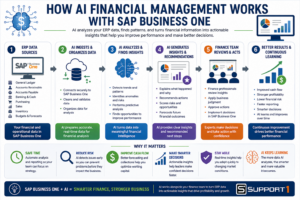
See how AI financial management works with SAP Business One to transform ERP data into actionable insights that improve cash flow, strengthen forecasting, reduce financial risk, and support smarter business decisions.
How AI Financial Management Works with SAP Business One
One of the biggest misconceptions surrounding artificial intelligence is that companies must replace their ERP system before adopting AI.
Fortunately, that’s not true.
SAP Business One already contains the financial information AI needs to deliver meaningful business insights.
Examples include:
- General Ledger
- Accounts Receivable
- Accounts Payable
- Banking
- Budgets
- Financial Statements
- Profit Centers
- Cost Centers
- Purchasing
- Sales
- Inventory
- Cash Flow
AI doesn’t replace these capabilities.
Instead, it analyzes ERP data to identify trends, detect anomalies, forecast future performance, and recommend actions.
Think of SAP Business One as your financial system of record.
AI becomes your financial analyst.
The cleaner your ERP data, the more valuable AI becomes.
If you’re preparing your ERP system for artificial intelligence, we recommend reading:
- AI for SAP Business One: Increase Revenue and Profit
- AI Purchasing
- AI Inventory Management
- Why Most ERP Systems Aren’t AI-Ready
- Clean Data for AI in ERP Systems
Finance Teams Don’t Need More Reports
They need faster answers.
AI analyzes thousands of financial transactions in seconds, helping finance leaders spend less time preparing reports and more time improving business performance.
Practical AI Prompts for Finance Leaders
One of the easiest ways to begin using AI is by asking better questions.
Here are several examples finance professionals can begin using today.
Cash Flow
Based on current accounts receivable, accounts payable, and expected sales, forecast our cash flow for the next 90 days.
Profitability
Which customers generated the highest gross profit during the past twelve months?
Margin Analysis
Explain why gross margin declined this quarter compared to the same quarter last year.
Expense Analysis
Identify the five expense categories with the largest percentage increases during the past six months.
Accounts Receivable
Which customers are most likely to pay invoices late based on historical payment behavior?
Accounts Payable
Which vendor invoices should be paid early to maximize available discounts without affecting cash flow?
Budget Planning
Compare actual financial performance to budget and identify the largest favorable and unfavorable variances.
Executive Summary
Summarize this month’s financial performance in one page for our executive leadership meeting, highlighting the most important trends, risks, and opportunities.
These examples demonstrate how AI financial management transforms financial data into meaningful business conversations rather than simply producing more reports.
Coming Up in Part 3
In the final section, we’ll explore best practices for implementing AI financial management, common mistakes to avoid, frequently asked questions, and how Support One helps manufacturers and distributors prepare their ERP systems for practical AI adoption. We’ll also finish with a strong call to action, strategic internal and external linking recommendations, and the complete SEO package for the article.
Part 3
Artificial intelligence is rapidly becoming one of the most valuable tools available to finance professionals. However, like any technology, success depends on how it is implemented.
Organizations that combine accurate ERP data, strong financial processes, and experienced finance professionals consistently achieve the greatest value from AI.
The goal isn’t to replace your finance team.
The goal is to help them make better decisions faster.
Best Practices for AI Financial Management
Successful AI initiatives begin with a strong financial foundation.
The better your ERP data and business processes, the more valuable AI becomes.
Maintain Clean Financial Data
Artificial intelligence depends on accurate information.
Before implementing AI, review your:
- Chart of Accounts
- Customer master records
- Vendor master records
- Cost centers
- Profit centers
- Financial dimensions
- Budget information
- Payment terms
- Bank accounts
Poor data produces poor recommendations.
Organizations preparing for AI should make financial data quality one of their highest priorities.
If you’re evaluating your ERP readiness, our article Clean Data for AI in ERP Systems explains why accurate data is the foundation of successful AI initiatives.
Standardize Financial Processes
AI performs best when organizations follow consistent financial procedures.
Examples include:
- Month-end close
- Budget preparation
- Account reconciliation
- Expense coding
- Purchasing approvals
- Financial reporting
Consistent business processes allow AI to recognize meaningful trends more accurately.
Keep Finance Professionals in Control
Artificial intelligence provides recommendations.
Finance professionals make decisions.
Controllers and CFOs bring business judgment that AI cannot replace, including:
- Strategic planning
- Regulatory compliance
- Tax considerations
- Financing decisions
- Risk management
- Board reporting
The most successful organizations combine AI-generated insights with experienced financial leadership.
Monitor Financial KPI’s
AI should become part of an ongoing financial improvement process.
Review key performance indicators regularly, including:
- Cash flow
- Gross margin
- Net profit
- Accounts receivable aging
- Accounts payable aging
- Inventory investment
- Operating expenses
- Budget variances
Over time, AI becomes increasingly valuable as it learns from additional ERP data and business activity.
Establish AI Governance
Financial information is among a company’s most sensitive business assets.
Organizations adopting AI should establish policies regarding:
- Data security
- User permissions
- Financial approvals
- Audit trails
- Regulatory compliance
- AI-generated recommendations
- Human review procedures
Governance builds confidence while ensuring AI remains aligned with company policies and financial controls.
For additional guidance, read our article AI Governance: The Missing Piece.
Common AI Financial Management Mistakes
Like every technology initiative, AI delivers the greatest value when organizations avoid common implementation mistakes.
Expecting AI to Replace Finance Professionals
AI can summarize financial information.
It cannot replace the experience of finance leaders who understand the business, interpret economic conditions, communicate with executives, and make strategic decisions.
Ignoring ERP Data Quality
Financial forecasting is only as accurate as the underlying ERP data.
Organizations should verify:
- Account structures
- Customer records
- Vendor records
- Payment terms
- Cost centers
- Budgets
- Historical financial data
before expecting AI to deliver meaningful insights.
Trusting Every Recommendation Without Review
AI recommendations should always be reviewed.
Finance professionals remain responsible for:
- Financial statements
- Budget approvals
- Regulatory compliance
- Audit requirements
- Executive reporting
Human oversight remains essential.
Treating AI as a Reporting Tool
Many organizations initially view AI as a faster reporting solution.
In reality, AI’s greatest value comes from helping finance teams:
- Identify risks
- Recognize opportunities
- Improve planning
- Strengthen forecasting
- Support executive decisions
The objective isn’t simply creating reports more quickly.
The objective is making better business decisions.
Failing to Train Employees
Successful AI adoption depends on people.
Finance teams should learn:
- Effective prompting
- AI limitations
- Data validation
- Financial review procedures
- Governance policies
Organizations investing in employee education consistently achieve better AI outcomes.
AI Supports Better Decisions—It Doesn’t Make Them
Artificial intelligence can analyze years of financial data in seconds.
Experienced finance professionals provide the judgment, context, and leadership required to turn those insights into successful business decisions.
AI Financial Management FAQs
Can AI prepare financial reports?
Yes.
AI can summarize financial information, explain variances, and help prepare executive reports.
Finance professionals should continue reviewing and approving all official financial statements.
Can AI improve cash flow forecasting?
Absolutely.
AI analyzes payment history, purchasing activity, inventory investment, and sales trends to generate more accurate cash flow projections.
Will AI replace accountants?
No.
AI automates repetitive analysis while allowing accountants and controllers to focus on planning, compliance, financial strategy, and business leadership.
Can AI improve budgeting?
Yes.
AI continuously evaluates changing business conditions and recommends budget adjustments based on current ERP data.
Can AI identify financial risks?
Yes.
AI helps identify unusual expenses, declining margins, late-paying customers, duplicate payments, and other financial anomalies that deserve management attention.
Is AI secure enough for financial data?
It can be, provided organizations implement appropriate security, governance, user permissions, and compliance controls.
Businesses should evaluate AI tools carefully before connecting them to financial systems.
Will AI work with SAP Business One?
Yes.
SAP Business One contains the financial, purchasing, inventory, and operational information AI needs to generate meaningful business insights.
Organizations with clean ERP data are in an excellent position to benefit from AI financial management.
Why Support One Helps Businesses Prepare for AI Financial Management
Finance departments already possess one of the most valuable business assets:
Data.
The opportunity lies in turning that ERP data into practical business intelligence.
Support One helps manufacturers and distributors prepare for AI by helping them:
- Improve ERP data quality
- Optimize financial workflows
- Modernize reporting
- Strengthen dashboards
- Improve forecasting
- Build practical AI roadmaps
- Identify high-value AI opportunities
Rather than promoting AI for its own sake, Support One focuses on helping organizations solve real business challenges and improve financial performance.
Whether your goal is improving cash flow, accelerating reporting, strengthening forecasting, or preparing SAP Business One for artificial intelligence, our team can help you build a practical roadmap that delivers measurable results. See why Businesses are Choosing Support One
Conclusion
Finance has always depended on accurate information.
Artificial intelligence transforms that information into meaningful business insight.
Instead of spending valuable time gathering data, finance leaders can focus on improving profitability, strengthening cash flow, reducing risk, and supporting executive decision-making.
Organizations that combine SAP Business One with practical AI tools are better positioned to respond to changing market conditions, improve financial performance, and make faster, more informed business decisions.
The future of finance isn’t about replacing experienced professionals.
It’s about giving them better information to lead the business with greater confidence.
Ready to Improve Financial Performance with AI?
Artificial intelligence is already helping manufacturers and distributors improve cash flow, strengthen forecasting, accelerate reporting, and make better executive decisions.
The question isn’t whether AI belongs in finance.
The question is whether your business is ready to take advantage of it.
Schedule your Complimentary AI Readiness Review with Support One.
We’ll help you:
- Evaluate your ERP data
- Assess your financial reporting processes
- Identify practical AI opportunities
- Prioritize initiatives with the greatest business impact
- Develop a realistic AI adoption roadmap
Whether you’re looking to improve forecasting, strengthen financial reporting, optimize cash flow, or prepare SAP Business One for AI, Support One can help you move forward with confidence.
Contact Support One today to schedule your Complimentary AI Readiness Review and discover how AI can transform your finance department.

Questions about AI for Finance in SAP Business One? Let’s talk.

