
How AI Improves Customer Service: Faster Responses and Better Support
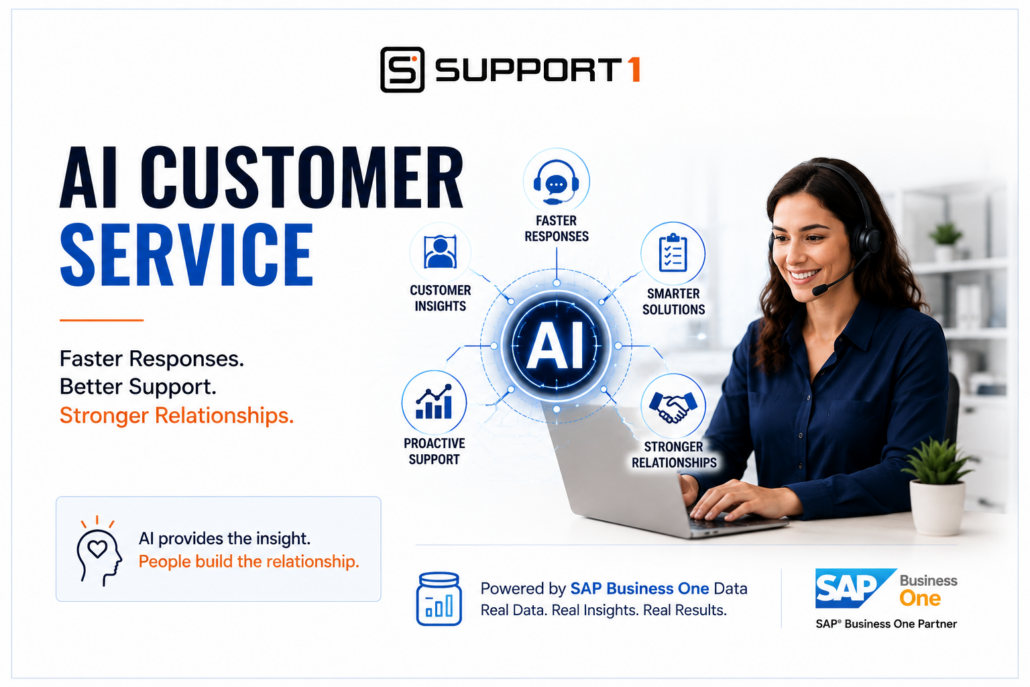
AI Customer Service Is Changing How Businesses Support Customers
AI customer service is changing how manufacturers and distributors respond to customers, resolve problems, and manage support operations. Instead of requiring employees to search through emails, service records, customer histories, and knowledge bases, artificial intelligence can help bring the right information to the right person at the right time.
For companies using SAP Business One, this creates an important opportunity. Customer, sales, inventory, order, financial, and service information may already exist within the ERP system. AI can help turn that information into faster answers and better customer experiences.
Consider a customer who calls asking about an order that hasn’t arrived.
A customer service representative may need to determine:
- When the order was entered
- Whether the product was available
- When it shipped
- Whether there was a partial shipment
- Which carrier has the shipment
- Whether the customer has contacted the company before
- Whether another employee has already addressed the problem
Traditionally, finding those answers can require searching multiple screens—or even multiple systems.
AI can help assemble and summarize that information quickly so the employee can focus on solving the customer’s problem.
The goal isn’t to replace the person helping the customer.
The goal is to give that person better information and more time to help the customer.
For a broader look at how businesses can apply artificial intelligence throughout their organization, see our AI for SAP Business One: A Complete Practical Guide.
Why AI Customer Support Is Becoming More Important
Customers have become accustomed to getting information quickly.
They can track a package in seconds, check a bank balance from their phone, and receive immediate confirmation when they place an online order. Those experiences influence what they expect when dealing with their suppliers.
For manufacturers and distributors, however, customer questions can be much more complicated than a typical retail transaction.
A customer may ask:
- Where is my order?
- Why is this item backordered?
- When will more inventory arrive?
- Why did the price change?
- Can you send another copy of my invoice?
- What happened with my last service request?
- Has my return been processed?
- When can the replacement product ship?
Answering those questions often requires information from several areas of the business.
That’s where AI customer support becomes particularly useful.
AI can help connect information, summarize what has happened, identify what deserves attention, and give employees the context they need to respond.
AI customer service tools can help support teams respond faster by connecting data, workflows, and knowledge while providing employees with real-time context and recommendations. Zendesk provides a useful overview of how these capabilities are being used in modern customer service.
What AI Customer Service Actually Does
There is an important distinction between automation and artificial intelligence.
Automation follows predefined rules.
For example:
When a service ticket is created, automatically send the customer a confirmation email.
AI does something different.
It analyzes information and helps determine what it means.
For example:
Review this customer’s service history, current orders, previous complaints, and open tickets and summarize what the representative should know before responding.
Both are valuable.
And when AI and automation work together, they can be extremely powerful.
A useful way to think about it is:
Your ERP stores the customer information.
Automation moves the process forward.
AI helps employees understand what to do next.
SAP describes SAP Business One as covering areas including sales and customer relationships alongside accounting, purchasing, inventory, reporting, and analytics. That breadth of connected business information is important because good customer service often depends on information outside the service department itself.
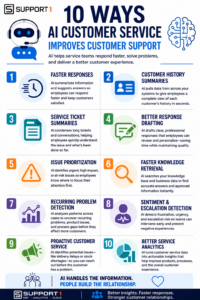
10 ways AI customer service helps teams respond faster, solve problems, identify customer needs, and build stronger customer relationships.
10 Ways AI Customer Service Can Improve Customer Support
1. AI Customer Service Helps Employees Respond Faster
Response time has a major influence on the customer experience.
But responding quickly isn’t helpful if the answer is wrong.
AI can help customer service employees quickly gather information about:
- The customer
- Previous orders
- Open orders
- Service history
- Previous communications
- Returns
- Deliveries
- Products purchased
Instead of spending several minutes searching for information before responding, the employee can receive a concise summary.
For example:
Customer has two open orders. Order 10482 shipped yesterday. Order 10517 is waiting for Item A100, which is expected next Tuesday. The customer contacted support about the same item three weeks ago.
The representative now has context before speaking with the customer.
This is one reason AI can improve service without removing the human element. The employee spends less time searching and more time helping.
IBM similarly describes modern customer-service AI as working across systems and workflows to help resolve issues while assisting human agents when needed.
2. AI Customer Support Summarizes Customer History
Long-term customers can have years of history.
That history might include:
- Hundreds of orders
- Multiple contacts
- Returns
- Credits
- Service requests
- Complaints
- Special pricing
- Delivery issues
No employee can reasonably review all of that information every time a customer calls.
AI can summarize it.
Instead of reviewing dozens of records, an employee could ask:
Summarize our relationship with this customer over the past 12 months. Highlight any recurring service issues, late deliveries, returns, or unresolved concerns.
AI could then provide the important information in seconds.
This is especially valuable when a different employee handles the customer than usual.
The customer doesn’t have to explain everything again.
The employee starts the conversation with context.
That can make service feel much more personal even though AI is working behind the scenes.
3. AI Customer Service Can Summarize Service Tickets and Conversations
Customer service cases often grow over time.
One issue may involve:
- Multiple emails
- Several phone calls
- Notes from different employees
- Technical troubleshooting
- Replacement shipments
- Internal discussions
When another employee becomes involved, understanding what has already happened can take significant time.
AI can create a concise case summary.
For example:
Customer reported equipment failure Monday. Technical support identified a faulty component Tuesday. Replacement part shipped Wednesday via overnight delivery. Customer confirmed receipt Thursday but has not yet confirmed installation.
Now the next employee immediately knows where things stand.
AI can also assist customer service representatives by surfacing relevant information and guidance in real time, helping employees understand customer issues and find answers more efficiently.
Additional Reading: IBM – What is Agent Assist?
4. AI Customer Service Helps Draft Better Responses
Writing customer emails takes time.
Even relatively simple messages require employees to:
- Review the situation
- Determine what happened
- Explain the issue
- Provide next steps
- Maintain an appropriate tone
AI can create a first draft based on the available information.
For example:
Draft a professional email explaining that the customer’s order is delayed because Item A100 is temporarily unavailable. The new expected ship date is August 22. Apologize for the delay and offer to ship the available items immediately.
The employee reviews the message, makes any necessary corrections, and sends it.
AI does the drafting.
The employee remains responsible for the communication.
This distinction matters.
Customer-facing AI should generally assist employees rather than encourage them to send unreviewed AI-generated responses.
Here is an excellent article from IBM which covers: AI assistants, chatbots, intelligent routing, personalization, real-time responses, and proactive customer service.
5. AI Customer Support Helps Prioritize Service Issues
Not every service request has the same urgency.
Compare these two cases:
Customer A
Can you send another copy of last month’s invoice?
Customer B
Our production line is down because the component you supplied isn’t working.
Both customers deserve a response.
But Customer B clearly requires immediate attention.
AI can analyze service requests and help identify:
- Urgency
- Customer impact
- Revenue at risk
- Production impact
- Repeat problems
- Customer sentiment
- SLA requirements
- Strategic accounts
The system could flag the production problem as a high-priority case and route it to the appropriate employee immediately.
This allows service teams to focus first on the issues that have the greatest business impact.
A recent article from McKinsey: Gen AI in Customer Care discusses generative AI’s potential to improve agent efficiency, effectiveness, operating costs, and customer experience.
AI Should Help Prioritize Customers—Not Decide Who Matters
AI can identify urgency, patterns, and potential business impact.
But customer relationships are more complicated than an algorithm.
Experienced employees should remain responsible for important service decisions, escalations, exceptions, and sensitive customer conversations.
AI provides the information.
People provide the judgment.
For businesses with technicians working at customer locations, AI for Field Service Management can extend AI-powered customer service into scheduling, service execution, technician preparation, and follow-up.
Where SAP Business One Fits into AI Customer Service
Customer service rarely operates in isolation.
A customer’s question may require information from:
Sales — What did the customer order?
Inventory — Is the product available?
Purchasing — When will more inventory arrive?
Warehouse — Has the order been picked?
Shipping — Has it shipped?
Finance — Is there a credit hold or invoice issue?
Service — Has the customer reported this problem before?
This is where an integrated ERP system becomes particularly valuable.
SAP Business One provides a common source of business information across customer relationships, sales, inventory, purchasing, financials, reporting, and other core operations.
Customer service teams can provide faster, more accurate answers when they have better visibility into product availability and future demand. Learn how AI Inventory Management helps businesses improve forecasting, reduce stockouts, and ensure the right products are available when customers need them.
When AI has access to appropriate, accurate, and authorized business data, customer service employees can potentially get a much more complete view of what’s happening.
That’s why AI readiness isn’t simply about choosing an AI tool.
It starts with the quality of the information inside your business systems. See why Clean Data for AI in ERP Systems is of the upmost importance.
Your ERP Data Is the Foundation
A sophisticated AI tool cannot compensate for inaccurate customer records, duplicate items, outdated contact information, or inconsistent service data.
Better data leads to better AI recommendations—and better customer service.
Part 2
In Part 1, we explored how AI customer service helps employees respond faster, summarize customer histories and service cases, draft better responses, and prioritize urgent issues.
But some of the greatest opportunities go beyond responding to individual customer questions. AI can also help service teams find answers faster, identify recurring problems, recognize dissatisfied customers, provide proactive support, and uncover patterns that improve the entire customer experience.
6. AI Customer Service Helps Employees Find Answers Faster
Even experienced customer service employees don’t know the answer to every question.
Information may be scattered across:
- Product documentation
- Training materials
- Service manuals
- Company policies
- Previous support cases
- Frequently asked questions
- ERP records
- Internal procedures
Finding the right answer can take longer than actually resolving the customer’s problem.
AI can help employees search this information using everyday language.
Instead of manually searching through documents, an employee might ask:
What is our return policy for this product, and has this customer returned the same item before?
Or:
What troubleshooting steps should I recommend for this issue?
AI can search approved business information and provide a summarized answer while directing the employee to the appropriate source.
This is especially useful for newer employees who may not yet know where every piece of information is stored.
Rather than replacing training, AI becomes an additional resource that helps employees become productive more quickly.
IBM provides an overview of how AI-powered agent assistance can help customer service representatives access knowledge and relevant information during customer interactions.
7. AI Customer Support Identifies Recurring Customer Problems
Individual customer complaints can sometimes appear unrelated.
AI is particularly good at identifying patterns across large numbers of service interactions.
For example, imagine that 15 customers contact support over several weeks about the same product.
Each case may initially appear to be an isolated incident.
AI could identify that:
- All customers purchased the same item.
- The products came from the same production batch.
- Most problems began within 30 days.
- Customers are describing similar symptoms.
- Returns for that item have also increased.
Suddenly, customer service information becomes valuable business intelligence.
The organization can investigate the underlying problem before dozens—or hundreds—of additional customers are affected.
This type of analysis can help identify:
- Product quality problems
- Shipping issues
- Packaging failures
- Incorrect documentation
- Training gaps
- Installation problems
- Recurring billing questions
- Supplier quality issues
Customer service teams often see business problems before anyone else because they’re hearing directly from customers.
AI customer support can help transform those conversations into actionable information for management.
Customer Service Data Is Business Intelligence
Customer complaints shouldn’t simply be viewed as problems to resolve.
They can reveal issues involving products, suppliers, inventory, shipping, documentation, and internal processes.
AI can help turn customer feedback into operational insight.
Customer-service information can also provide valuable signals to the sales team. AI for Sales can combine purchasing patterns with customer activity to help salespeople recognize accounts at risk, identify opportunities, and prepare for more productive customer conversations.
Read More: Business Intelligence for SAP Business One customer-service trends can become another source of information for management dashboards and decision-making.
8. AI Customer Service Can Help Identify Customer Sentiment and Escalation Risk
Sometimes the words a customer uses tell only part of the story.
Consider these two messages:
Can you tell me when my order will arrive?
and
This is the third time I’ve contacted you about this order. I need someone to tell me what’s going on today.
Both messages are asking about an order.
But they clearly don’t have the same urgency.
AI can analyze customer communications for indicators such as:
- Frustration
- Urgency
- Repeated complaints
- Negative sentiment
- Escalation risk
- Cancellation risk
This allows service teams to identify customers who may need immediate personal attention.
For example, AI could flag:
High escalation risk: Customer has contacted support three times in seven days regarding the same unresolved delivery issue.
A service manager could then intervene before the customer relationship deteriorates further.
This doesn’t mean AI should decide whether a customer is happy or unhappy without human review. Sentiment analysis isn’t perfect, and tone can be difficult to interpret.
Instead, AI provides another signal that helps service professionals determine where their attention may be needed most.
McKinsey has reported that generative AI in customer care can support representatives during interactions, improve productivity, and help organizations improve the customer experience when implemented thoughtfully.
9. AI Customer Support Enables More Proactive Service
Most customer service is reactive.
A customer has a problem.
The customer contacts the company.
The company responds.
AI creates an opportunity to reverse that process.
Instead of waiting for customers to discover problems, businesses can identify potential issues and communicate proactively.
Imagine that SAP Business One shows an important customer has an order scheduled for delivery Friday.
AI identifies that one item is unlikely to arrive from the supplier in time to complete the order.
Instead of waiting until Friday for the customer to ask:
Where is my order?
the service team could contact the customer on Wednesday:
We wanted to let you know that one item on your order may be delayed. We can ship the available items now or hold the order until everything is available.
The underlying problem hasn’t disappeared.
But the customer experience is completely different.
Proactive service can be especially valuable for:
- Potential shipment delays
- Backordered products
- Inventory shortages
- Service contract renewals
- Upcoming maintenance
- Product recalls
- Pricing changes
- Delivery exceptions
This is another area where AI Inventory Management and AI Purchasing connect naturally with customer service. Better forecasting and supplier visibility can give service teams earlier warning about problems that may eventually affect customers.
10. AI Customer Service Improves Service Analytics
Customer service departments generate enormous amounts of information.
The challenge is understanding what all of it means.
Traditional customer-service metrics might include:
- Number of open cases
- Average response time
- Average resolution time
- Cases by employee
- Customer satisfaction
- Number of escalations
Those metrics remain important.
AI adds another layer of analysis.
Management can ask questions such as:
What are the five most common reasons customers contacted us this quarter?
Which products generate the most support requests?
Which customer issues take the longest to resolve?
Are complaints increasing for any particular product?
Which service problems are associated with our largest customers?
What issues could we eliminate through better training or documentation?
AI helps management move beyond measuring how many service requests exist to understanding why they’re happening.
That’s a much more valuable question.
If 20% of customer service cases involve customers asking for order status, the solution may not be hiring another service representative.
The better solution might be improving order visibility.
If support calls repeatedly involve the same product problem, the solution may lie with quality control or the supplier.
AI helps uncover those relationships.
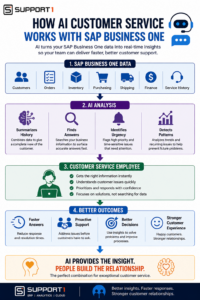
See how AI customer service can turn SAP Business One data into faster answers, proactive support, better decisions, and stronger customer relationships.
How AI Customer Service Works with SAP Business One
The real value of AI emerges when customer-service information isn’t isolated from the rest of the business.
SAP Business One can provide important context involving:
- Customer master records
- Sales orders
- Delivery documents
- Invoices
- Accounts receivable
- Inventory
- Purchasing
- Service information
- Returns
- Pricing
- Credit information
Consider a customer who asks:
When will my backordered item ship?
A useful AI response may require several pieces of information.
Step 1 — Sales
What did the customer order?
Step 2 — Inventory
Is the item currently available?
Step 3 — Purchasing
Is additional inventory already on order?
Step 4 — Supplier
When is that inventory expected?
Step 5 — Customer History
Is this a strategic customer or a recurring issue?
Step 6 — Response
What should the service representative tell the customer?
Without integrated business information, the employee may have to investigate each question individually.
With clean ERP data and properly implemented AI, much of that information can potentially be summarized for the employee.
That’s the difference between simply adding a chatbot and building genuinely useful AI customer service capabilities.
The value isn’t the chatbot.
The value is connecting AI to reliable business information and putting useful insights in the hands of employees.
Practical AI Customer Service Prompts
One of the easiest ways to understand AI’s potential is to consider the questions service employees and managers could ask.
Customer History
Summarize this customer’s orders, returns, service cases, and major issues during the past 12 months.
Order Status
Summarize the current status of this customer’s open orders and identify anything that may delay shipment.
Service Case
Summarize this service case, including what the customer reported, actions already taken, and recommended next steps.
Response Drafting
Draft a professional response explaining the shipment delay, the expected delivery date, and the options available to the customer.
Escalation
Identify open customer issues that have been unresolved for more than five days or involve multiple customer contacts.
Recurring Problems
What are the five most common customer complaints during the past 90 days?
Product Quality
Which products generated the largest increase in customer complaints during the past six months?
Customer Risk
Identify customers showing increasing service problems, repeated complaints, or signs of dissatisfaction.
Management Summary
Summarize the most important customer service issues management should review this week.
These are not simply ways to generate text.
They’re examples of using AI to interrogate business data in natural language and turn that information into practical decisions.
Ask Better Questions, Get Better Insights
One of the most valuable AI skills may not be technical at all.
It’s knowing what questions to ask.
Experienced customer service employees already know the questions that matter.
AI simply gives them a faster way to find the answers.
AI Customer Service and the Human Experience
There is an important danger businesses should avoid.
AI makes it possible to automate more customer interactions.
That doesn’t mean every interaction should be automated.
Customers still value human interaction when:
- A problem is complicated
- They’re frustrated
- Significant money is involved
- Production has stopped
- An important order is delayed
- A relationship is at risk
- An exception needs to be made
The strongest AI customer support strategy isn’t:
How many customer conversations can we eliminate?
It’s:
How can we help our employees provide better service?
AI should handle repetitive information gathering and analysis so employees have more time for conversations that require empathy, judgment, negotiation, and relationship building.
Zendesk similarly emphasizes combining AI-powered service with human agents rather than treating AI solely as a replacement for people.
Part 3
AI can help customer service teams respond faster, find better answers, recognize recurring problems, and provide more proactive support. But successful AI customer service requires more than simply choosing an AI tool.
The quality of your ERP data, business processes, security controls, and employee training all influence the results.
The objective should not be to automate every customer interaction. It should be to use AI where it improves the experience for both customers and employees.
Best Practices for AI Customer Service
Start AI Customer Service with Clean Customer Data
Artificial intelligence is only as useful as the information available to it.
Before connecting AI to customer service processes, businesses should review the quality of their:
- Customer master records
- Contact information
- Item records
- Sales history
- Service history
- Pricing information
- Inventory data
- Purchasing information
- Shipping information
- Service notes
Duplicate customer records, outdated contact information, inconsistent item descriptions, and incomplete service histories can all reduce the quality of AI-generated answers.
Imagine asking:
What problems has this customer experienced during the past year?
If customer interactions are scattered across duplicate records or important service notes were never entered, AI cannot provide a complete answer.
This is why clean ERP data is one of the foundations of successful AI adoption.
Give AI Customer Support Access Only to the Information It Needs
Customer information can include sensitive business and financial data.
Not every employee—and not every AI application—should have unrestricted access to everything stored in your ERP system.
Organizations should consider:
- User permissions
- Customer privacy
- Financial information
- Pricing information
- Credit information
- Employee access
- AI application permissions
- Data retention
- Audit requirements
A customer service employee may need to see an invoice balance.
That doesn’t necessarily mean the employee—or an AI assistant used by that employee—should have access to confidential financial reports.
Existing ERP security principles should continue to apply when AI is introduced.
Keep Humans Involved in Important Customer Decisions
AI can help recommend an answer.
It should not automatically make every customer decision.
Human review becomes especially important when dealing with:
- Large credits
- Refunds
- Pricing exceptions
- Contract disputes
- Customer complaints
- Legal concerns
- Significant service failures
- Strategic customers
- Potential customer loss
For example, AI might identify that a customer has experienced three late shipments and recommend providing a credit.
That’s useful information.
But an experienced employee should determine whether the credit is appropriate and how the conversation should be handled.
AI provides context and recommendations.
People remain responsible for the customer relationship.
Measure Whether AI Customer Service Is Actually Improving Service
The purpose of AI isn’t simply to say your company uses AI.
It should produce measurable improvements.
Businesses can monitor metrics such as:
- First response time
- Average resolution time
- First-contact resolution
- Customer satisfaction
- Number of escalations
- Repeat service requests
- Open cases
- Employee productivity
- Customer retention
However, businesses should be careful not to focus exclusively on speed.
Resolving a problem correctly in ten minutes is better than sending an incorrect response in ten seconds.
The best measurements balance efficiency with customer satisfaction and service quality.
Train Employees to Work with AI Customer Support
AI adoption is partly a technology project.
It’s also an employee training project.
Customer service teams should understand:
- What AI can do
- What AI cannot do
- How to write effective prompts
- How to verify AI-generated information
- When human judgment is required
- What information should not be entered into unapproved AI tools
- How to report inaccurate AI responses
Employees who understand AI’s strengths and limitations are much more likely to use it successfully.
Common AI Customer Service Mistakes
Trying to Automate Every Customer Interaction
One of the biggest mistakes businesses can make is assuming AI should replace as many customer conversations as possible.
Some interactions are excellent candidates for automation:
- Order status
- Invoice copies
- Basic product information
- Frequently asked questions
- Appointment confirmations
Others benefit greatly from human involvement:
- Complex complaints
- Production emergencies
- Pricing disputes
- Large returns
- Relationship problems
- Contract issues
The goal should be to automate repetitive work while giving employees more time for valuable customer conversations.
Using AI Customer Support with Poor ERP Data
If your ERP system says an item is available when it isn’t, AI may confidently provide the wrong answer.
If expected delivery dates aren’t maintained, AI can’t reliably tell customers when products will arrive.
If customer records are incomplete, AI-generated summaries will also be incomplete.
Artificial intelligence doesn’t eliminate data-quality problems.
It can make those problems more visible.
Allowing AI to Send Important Responses Without Review
AI-generated drafts can save employees significant time.
But customer-facing communications should be reviewed when they involve:
- Financial information
- Pricing
- Commitments
- Delivery promises
- Complaints
- Credits
- Legal matters
- Contract terms
A convincing AI-generated response can still contain an error.
Employees remain responsible for verifying important information before communicating it to customers.
Ignoring AI Governance and Security
Customer-service AI may interact with sensitive information.
Organizations need clear policies regarding:
- Approved AI tools
- Data access
- Customer information
- Confidential business information
- Human approval
- AI-generated content
- Data retention
- Security monitoring
AI governance shouldn’t prevent innovation.
It should make innovation safer.
If you’re developing an organization-wide AI strategy, our AI Governance guide explains how businesses can establish practical policies and controls while still allowing employees to benefit from artificial intelligence.
Suggested internal link: AI Governance
Buying AI Before Identifying the Business Problem
This may be the most important mistake to avoid.
Don’t start with:
We need an AI customer service platform.
Start with:
What customer-service problems are we trying to solve?
Perhaps your biggest problem is:
- Slow response times
- Employees can’t find information
- Too many order-status calls
- Service cases take too long to resolve
- Customers repeatedly report the same problems
- Management can’t identify service trends
Once you’ve identified the problem, you can determine whether AI is the right solution.
Technology should follow the business need—not the other way around.
Start with the Problem, Not the AI
The best AI projects don’t begin by asking:
“Where can we use AI?”
They begin by asking:
“Where are we losing time, money, or customers?”
Then determine whether AI can help solve the problem.
AI Customer Service FAQs
What is AI customer service?
AI customer service uses artificial intelligence to help businesses understand customer information, answer questions, summarize service histories, draft responses, identify patterns, prioritize issues, and improve customer support.
AI can assist employees or power certain automated customer-service functions.
How can AI improve customer support?
AI can help employees find information faster, summarize customer history, identify urgent service cases, draft responses, analyze customer sentiment, detect recurring problems, and provide proactive support.
The result can be faster responses and more informed customer interactions.
Will AI replace customer service employees?
AI will automate some repetitive customer-service tasks, but it is unlikely to eliminate the need for skilled customer service professionals.
Complicated problems, frustrated customers, exceptions, negotiations, and important relationships still require human judgment.
For many businesses, the greater opportunity is using AI to make customer service employees more effective, rather than replacing them.
Can AI answer questions about customer orders?
Potentially, yes.
When properly integrated with authorized business data, AI can help employees answer questions involving:
- Order status
- Inventory availability
- Expected deliveries
- Invoices
- Returns
- Previous orders
The accuracy of those answers depends heavily on the quality and timeliness of the underlying ERP data.
Can AI summarize customer service cases?
Yes.
AI is particularly useful for summarizing lengthy service cases, email conversations, notes, and previous interactions.
This can help another employee quickly understand what happened and determine the next step.
Can AI detect unhappy customers?
AI can analyze language and interaction patterns to identify potential frustration, negative sentiment, repeated complaints, or escalation risk.
However, sentiment analysis isn’t perfect.
Employees should use these indicators as additional information rather than unquestioningly accepting an AI assessment of a customer’s feelings.
Can AI provide proactive customer service?
Yes.
When AI identifies potential inventory shortages, shipment delays, recurring product problems, or other exceptions, service teams can potentially contact customers before they experience the problem.
This can turn a negative situation into a much better customer experience.
Can AI Customer Service Work with SAP Business One?
Yes. SAP Business One contains much of the information required to support customer interactions, including customer records, sales orders, inventory, purchasing, deliveries, invoices, financial information, and service history.
The specific AI capabilities available will depend on the tools, integrations, data access, and SAP Business One environment being used.
The important point is that businesses don’t necessarily need to replace their ERP system to begin preparing for AI.
A well-maintained SAP Business One environment can provide a strong data foundation for practical AI initiatives.
Is AI Customer Service Secure?
It can be, but security depends on implementation.
Businesses should evaluate:
- Which AI tools are approved
- Where information is processed
- What data the AI can access
- User permissions
- Data retention policies
- Privacy requirements
- Human approval procedures
Customer and financial information should never be casually entered into unapproved public AI tools.
AI security should become part of the organization’s broader data governance and cybersecurity strategy.
How Support One Helps Businesses Prepare for AI Customer Service
For manufacturers and distributors using SAP Business One, successful AI adoption often begins long before an AI tool is implemented.
It begins with the ERP system.
Support One can help businesses evaluate:
- ERP data quality
- Customer master data
- Inventory accuracy
- Business processes
- Reporting
- Integrations
- SAP Business One configuration
- AI readiness
- Opportunities for automation
- Practical AI use cases
We believe businesses should approach AI with a clear objective.
Not:
Let’s add AI because everyone is talking about it.
But:
Where can AI help us improve customer service, reduce repetitive work, and give employees better information?
That approach leads to more practical projects and better business outcomes.
Check out our article on: Why ERP Systems Are Not AI Ready
The Future of AI Customer Service Is Human + AI
Customer service has always been about relationships.
Artificial intelligence doesn’t change that.
What AI changes is how much information employees can access and how quickly they can understand it.
AI can summarize a customer’s history.
AI can identify an urgent problem.
AI can draft a response.
AI can recognize patterns across thousands of service cases.
AI can alert employees before a customer experiences a problem.
But people still build relationships.
People still make judgment calls.
People still handle difficult conversations.
And people still determine how customers should be treated.
The strongest customer-service organizations won’t choose between people and AI.
They’ll combine the strengths of both.
For manufacturers and distributors using SAP Business One, that can mean faster responses, better information, more proactive support, and ultimately stronger customer relationships.
Ready to Improve Customer Service with AI?
Artificial intelligence can help your customer service team respond faster, identify problems sooner, reduce repetitive work, and provide employees with better information.
But before choosing an AI solution, you need to know whether your ERP data and business processes are ready to support it.
Schedule your Complimentary AI Readiness Review with Support One.
We’ll help you evaluate your SAP Business One environment, identify practical opportunities for AI and automation, and prioritize the projects most likely to improve customer service and deliver measurable business value.
Call Support One at (720) 545-9225 or visit supportone.us to schedule your Complimentary AI Readiness Review.

Questions about AI for Customer Service in SAP Business One? Let’s talk.

