,

AI in ERP Systems Use Cases: 10 That Deliver ROI
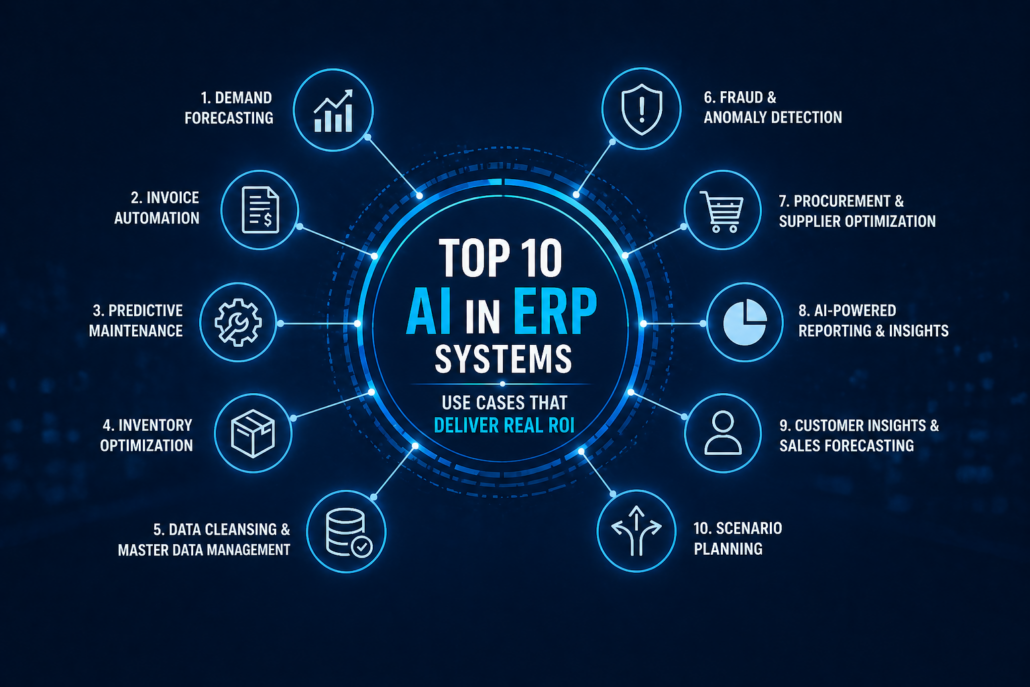
Top 10 AI in ERP systems use cases infographic showing forecasting, automation, predictive maintenance, and analytics delivering real ROI.

AI in ERP systems use cases are helping manufacturers and distributors reduce costs, improve forecasting, automate routine work, and make faster, more informed decisions. In this guide, you’ll discover 10 ERP AI examples that demonstrate how artificial intelligence is delivering measurable ROI across finance, operations, inventory, and supply chain management.

In our last post, we broke down what AI in ERP systems actually does today.

Now let’s get more practical.

Because the real question most companies are asking isn’t:

“What is AI?”

It’s:

“Where does AI actually deliver measurable ROI inside ERP?”

The answer: not everywhere.

But in the right use cases, AI is already delivering real, tangible business value—from cost reduction to better forecasting and faster decision-making.

These AI in ERP systems use cases highlight where companies are seeing real, measurable returns—not just theoretical benefits. However, not every organization can take advantage of these opportunities due to gaps in AI in ERP systems readiness.

Why AI in ERP Systems Use Cases Matter

Many organizations know artificial intelligence can improve business operations, but they’re unsure where to begin. The best AI in ERP systems use cases solve specific operational problems instead of trying to replace employees or automate everything.

Whether you’re evaluating SAP Business One or another ERP platform, focusing on proven AI use cases helps you prioritize projects that deliver measurable business value quickly.
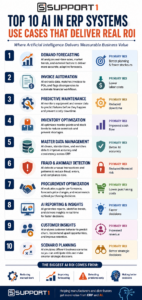
Infographic showing the top 10 AI in ERP systems use cases, including demand forecasting, invoice automation, predictive maintenance, inventory optimization, fraud detection, AI reporting, customer insights, and scenario planning that deliver measurable ROI.

Discover the top 10 AI in ERP systems use cases that help manufacturers and distributors reduce costs, improve forecasting, automate processes, and achieve measurable business ROI.

10 Real-World ERP AI Examples That Deliver ROI

1. Demand Forecasting That Actually Adapts

Traditional ERP forecasting relies heavily on historical averages.

AI changes that completely.

It analyzes:

  • Real-time sales data
  • Market trends
  • External variables (seasonality, pricing, disruptions)

AI-powered forecasting helps businesses move beyond static models to more accurate, dynamic predictions.

👉 ROI Impact:

  • Reduced stockouts
  • Lower excess inventory
  • Better cash flow

2. Automated Invoice Processing & Financial Workflows

Manual invoice entry is one of the biggest hidden costs in ERP.

AI can:

  • Extract data from invoices (OCR + NLP)
  • Match invoices to POs
  • Flag discrepancies automatically

Organizations are seeing significant reductions in processing time and manual effort through AI-driven automation.

👉 ROI Impact:

  • Faster processing cycles
  • Lower labor costs
  • Fewer errors

3. Predictive Maintenance (Major Cost Saver)

For manufacturers and asset-heavy businesses, this is one of the highest ROI use cases.

AI monitors:

  • Equipment performance
  • Sensor data
  • Maintenance history

Then predicts failures before they happen.

AI-driven predictive maintenance helps reduce downtime and avoid costly repairs.

👉 ROI Impact:

  • Reduced downtime
  • Lower maintenance costs
  • Extended asset life

4. Inventory Optimization

Inventory is where cash gets tied up—or lost.

AI helps:

  • Optimize reorder points
  • Adjust stock levels dynamically
  • Predict shortages or overstock

AI-driven ERP systems improve inventory planning by aligning stock levels with real-time demand signals. These outcomes depend heavily on having clean data for AI in ERP systems.

👉 ROI Impact:

  • Reduced carrying costs
  • Improved fulfillment rates
  • Better working capital management

Want to explore this use case in greater detail? Read our complete guide to AI Inventory Management and discover how AI helps manufacturers reduce stockouts, improve warehouse efficiency, and lower carrying costs.

5. Data Cleansing and Master Data Management

This one is less flashy—but critical.

AI can:

  • Detect duplicate or inconsistent records
  • Standardize data automatically
  • Fill in missing fields intelligently

AI improves ERP data quality by identifying errors and enriching datasets for better accuracy. This is why having clean ERP data is essential—without it, even the best AI models will produce unreliable results.

👉 ROI Impact:

  • More reliable reporting
  • Better AI outputs (this compounds over time)
  • Fewer downstream errors

These outcomes depend heavily on data quality. Without clean ERP data for AI and automation, even the best AI models will produce unreliable insights.

6. Fraud Detection and Anomaly Detection

AI is extremely good at spotting patterns—and anomalies.

It can:

  • Flag unusual transactions
  • Detect duplicate payments
  • Identify compliance risks

AI-enhanced ERP systems can monitor financial data in real time to identify anomalies and reduce risk.

👉 ROI Impact:

  • Reduced financial losses
  • Improved audit readiness
  • Stronger compliance

While these use cases deliver strong ROI, they’re not without challenges. Many companies run into issues due to poor planning or unrealistic expectations—something we explore in detail in AI in ERP systems risks and failures.

7. Procurement and Supplier Optimization

Procurement is often reactive. AI makes it proactive.

AI can:

  • Evaluate supplier performance
  • Predict price changes
  • Recommend optimal purchasing decisions

AI-powered procurement improves vendor selection and pricing strategies within ERP systems.

👉 ROI Impact:

  • Lower procurement costs
  • Better supplier reliability
  • Reduced supply chain risk

Want to explore this use case in greater depth? Read our complete guide to AI Purchasing and learn how manufacturers use AI to improve procurement, supplier performance, and purchasing efficiency.

8. AI-Powered Reporting and Insights

Instead of static dashboards, AI delivers:

  • Automated report generation
  • Trend identification
  • Insight summaries

AI can generate reports and recommendations from ERP data in real time.

👉 ROI Impact:

  • Faster decision-making
  • Reduced reporting workload
  • Better visibility across the business

Not all AI in ERP systems use cases deliver the same ROI, which is why prioritization is critical.

9. Customer Insights and Sales Forecasting

AI connects ERP data with customer behavior.

It helps:

  • Identify buying patterns
  • Predict churn risk
  • Recommend upsell opportunities

AI-driven ERP systems enable more personalized customer insights and improved sales forecasting.

👉 ROI Impact:

  • Increased revenue
  • Better customer retention
  • More effective sales strategies

10. Scenario Planning (“What-If” Analysis)

This is where AI becomes strategic.

AI can simulate:

  • Supply chain disruptions
  • Cost increases
  • Demand changes

AI enables scenario planning by modeling different business outcomes and recommending actions.

👉 ROI Impact:

  • Better strategic decisions
  • Reduced risk exposure
  • Faster response to change

What the Best AI in ERP Systems Use Cases Have in Common

If you step back, there’s a pattern:

The highest ROI AI use cases in ERP all focus on:

  • Reducing manual work
  • Improving predictions
  • Catching problems early

Not replacing your ERP.
Not replacing your team.

Just making both more effective.

These examples are just the beginning. Our AI for SAP Business One: The Complete Guide explores these use cases in greater detail while also covering AI tools, prompts, best practices, governance, and implementation strategies.

A Reality Check (Worth Paying Attention To)

Not every AI feature delivers ROI.

In fact, many don’t.

As one industry discussion put it:

AI works best when it solves specific operational problems—not when it’s added as a feature without a clear use case.

And there’s a consistent theme across real-world implementations:

  • Clean data matters
  • Clear processes matter
  • Adoption matters

Without those, AI doesn’t create value—it creates noise.

The most successful organizations focus on a small number of high-impact AI in ERP systems use cases and build from there.

These AI use cases are just the beginning. If you’re looking for a broader look at how AI contributes to business growth, explore our guide on How AI Helps SAP Business One Users Increase Revenue and Profit.

AI Use Case Primary Benefit Typical ROI
Demand Forecasting Better planning Lower inventory costs
Invoice Automation Reduced manual work Lower labor costs
Predictive Maintenance Less downtime Reduced repair costs
Inventory Optimization Better stock levels Improved cash flow
Master Data Management Better data More accurate AI
Fraud Detection Lower financial risk Reduced losses
Procurement Optimization Better purchasing Lower supplier costs
AI Reporting Faster insights Better decisions
Customer Insights Higher sales Increased revenue
Scenario Planning Better strategy Reduced business risk

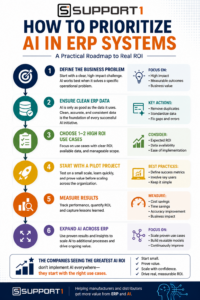
How to Prioritize AI in ERP Systems Use Cases

Rather than trying to implement every AI capability at once, most organizations achieve better results by prioritizing projects with the greatest operational impact.

A practical approach is to evaluate each opportunity based on:

  • Expected ROI
  • Ease of implementation
  • Data quality
  • User adoption
  • Integration requirements
  • Business risk

Starting with one or two high-value AI use cases allows teams to build confidence while creating measurable wins that support future AI initiatives.

According to McKinsey’s latest State of AI survey, 78% of organizations now use AI in at least one business function, with the greatest business value coming from organizations that redesign workflows instead of simply adding AI tools. IDC also predicts that AI will contribute $19.9 trillion in cumulative global economic impact by 2030, highlighting the growing importance of practical, high-value AI initiatives rather than experimental projects.

Infographic showing a six-step roadmap for prioritizing AI in ERP systems, including defining business problems, cleaning ERP data, selecting high-ROI use cases, piloting AI projects, measuring results, and scaling AI across the organization.

Follow this six-step roadmap to prioritize AI in ERP systems, maximize ROI, and successfully scale AI initiatives with clean data, measurable goals, and proven business use cases.

Frequently Asked Questions About AI in ERP Systems Use Cases

What are the best AI in ERP systems use cases?

The highest ROI use cases include demand forecasting, inventory optimization, predictive maintenance, invoice automation, fraud detection, procurement optimization, reporting, customer insights, scenario planning, and master data management.

Which AI use case delivers the fastest ROI?

Invoice processing, reporting automation, and inventory optimization often produce measurable savings quickly because they reduce manual work and improve operational efficiency.

Can SAP Business One use AI?

Yes. SAP Business One users can integrate AI tools for forecasting, reporting, document processing, customer insights, and automation. Success depends on clean data, strong governance, and clearly defined business objectives.

Do companies need cloud ERP before using AI?

Not necessarily. Many AI capabilities can work with on-premise ERP systems, although cloud-based platforms generally provide easier integration and access to newer AI services.

What industries benefit most from AI in ERP?

Manufacturing, wholesale distribution, food processing, logistics, and field service organizations often see the highest ROI because AI improves forecasting, inventory, maintenance, purchasing, and operational planning.

Final Thought

AI in ERP systems is already delivering real ROI—but only in the right places.

The companies seeing success aren’t trying to “AI everything.”

They’re focusing on:

  • High-impact use cases
  • Measurable outcomes
  • Strong data foundations

These use cases represent what’s possible—but success depends on having the right foundation, strategy, and governance in place.

The organizations achieving the greatest return from AI aren’t necessarily using the most AI.

They’re choosing the right AI.

That means identifying high-impact business processes, ensuring data quality, measuring outcomes, and expanding only after early success.

For manufacturers and distributors, this often starts with forecasting, inventory optimization, financial automation, or predictive maintenance before moving into more advanced AI capabilities.

Of course, not every AI initiative succeeds. In fact, some create new challenges if implemented incorrectly—something we explore in AI in ERP systems risks and where it goes wrong.

👉 If you’re exploring AI in your ERP, start by identifying 1–2 high-value use cases—not 10—and build from there.

Continue the AI in ERP Systems Series

👉 Let’s talk about where AI can deliver real ROI in your ERP—and where it’s likely to fall short.

Contact us banner for ERP and AI strategy showing business professionals, analytics icons, and call to action for consultation.

Talk with an expert about how AI can deliver real results in your ERP system.