
SAP Business One WMS: Improve Warehouse Efficiency and ROI
How SAP Business One WMS Integration Improves ROI
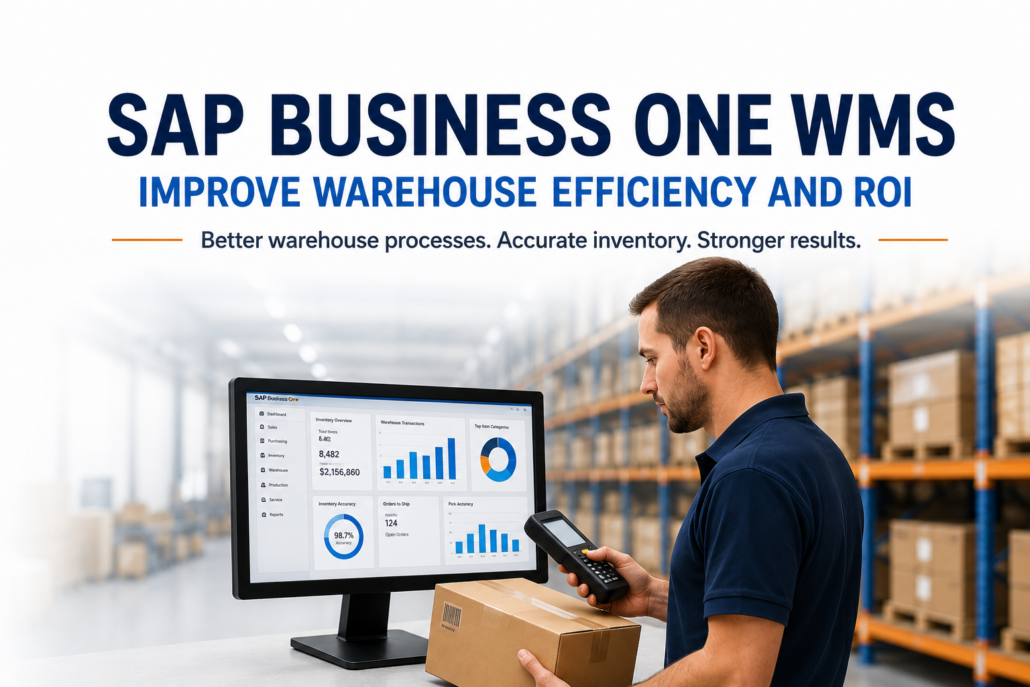
SAP Business One WMS solutions help companies improve warehouse accuracy, reduce operational costs, and achieve a stronger return on their ERP investment through better warehouse processes and system integration.
For many manufacturing, distribution, and wholesale businesses, the warehouse is where profitability is either protected or lost.
Inventory errors, inefficient picking processes, inaccurate stock levels, and manual data entry can create hidden costs that impact the entire organization.
Many companies already use SAP Business One as the foundation of their business operations. However, as companies grow, they often need more advanced warehouse capabilities to improve efficiency and maintain accurate real-time inventory information.
A warehouse management system (WMS) integrated with SAP Business One can help businesses:
- Improve inventory accuracy
- Reduce warehouse labor costs
- Increase order fulfillment speed
- Eliminate manual processes
- Improve customer satisfaction
The real value of a WMS integration is not simply connecting two systems. It is creating a warehouse operation that is faster, more accurate, and more profitable.
What Is SAP Business One WMS?
A warehouse management system is software designed to manage and optimize warehouse operations.
A WMS helps businesses control processes such as:
- Receiving
- Put-away
- Inventory movement
- Picking
- Packing
- Shipping
- Cycle counting
While SAP Business One provides inventory management capabilities, many growing companies require additional warehouse functionality to manage complex operations.
A WMS extends SAP Business One by providing warehouse employees with tools designed specifically for daily warehouse activities.
Read More: What is a Warehouse Management System (WMS)?
SAP Business One WMS helps businesses improve warehouse efficiency, inventory accuracy, and ROI through better processes, automation, and integration.
Consider SAP Business One Upgrades Before Investing in a New WMS
Many companies assume they need a third-party warehouse management system because their current SAP Business One environment does not provide the warehouse capabilities they need.
However, businesses running older versions of SAP Business One may not realize how much warehouse functionality has been added in newer releases.
The latest versions of SAP Business One include expanded inventory and warehouse management capabilities that were not available in earlier versions. Depending on the business requirements, upgrading SAP Business One may provide many of the improvements companies are looking for without the cost and complexity of implementing an entirely separate WMS platform.
Newer SAP Business One functionality can help businesses improve areas such as:
- Inventory management
- Bin location management
- Warehouse processes
- Inventory tracking
- Mobile accessibility
- Operational visibility
A knowledgeable SAP Business One partner can help determine whether an upgrade, configuration change, integration, or new warehouse solution provides the best return.
For some companies, an SAP Business One upgrade may eliminate the need for a full third-party WMS.
Considering an Upgrade? ERP Upgrade Problems: Causes and Solutions
When a Full WMS May Still Be the Right Choice
While SAP Business One continues to add warehouse capabilities, some businesses have more advanced requirements that justify a dedicated WMS solution.
Examples include:
- High-volume distribution operations
- Multiple warehouse locations
- Advanced picking strategies
- Complex shipping requirements
- Automated warehouse equipment
- Advanced labor management
- Real-time warehouse optimization
In these situations, integrating SAP Business One with a specialized WMS can provide the additional functionality needed for a highly efficient warehouse operation.
The key is evaluating the business requirements first rather than assuming more software is always the answer.
When additional warehouse functionality is needed, SAP Business One integrations can connect specialized systems while maintaining accurate business data.
Lighter-Weight Solutions Can Deliver Significant ROI
Not every business needs a full warehouse management system.
Many companies simply need better tools for specific warehouse processes, such as barcode scanning.
For example, businesses may benefit from solutions that provide:
- Mobile barcode scanning
- Receiving automation
- Inventory transfers
- Cycle counting
- Pick confirmation
These lighter-weight solutions can often provide significant improvements at a lower cost and with less complexity than a complete WMS implementation.
For smaller and mid-sized SAP Business One customers, a targeted solution may deliver faster ROI by solving the specific operational challenges they experience today.
Interested in a Low-Cost Barcode Scanning Solution? Video: CoreFunction Scanning Solution
How WMS Integration Improves SAP Business One ROI
A properly designed WMS integration helps businesses maximize their SAP Business One investment by improving the connection between warehouse operations and business data.
The benefits include:
- More accurate inventory information
- Faster warehouse processes
- Reduced manual work
- Better employee productivity
- Improved customer service
The following areas typically provide the greatest return.
1. Improve Inventory Accuracy with Real-Time Updates
Inventory accuracy is one of the biggest factors affecting profitability.
When warehouse activity is recorded manually, companies often experience:
- Incorrect inventory counts
- Lost inventory
- Picking mistakes
- Delayed updates
A WMS integrated with SAP Business One allows inventory movements to be recorded as they happen.
Examples:
- Receiving inventory
- Moving products between locations
- Picking orders
- Shipping products
Employees no longer have to rely on spreadsheets, handwritten notes, or delayed data entry.
The result is better visibility throughout the organization.
Warehouse managers can gain even greater visibility with Business Intelligence for SAP Business One, using dashboards to monitor inventory levels, warehouse productivity, order fulfillment, and inventory turnover in real time.
Warehouse management systems improve inventory execution, while AI Inventory Management improves planning and forecasting. Together they help manufacturers increase warehouse efficiency and reduce inventory costs.
2. Increase Efficiency with SAP Business One Barcode Scanning
Barcode scanning is one of the most immediate ways businesses see value from a warehouse management system.
Without barcode scanning, warehouse employees often manually enter:
- Item numbers
- Quantities
- Warehouse locations
- Order information
This creates opportunities for errors.
Barcode scanning allows employees to quickly and accurately:
- Receive inventory
- Identify products
- Confirm picks
- Complete transfers
- Perform cycle counts
Instead of relying on memory or manual entry, employees scan the actual product.
This improves:
Accuracy
The system confirms the correct item and quantity.
Speed
Employees complete warehouse transactions faster.
Accountability
Businesses gain better visibility into who performed each transaction.
For many companies, barcode scanning creates immediate ROI by reducing labor hours and costly inventory mistakes. SAP Business One Barcode Scanning gives employees the real-time tools they need to receive, pick, transfer, and ship inventory accurately.
Warehouse automation is one of the fastest ways to improve operational efficiency. SAP Business One Automation extends these benefits beyond the warehouse by streamlining sales, purchasing, finance, and customer service workflows across the entire organization.
Curious about SAP Business One automation? SAP Business One ROI: 10 Ways Businesses Increase Profitability
3. Optimize Warehouse Operations with Bin Location Management
Why Bin Locations Matter
Many companies begin with simple warehouse layouts:
- Products stored wherever space is available
- Employees relying on memory
- Limited visibility into exact inventory locations
As companies grow, this approach creates problems.
Employees waste time searching for products, and inventory accuracy declines.
Bin location management creates a structured warehouse environment where every item has a defined location.
Examples:
- Receiving areas
- Storage bins
- Picking locations
- Shipping areas
A WMS integrated with SAP Business One allows businesses to know:
- What inventory they have
- Where it is located
- How much is available
- Where it should be picked from
Benefits of Bin Location Management
Faster Picking
Employees spend less time searching for products.
Better Space Utilization
Companies can optimize warehouse layouts.
Improved Inventory Control
Businesses know exactly where inventory exists.
Easier Employee Training
New employees can follow system-directed processes instead of relying on tribal knowledge.
For growing companies, bin location management can be one of the biggest drivers of warehouse efficiency.
A manufacturer using SAP Business One may know how much inventory exists but still struggle to quickly locate products, confirm picks, or update warehouse transactions. Adding barcode scanning and better warehouse processes can eliminate these delays without replacing the ERP system.
The next step in warehouse optimization may involve using artificial intelligence alongside WMS capabilities. AI warehouse management can analyze operational data to identify picking inefficiencies, improve replenishment, anticipate workload, and help warehouse managers make better decisions.
4. Reduce Warehouse Labor Costs
Labor is often one of the largest warehouse expenses.
A WMS helps employees work more efficiently by providing:
- Directed picking instructions
- Mobile warehouse transactions
- Automated inventory updates
- Better workflows
The goal is not replacing employees.
The goal is allowing employees to accomplish more with fewer errors.
5. Improve Order Fulfillment and Customer Satisfaction
Customers expect:
- Accurate shipments
- Fast delivery
- Reliable inventory availability
Warehouse errors directly affect customer relationships.
A WMS helps improve:
- Picking accuracy
- Shipping accuracy
- Order visibility
- Delivery performance
Better warehouse operations create better customer experiences.
While warehouse employees benefit from real-time inventory visibility, mobile technicians and outside sales teams can achieve similar advantages using SAP Business One Field Service, giving them access to inventory, customer information, and work orders wherever they are.
Businesses that implement eCommerce Integration for SAP Business One can automatically send online orders to the warehouse, reducing fulfillment time and improving customer satisfaction.
When CRM Integration for SAP Business One is combined with warehouse management, sales teams can provide customers with accurate inventory availability and real-time order status without switching between multiple systems.
Warehouse efficiency doesn’t end with picking and packing. Shipping Integration for SAP Business One automates shipping labels, tracking numbers, and carrier selection, helping businesses complete the fulfillment process faster and with fewer errors.
Warehouse operations become even more efficient when EDI Integration for SAP Business One automatically sends shipping notices and receives purchase orders, allowing warehouse teams to process orders with greater speed and accuracy.
6. Improve Cycle Counting and Inventory Control
Traditional physical inventory counts can be disruptive and time-consuming.
A WMS supports more efficient cycle counting by allowing businesses to:
- Count specific locations regularly
- Identify discrepancies quickly
- Maintain accurate inventory records
Improved inventory control helps reduce:
- Excess inventory
- Stock shortages
- Financial reporting issues
7. Create Better Data for Business Decisions
A warehouse management system provides valuable operational information.
Businesses can analyze:
- Warehouse productivity
- Order processing times
- Inventory movement
- Employee efficiency
- Product demand
This information helps management make better decisions.
Connected data also creates a stronger foundation for future automation and AI capabilities.
Read More: The Future of AI in ERP: What Businesses Should Do Now
8. Extend the Value of SAP Business One
Many companies invest heavily in SAP Business One but do not fully utilize its capabilities.
A WMS integration helps extend the value of the ERP system by improving the operational processes that happen every day.
Instead of SAP Business One only managing transactions after they happen, the warehouse becomes an active source of accurate, real-time information.
Choosing the Right SAP Business One WMS Solution
Not every warehouse requires the same level of functionality.
Companies should consider:
- Warehouse size
- Number of inventory items
- Number of locations
- Order volume
- Manufacturing requirements
- Shipping complexity
The right solution should match business needs while integrating smoothly with SAP Business One.
Read More: The Real ROI of SAP Business One Integrations: More Than Just Connecting Systems
Conclusion: WMS Creates ROI by Improving the Way Businesses Operate
A warehouse management system is not valuable simply because it adds more technology.
It creates value because it helps businesses operate better.
By improving:
- Barcode scanning
- Bin location management
- Inventory accuracy
- Warehouse productivity
- Order fulfillment
companies can achieve a stronger return on their SAP Business One investment.
The best WMS solutions do not replace SAP Business One. They make SAP Business One more valuable.
Warehouse efficiency is only one part of maximizing ERP performance. Many businesses also implement AP Automation for SAP Business One to eliminate manual accounting tasks and improve financial efficiency.
Another part of maximizing ERP performance would be to integrate Payment Processing for SAP Business One. This helps businesses accelerate collections, improve cash flow, and strengthen financial performance.
Ready to Improve Your SAP Business One Warehouse Operations?
Many companies have opportunities to improve inventory accuracy, reduce manual processes, and increase warehouse efficiency.
Schedule a Warehouse Optimization Review to identify opportunities to improve SAP Business One warehouse efficiency, inventory accuracy, and ROI.
See: Why Businesses are choosing Support One

Schedule a Warehouse Optimization Review

