
Business Intelligence for SAP Business One
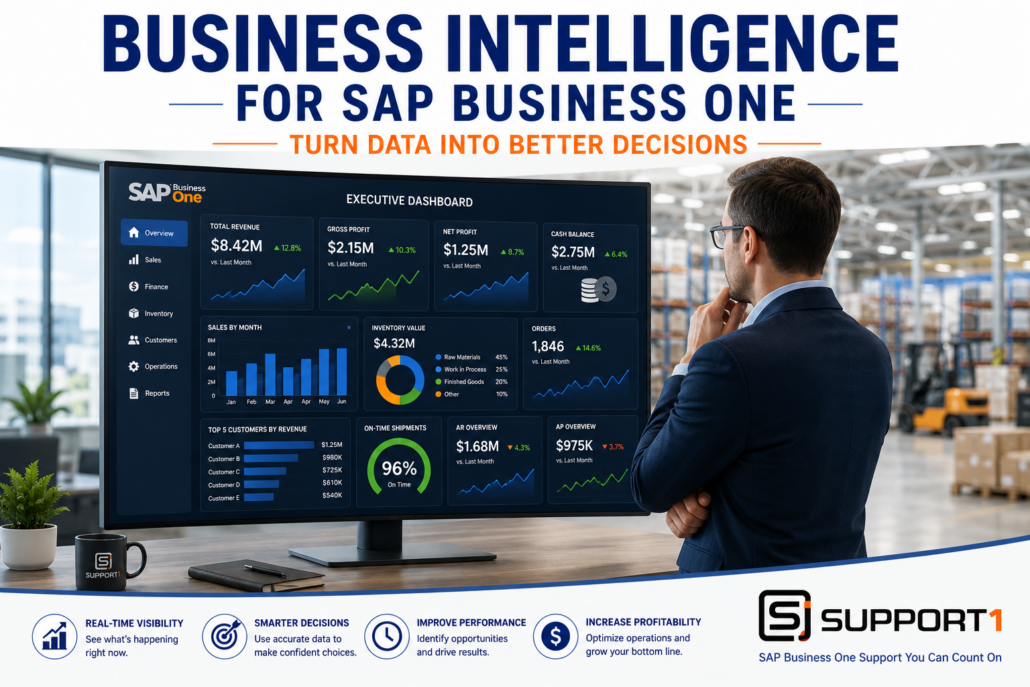
Business Intelligence for SAP Business One: Turn Data into Better Decisions
Business Intelligence for SAP Business One helps businesses transform ERP data into real-time dashboards, reports, and actionable insights that support faster, more informed decision-making. Many organizations collect vast amounts of operational data but still rely on spreadsheets, manually created reports, or outdated information, making it difficult to identify trends, respond quickly to changing conditions, or maximize profitability.
By combining SAP Business One with modern Business Intelligence (BI) tools, companies gain complete visibility into sales, inventory, financial performance, customer activity, and operational efficiency. The result is better business decisions, improved productivity, and a greater return on your ERP investment.
What Is Business Intelligence for SAP Business One?
Business Intelligence (BI) transforms raw ERP data into meaningful dashboards, reports, and performance metrics that help managers and executives understand how their business is performing.
Rather than spending hours compiling spreadsheets, decision-makers can access real-time information through interactive dashboards that display key performance indicators (KPIs).
Common Business Intelligence dashboards include:
- Executive dashboards
- Sales performance
- Financial reporting
- Inventory management
- Warehouse operations
- Customer profitability
- Purchasing analytics
- Cash flow reporting
- Operational KPIs
When integrated with SAP Business One, Business Intelligence provides a single source of truth that helps organizations make faster and more confident business decisions.
Related Reading: The Real ROI of SAP Business One Integrations
Business Intelligence for SAP Business One transforms ERP data into real-time dashboards and actionable insights, helping organizations improve reporting, monitor KPIs, optimize operations, and make faster, data-driven business decisions.
Why Spreadsheets Limit Business Growth
Spreadsheets continue to play an important role in many businesses, but they become increasingly difficult to manage as organizations grow.
Common challenges include:
- Multiple spreadsheet versions
- Manual report preparation
- Outdated information
- Data inconsistencies
- Slow reporting cycles
- Limited visibility
- Difficult forecasting
- Time-consuming analysis
Business leaders often spend more time gathering information than acting on it.
Business Intelligence eliminates these limitations by automatically presenting current information from SAP Business One in easy-to-understand dashboards.
1. Improve Executive Visibility
Executives need immediate access to accurate business information.
Business Intelligence dashboards can display:
- Revenue
- Gross profit
- Cash flow
- Inventory value
- Sales trends
- Customer performance
- Operational KPIs
Instead of waiting for month-end reports, leadership teams can monitor business performance in real time and respond quickly to changing conditions.
Executive dashboards become even more valuable when they’re available on the go. Mobile ERP for SAP Business One gives business leaders secure access to KPIs, reports, and real-time performance metrics from anywhere.
Related Reading: SAP Business One ROI: 10 Ways to Increase Profitability
2. Monitor Sales Performance
Sales dashboards provide valuable insight into business growth.
Managers can monitor:
- Sales by customer
- Sales by product
- Sales by territory
- Open opportunities
- Quote conversion rates
- Customer purchasing trends
Combining CRM data with ERP information creates a more complete view of the customer journey while helping sales teams identify new opportunities.
Related Reading: CRM Integration for SAP Business One: Improve Sales and Customer Relationships
3. Optimize Inventory and Warehouse Operations
Inventory is one of the largest investments many businesses make.
Business Intelligence helps managers monitor:
- Inventory turns
- Stock availability
- Slow-moving inventory
- Warehouse productivity
- Fill rates
- Order fulfillment performance
These insights help improve purchasing decisions while reducing carrying costs and inventory shortages.
Automation accelerates purchasing workflows, while AI Purchasing improves the decisions behind those workflows through forecasting, supplier analysis, and intelligent recommendations.
Related Reading: SAP Business One WMS: Improve Warehouse Efficiency and ROI
Related Reading: SAP Business One Barcode Scanning: Improve Accuracy and Productivity
4. Improve Financial Reporting
Finance teams need timely, accurate information to manage business performance.
Business Intelligence dashboards provide visibility into:
- Cash flow
- Accounts Receivable
- Accounts Payable
- Gross margins
- Operating expenses
- Profitability
- Budget performance
Instead of manually building financial reports, managers can access current information whenever they need it.
Related Reading: Payment Processing for SAP Business One: Improve Cash Flow and Reduce Costs
Related Reading: AP Automation for SAP Business One: Reduce Costs and Eliminate Manual Processing
5. Measure Operational Efficiency
Business Intelligence helps organizations monitor operational performance across multiple departments.
KPIs may include:
- Order processing time
- Warehouse productivity
- Shipping performance
- Customer response times
- Automation success
- Employee productivity
These metrics allow businesses to identify bottlenecks and continuously improve operations.
Related Reading: Shipping Integration for SAP Business One: Automate Shipping and Improve Fulfillment
Related Reading: SAP Business One Automation: Save Time, Reduce Costs, and Improve Efficiency
Customer-service information can also become valuable business intelligence. AI Customer Service can help identify recurring complaints, product issues, service trends, and other patterns that management might otherwise miss.
6. Improve Forecasting and Business Planning
Business Intelligence doesn’t just report on the past—it helps organizations prepare for the future.
Historical trends help businesses forecast:
- Customer demand
- Inventory requirements
- Purchasing needs
- Cash flow
- Sales growth
- Staffing requirements
Better forecasting supports smarter planning and more informed strategic decisions.
Businesses exploring advanced forecasting capabilities should also consider how artificial intelligence can enhance predictive analytics and decision-making.
Related Reading: What AI Features in ERP Actually Deliver ROI?
Business Intelligence dashboards help you understand what happened. AI Financial Management helps explain why it happened and recommends the next best actions.
Artificial intelligence can take sales analysis another step by helping users investigate why results changed and where to focus next. AI for Sales can uncover customer trends, cross-sell opportunities, declining accounts, and other patterns hidden within sales data.
Business Intelligence Is More Valuable with Integrated Data
Business Intelligence becomes significantly more powerful when information flows seamlessly throughout the organization.
For example, customer information from CRM, online orders from eCommerce, payment transactions, warehouse activity, barcode scanning, shipping updates, and EDI trading partner communications can all feed into a single dashboard.
Instead of viewing departments independently, executives gain a complete picture of business performance—from customer acquisition through order fulfillment and financial reporting.
This connected approach allows organizations to identify trends, measure performance, and make better decisions based on accurate, real-time information.
Accurate reporting depends on organized information. Document Management for SAP Business One ensures supporting documents remain accessible alongside ERP data, helping businesses improve reporting, compliance, and operational visibility.
Choosing the Right Business Intelligence Solution
Not every Business Intelligence platform offers the same capabilities.
When evaluating BI software, consider:
- Native SAP Business One integration
- Dashboard customization
- Real-time reporting
- Mobile access
- Power BI compatibility
- Data security
- Scalability
- Ease of use
- Ongoing support
If your organization is using an older version of SAP Business One, it may also be worth evaluating an ERP upgrade to ensure compatibility with modern reporting and analytics tools.
Explore: SAP Analytics Cloud
Explore: Microsoft Power B1
Related Reading: ERP Upgrade Problems: Causes and Solutions
Related Reading: How to Choose the Right SAP Business One Support Partner
Traditional dashboards tell you what happened. AI helps explain why it happened and what actions to consider next. Learn more in our AI for SAP Business One: The Complete Guide.
Conclusion: Why Business Intelligence for SAP Business One Delivers ROI
Collecting data is only the first step. The real value comes from turning that data into actionable business intelligence.
Business Intelligence for SAP Business One provides executives and managers with real-time dashboards, meaningful reports, and key performance metrics that support faster decision-making, improved operational visibility, and stronger financial performance.
Whether your goal is increasing profitability, improving inventory management, streamlining financial reporting, or gaining deeper operational insight, Business Intelligence helps organizations maximize the value of their SAP Business One investment.
Ready to Turn Data into Better Business Decisions?
Support One helps businesses implement Business Intelligence solutions that transform SAP Business One data into meaningful dashboards and actionable insights. Whether you’re looking to improve executive reporting, monitor KPIs, or gain greater visibility across your organization, our team can help you unlock the full potential of your ERP system.
Learn Why Businesses Are Choosing Support One for SAP Business One Support and discover how Business Intelligence can help your organization improve decision-making and drive long-term growth.
Schedule a Business Intelligence Consultation to see how real-time dashboards can improve visibility, increase efficiency, and maximize your ERP investment.

Questions about Business Intelligence Let’s talk.

