
AI Purchasing: Reduce Costs & Improve Procurement
How AI Improves Purchasing: Reduce Costs, Strengthen Supplier Relationships, and Buy Smarter
Introduction
AI purchasing and AI procurement are transforming how manufacturers and distributors manage supplier relationships and purchasing decisions. Today’s purchasing professionals face constant pressure to reduce costs while maintaining inventory levels, improving supplier performance, and responding quickly to changing market conditions. Artificial intelligence helps purchasing teams analyze ERP data, identify trends, and make more informed decisions that support both operational efficiency and profitability.
Purchasing has always been about finding the right balance between cost, availability, quality, and customer demand. Unfortunately, that balance has become much harder to achieve. Supply chain disruptions, inflation, tariffs, fluctuating material costs, and longer supplier lead times have forced purchasing managers to make increasingly complex decisions.
Traditional ERP systems like SAP Business One provide the information needed to manage purchasing effectively, but they don’t always highlight opportunities or predict future challenges. Artificial intelligence fills that gap by analyzing purchasing history, supplier performance, inventory levels, and demand trends to generate practical recommendations that help buyers make better decisions.
It’s important to understand that AI doesn’t replace purchasing professionals. It enhances their ability to evaluate information, identify risks, and respond more quickly to changing business conditions. SAP Business One remains your trusted system of record, while AI becomes an intelligent assistant that transforms ERP data into actionable business insights.
If you’re looking for a broader understanding of how artificial intelligence works across every department, we recommend reading our AI for SAP Business One: The Complete Guide, which explains how manufacturers and distributors are successfully adopting practical AI throughout their organizations.
Why AI Purchasing Is More Important Than Ever
The role of purchasing has changed dramatically over the past several years.
What was once primarily focused on negotiating prices and issuing purchase orders has evolved into a strategic business function responsible for protecting profitability, maintaining production schedules, and reducing supply chain risk.
Today’s purchasing teams must balance numerous competing priorities, including:
- Rising material costs
- Global supply chain disruptions
- Tariffs and trade uncertainty
- Longer supplier lead times
- Changing customer demand
- Inventory carrying costs
- Supplier reliability
- Cash flow management
A purchasing decision made today may affect production schedules several months into the future.
For example, ordering too much inventory increases carrying costs and ties up working capital. Ordering too little inventory may create production delays, missed customer shipments, and expensive emergency purchases.
Adding to the challenge, supplier performance is constantly changing. Vendors that consistently delivered on time a year ago may now experience transportation delays, labor shortages, or material constraints that impact delivery schedules.
According to the Institute for Supply Management (ISM), procurement organizations are increasingly adopting advanced analytics and AI technologies to improve purchasing decisions, strengthen supplier relationships, and better manage supply chain risk.
Businesses that rely solely on historical reports often react after problems have already occurred. Modern AI procurement solutions help purchasing professionals to anticipate challenges before they become costly disruptions.
What AI Purchasing Actually Does
Artificial intelligence is often misunderstood within procurement.
Some assume AI automatically creates purchase orders or replaces purchasing professionals.
That isn’t how successful organizations use AI.
Think of it this way:
ERP records transactions
AI analyzes transactions
Together they create a smarter purchasing process.
Instead of manually reviewing hundreds of reports, spreadsheets, and supplier records, Today’s AI procurement platforms analyze years of purchasing history within seconds and identifies patterns that deserve attention.
AI purchasing can help businesses:
- Predict future material requirements
- Recommend purchase quantities
- Analyze supplier performance
- Identify price trends
- Detect purchasing anomalies
- Recommend order timing
- Reduce emergency purchases
- Improve cash flow
- Prioritize purchasing activities
- Support better decision-making
Rather than replacing buyers, AI allows experienced purchasing professionals to spend less time gathering information and more time negotiating with suppliers, managing relationships, and making strategic decisions.
Microsoft describes this approach as using AI to augment human expertise by providing faster access to meaningful business insights while allowing employees to remain in control of important decisions.
AI Purchasing vs. AI Procurement
The terms AI purchasing and AI procurement are often used interchangeably, but procurement typically refers to the broader process of sourcing, evaluating suppliers, negotiating contracts, and managing purchasing strategy. Purchasing focuses on acquiring the materials and services needed to support day-to-day operations. In either case, artificial intelligence helps organizations analyze ERP data, improve supplier performance, reduce costs, and make smarter buying decisions.
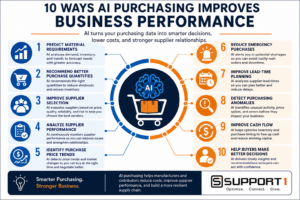
Discover 10 practical ways AI purchasing helps manufacturers and distributors reduce costs, improve supplier performance, optimize procurement decisions, and make smarter purchasing decisions with SAP Business One.
10 Ways AI Purchasing Improves Business Performance
1. AI Purchasing Predicts Material Requirements More Accurately
One of the biggest challenges in purchasing is knowing what materials will be needed—and when.
Traditional purchasing often relies on historical sales, MRP recommendations, and planner experience. While these methods remain valuable, they may not respond quickly enough to changing market conditions.
AI analyzes a much broader range of information, including:
- Historical purchasing
- Sales trends
- Inventory levels
- Seasonal demand
- Supplier lead times
- Production schedules
- Customer ordering patterns
- Market conditions
As AI continuously evaluates new ERP data, purchasing forecasts become more accurate over time.
This helps organizations:
- Purchase materials earlier
- Avoid shortages
- Reduce expedited freight
- Improve production scheduling
- Lower purchasing costs
Within SAP Business One, purchasing history and inventory transactions provide an excellent foundation for AI-powered demand planning.
Purchasing decisions can have an immediate effect on the production schedule. AI for manufacturing can help identify which component shortages, supplier delays, or purchasing risks are most likely to disrupt upcoming production.
2. AI Purchasing Recommends Better Purchase Quantities
Many organizations continue using reorder quantities established years ago.
Unfortunately, customer demand, supplier performance, and inventory strategies rarely remain the same.
AI continuously evaluates purchasing activity to recommend quantities that better reflect current business conditions.
Rather than relying on fixed reorder rules, AI considers factors such as:
- Current inventory
- Forecast demand
- Supplier reliability
- Lead times
- Order frequency
- Safety stock
- Seasonal demand
These recommendations help purchasing teams maintain appropriate inventory while reducing excess stock.
The result is a healthier balance between customer service and working capital.
Purchasing decisions become even more useful when they’re connected to what the sales team sees coming. AI for Sales can help identify changing customer demand and potential opportunities that purchasing teams may need to prepare for.
3. AI Purchasing Improves Supplier Selection
Choosing the right supplier involves much more than comparing prices.
Purchasing professionals must also evaluate:
- Delivery performance
- Product quality
- Lead time consistency
- Communication
- Financial stability
- Responsiveness
AI can analyze years of supplier performance and identify vendors that consistently provide the greatest overall value.
For example, a supplier offering the lowest price may frequently deliver late, resulting in production delays and higher freight costs.
Another supplier may charge slightly more but consistently delivers on time, reducing business risk and improving customer satisfaction.
Rather than relying solely on experience or anecdotal feedback, AI provides objective recommendations supported by ERP data.
4. AI Purchasing Analyzes Supplier Performance
Every purchasing department collects supplier information.
The challenge is turning that information into meaningful insights.
AI can continuously monitor supplier performance by analyzing:
- On-time delivery
- Lead time trends
- Purchase price changes
- Order accuracy
- Fill rates
- Returns
- Quality issues
Instead of reviewing individual reports, purchasing managers receive summarized recommendations that highlight suppliers requiring attention.
For example, one of the greatest strengths of AI procurement is to help identify:
- Suppliers with declining performance
- Vendors experiencing increasing lead times
- Suppliers consistently missing delivery commitments
- Vendors with unusually frequent pricing changes
These insights help businesses proactively strengthen supplier relationships before problems affect production.
The Association for Supply Chain Management (ASCM) continues to emphasize supplier collaboration and performance measurement as key elements of resilient supply chains.
Purchasing decisions affect inventory, production, warehouse activity, and customer delivery, which is why AI for Supply Chain Management can provide a broader view of the impact of buying decisions.
5. AI Purchasing Identifies Price Trends
Material pricing changes constantly.
Without AI, identifying long-term pricing trends often requires extensive spreadsheet analysis.
AI automatically evaluates purchasing history to identify:
- Gradual supplier price increases
- Seasonal pricing patterns
- Commodity cost trends
- Purchasing opportunities
- Vendors with improving pricing
- Items experiencing unusual cost increases
This allows purchasing managers to negotiate more effectively using historical purchasing data rather than relying on memory or isolated transactions.
AI can even recommend purchasing certain materials earlier when it detects pricing patterns that suggest future increases.
For manufacturers operating on narrow profit margins, these insights can significantly improve purchasing performance while protecting profitability.
If improving profitability is one of your organization’s goals, our article AI in ERP Systems Use Cases: 10 That Deliver ROI explores additional ways technology and better decision-making can improve financial performance.
AI Doesn’t Replace Great Buyers
The most successful purchasing professionals still negotiate contracts, build supplier relationships, evaluate strategic risks, and make final purchasing decisions.
AI simply helps them make those decisions with better information.
Coming Up in Part 2
In the next section, we’ll explore five additional ways AI purchasing improves procurement performance, including reducing emergency purchases, improving lead-time planning, detecting purchasing anomalies, strengthening cash flow, and helping buyers make faster, more informed decisions. We’ll also examine how AI works with SAP Business One, provide practical AI prompts for purchasing managers, and include actionable recommendations you can begin using immediately.
Part 2
In Part 1, we explored how AI purchasing helps organizations predict material requirements, recommend better purchase quantities, improve supplier selection, analyze supplier performance, and identify purchasing price trends.
These capabilities alone can significantly improve procurement performance, but AI offers even more opportunities to streamline purchasing operations, reduce business risk, and improve profitability.
6. AI Purchasing Reduces Emergency Purchases
Emergency purchases are expensive.
When materials aren’t available when needed, businesses often face:
- Rush shipping charges
- Premium supplier pricing
- Production delays
- Overtime labor
- Missed customer commitments
- Reduced profit margins
Most emergency purchases don’t happen because purchasing teams aren’t doing their jobs—they happen because market conditions change faster than traditional planning methods can respond.
AI continuously monitors:
- Inventory consumption
- Supplier lead times
- Customer demand
- Production schedules
- Purchase order status
Instead of reacting to shortages after they occur, AI alerts purchasing teams to potential supply risks while there is still time to take corrective action.
Reducing emergency purchases not only lowers costs but also creates a more stable and predictable supply chain.
7. AI Purchasing Improves Lead-Time Planning
Supplier lead times have become far less predictable than they once were.
Many ERP systems store expected lead times, but actual delivery performance often varies considerably.
AI analyzes historical supplier performance to identify:
- Average lead times
- Seasonal delivery fluctuations
- Vendors with increasing delays
- Suppliers with improving performance
- Products consistently arriving late
Rather than relying on static lead times entered years ago, AI continuously recommends adjustments based on current supplier performance.
Purchasing managers can then make more informed decisions regarding:
- Order timing
- Safety stock
- Alternate suppliers
- Production scheduling
This helps reduce inventory shortages while minimizing unnecessary inventory investment.
Supplier delays don’t stop with the purchasing department—they can quickly become customer-service issues. AI Customer Service can help employees identify potential delays earlier and communicate with customers before problems escalate.
8. AI Purchasing Detects Purchasing Anomalies
One of AI’s greatest strengths is recognizing unusual patterns.
Purchasing departments generate thousands of transactions each year, making it nearly impossible for buyers to manually review every purchase order.
AI can quickly identify anomalies such as:
- Duplicate purchase orders
- Unexpected price increases
- Purchases outside normal buying patterns
- Unusual supplier activity
- Significant changes in order quantities
- Vendors receiving unusually large orders
- Items purchased outside approved suppliers
Rather than reviewing dozens of reports, buyers receive prioritized recommendations highlighting purchasing activity that deserves attention.
Instead of asking:
“What happened?”
Purchasing managers can ask:
- Which purchase orders require immediate review?
- Which suppliers are showing unusual behavior?
- Which materials experienced unexpected price increases this month?
This proactive approach helps reduce errors while improving purchasing controls.
Purchasing decisions ultimately affect what arrives at the receiving dock. AI warehouse management can use expected receipts, inventory needs, available space, and warehouse workload to help teams prepare for incoming products and avoid receiving bottlenecks.
9. AI Purchasing Improves Cash Flow
Every purchasing decision affects cash flow.
Buying too much inventory ties up working capital.
Buying too little inventory creates operational risk.
AI helps purchasing professionals strike the right balance.
By analyzing inventory levels, demand forecasts, supplier lead times, and purchasing history, AI recommends purchasing strategies that improve both inventory availability and cash flow.
Examples include:
- Consolidating purchase orders
- Reducing excess inventory
- Purchasing closer to actual demand
- Prioritizing strategic inventory
- Identifying opportunities to delay non-essential purchases
These recommendations help organizations invest their working capital where it creates the greatest business value.
If improving cash flow and profitability is one of your goals, you may also enjoy our article AI for SAP Business One: Increase Revenue and Profit, which explores additional strategies for maximizing the value of your ERP investment.
10. AI Purchasing Helps Buyers Make Better Decisions
Perhaps the greatest advantage of AI purchasing is its ability to summarize complex information into simple recommendations.
Instead of opening multiple ERP reports, buyers can simply ask questions in natural language.
For example:
“Which suppliers require my attention today?”
AI may respond with:
- Three suppliers experiencing longer lead times
- Two vendors with recent price increases
- One purchase order at risk of delaying production
- Five items requiring replenishment sooner than expected
Instead of spending hours gathering information, purchasing professionals begin the day with prioritized recommendations.
Microsoft refers to this as Copilot-style assistance, where AI helps employees interpret business information rather than replacing their expertise.
The result is faster decision-making, greater confidence, and improved purchasing performance.
Better purchasing decisions improve financial performance, but finance leaders also benefit from AI-driven forecasting and reporting. Discover how AI Financial Management helps transform ERP data into smarter financial decisions.
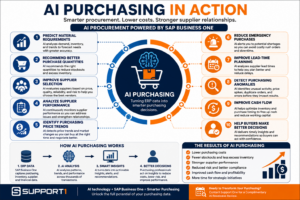
See how AI purchasing transforms SAP Business One ERP data into smarter procurement decisions by analyzing supplier performance, forecasting demand, optimizing purchasing, and improving business results.
How AI Purchasing Works with SAP Business One
One of the biggest misconceptions about AI is that businesses need to replace their ERP system before they can benefit from artificial intelligence.
In reality, AI becomes far more valuable when it’s connected to an ERP system like SAP Business One.
SAP Business One already manages critical purchasing information, including:
- Vendor master records
- Purchase orders
- Purchasing history
- Inventory levels
- MRP recommendations
- Lead times
- Item master data
- Landed costs
- Approval workflows
- Goods receipts
AI doesn’t replace these capabilities.
Instead, it analyzes this information to uncover trends, identify opportunities, and recommend actions that help purchasing professionals make better decisions.
Think of SAP Business One as the business system that records purchasing activity.
SAP Business One provides an excellent foundation for AI procurement because AI becomes the intelligent advisor that explains what the data means and where buyers should focus their attention.
Organizations with clean ERP data are in the best position to benefit from AI purchasing.
For additional guidance, we recommend these related articles:
- AI for SAP Business One: The Complete Guide
- AI Inventory Management
- Why Most ERP Systems Aren’t AI-Ready
- Clean Data for AI in ERP Systems
- AI Governance: The Missing Piece
Purchasing Insight
AI can analyze years of purchasing history in seconds, uncovering supplier trends, pricing patterns, and procurement opportunities that would be difficult to identify manually.
Practical AI Purchasing Prompts for Purchasing Managers
One of the easiest ways to begin using AI is by asking better questions.
Here are several prompts purchasing professionals can use today.
Supplier Performance
Which suppliers consistently deliver purchase orders on time, and which vendors have shown declining performance during the past 12 months?
Purchasing Costs
Identify vendors with the largest purchase price increases over the past year and recommend opportunities for renegotiation.
Material Planning
Based on current sales trends and inventory levels, which materials should be purchased within the next 30 days?
Lead Times
Which suppliers have experienced increasing lead times during the past six months?
Inventory Optimization
Which purchased materials have excess inventory compared to expected demand?
Cash Flow
Which purchase orders could be delayed without affecting production schedules?
Purchasing Efficiency
Identify purchase orders that could be consolidated to reduce freight costs and improve purchasing efficiency.
Executive Summary
Summarize the five purchasing issues that require management attention this week.
These examples demonstrate how AI transforms thousands of ERP transactions into practical recommendations that help purchasing teams focus on the decisions that matter most.
Coming Up in Part 3
In the final section, we’ll explore best practices for implementing AI purchasing, common mistakes to avoid, answers to frequently asked questions, and how Support One helps manufacturers and distributors prepare for practical AI adoption. We’ll finish with a strong call to action and complete the article with final SEO recommendations.
Part 3
Successful organizations don’t implement AI simply because it’s the latest technology trend. They implement it to solve real business problems, improve decision-making, and create measurable value. The same principle applies to purchasing.
Artificial intelligence delivers the greatest results when it’s built on a solid ERP foundation, supported by accurate data, and guided by experienced purchasing professionals who understand their suppliers, products, and business objectives.
Best Practices for AI Purchasing
Like any business technology, AI performs best when organizations establish the right processes before implementation. Successful AI procurement depends on:
Maintain Clean Purchasing Data
Artificial intelligence depends on accurate ERP information.
Before implementing AI purchasing initiatives, review your:
- Vendor master records
- Item master data
- Lead times
- Purchase history
- Pricing information
- Units of measure
- Approved supplier lists
- Payment terms
Incomplete or outdated purchasing records reduce the accuracy of AI recommendations.
If you’re preparing your ERP system for AI, our article Why Clean Data Matters More Than AI Tools explains why data quality is one of the most important factors in successful AI adoption.
Develop Supplier Scorecards
The best purchasing organizations evaluate suppliers using objective performance metrics.
AI becomes even more valuable when supplier scorecards include:
- On-time delivery
- Order accuracy
- Quality performance
- Lead time consistency
- Price competitiveness
- Responsiveness
- Fill rates
Instead of relying on opinions or isolated experiences, AI can analyze long-term supplier performance and recommend vendors based on measurable business results.
Keep Buyers in Control
AI provides recommendations.
People make decisions.
Experienced buyers understand factors AI cannot always evaluate, including:
- Strategic supplier relationships
- Contract negotiations
- New product launches
- Market intelligence
- Business priorities
- Customer commitments
The most successful organizations use AI to support purchasing professionals—not replace them.
Monitor Purchasing Performance
AI should become part of a continuous improvement process.
Regularly review key purchasing metrics such as:
- Purchase price variance
- Supplier performance
- Inventory turnover
- Emergency purchases
- Lead time accuracy
- Purchase order cycle time
- Cost savings
- Inventory carrying costs
Monitoring results helps purchasing teams continually improve both business processes and AI recommendations.
Establish AI Governance
As AI becomes part of procurement decision-making, organizations should define clear guidelines regarding:
- Purchasing approvals
- Data security
- Vendor information
- AI-generated recommendations
- Employee responsibilities
- Exception handling
Governance builds confidence while ensuring purchasing decisions remain aligned with company policies.
For additional guidance, read our article AI Without Governance is a Business Risk Multiplier.
Common AI Purchasing Mistakes to Avoid
Organizations sometimes expect AI to transform purchasing overnight.
In reality, the best results come from combining AI with strong procurement practices.
Here are several common mistakes to avoid.
Expecting AI to Replace Buyers
AI can analyze supplier data faster than humans.
It cannot build supplier relationships.
Successful purchasing still depends on experienced professionals who understand negotiations, risk management, and long-term business strategy.
Ignoring ERP Data Quality
Poor purchasing data produces poor recommendations.
Before implementing AI, verify that:
- Vendor information is current.
- Lead times are accurate.
- Pricing is maintained.
- Purchase history is complete.
- Item records are standardized.
Clean ERP data is one of the greatest predictors of AI success.
Automating Every Purchasing Decision
Not every purchase should be automated.
Certain purchasing decisions require human judgment, including:
- Strategic sourcing
- Capital equipment
- New suppliers
- Contract negotiations
- High-value purchases
AI should improve purchasing decisions—not eliminate oversight.
Focusing Only on Lowest Cost
The lowest purchase price doesn’t always produce the lowest overall cost.
AI helps organizations evaluate:
- Delivery reliability
- Quality
- Total landed cost
- Supplier risk
- Inventory impact
Sometimes paying slightly more results in significantly lower operational costs.
Treating AI as a One-Time Project
AI purchasing isn’t software you install once and forget.
As markets change, supplier performance evolves, and customer demand shifts, AI continuously learns and improves.
Organizations that regularly review AI recommendations achieve the greatest long-term value.
AI Purchasing FAQs
Can AI create purchase orders automatically?
AI can recommend purchase orders and purchasing quantities based on ERP data, but most organizations continue requiring human approval before purchase orders are released.
Does AI replace purchasing professionals?
No.
AI supports buyers by analyzing large volumes of purchasing data and generating recommendations.
Experienced purchasing professionals remain responsible for supplier relationships, negotiations, and final purchasing decisions.
Can AI improve supplier relationships?
Yes.
By identifying delivery trends, quality issues, and performance patterns, AI helps purchasing teams have more productive conversations with suppliers and address problems before they affect operations.
Will AI work with SAP Business One?
Absolutely.
SAP Business One stores the purchasing, inventory, supplier, and financial information that AI analyzes to generate recommendations and business insights.
The better your ERP data, the greater the value AI can provide.
Can AI reduce purchasing costs?
Yes.
Organizations use AI to:
- Improve purchasing timing
- Reduce emergency purchases
- Optimize order quantities
- Identify better suppliers
- Improve negotiations
- Reduce inventory carrying costs
How much purchasing history is needed?
Most organizations benefit from at least one year of purchasing history.
Additional historical data often improves forecasting accuracy and supplier performance analysis.
Is AI only useful for large companies?
No.
Small and mid-sized manufacturers and distributors often benefit even more because AI helps lean purchasing teams analyze information that would otherwise require significant manual effort.
Why Support One Helps Businesses Prepare for AI Purchasing
Purchasing is one of the most valuable areas for practical AI adoption.
Organizations already have years of purchasing history stored inside SAP Business One.
The opportunity lies in turning that data into better business decisions.
Support One helps manufacturers and distributors prepare for AI by helping them:
- Improve ERP data quality
- Optimize purchasing workflows
- Strengthen supplier management
- Improve inventory planning
- Enhance reporting and analytics
- Identify practical AI opportunities
- Develop a realistic AI roadmap
Rather than recommending technology for technology’s sake, we focus on helping businesses achieve measurable operational improvements.
Whether your goal is reducing purchasing costs, improving supplier performance, increasing inventory accuracy, or preparing for AI adoption, Support One can help you build a practical roadmap that fits your business. See Why Business Are Choosing Support One.
The Future of AI Purchasing
Purchasing has evolved from a transactional function into a strategic driver of business performance. Every purchasing decision affects inventory levels, production schedules, customer satisfaction, cash flow, and profitability.
Artificial intelligence gives purchasing professionals a powerful new advantage by transforming ERP data into meaningful recommendations that support faster, more informed decision-making.
Rather than replacing experienced buyers, AI helps them spend less time searching for information and more time strengthening supplier relationships, negotiating contracts, and making strategic purchasing decisions.
Organizations that combine SAP Business One with practical AI tools are better positioned to reduce costs, improve supplier performance, strengthen supply chain resilience, and increase profitability.
The future of purchasing isn’t about replacing people with artificial intelligence.
It’s about giving purchasing professionals the insights they need to make better business decisions every day.
Get Started with AI Purchasing
Artificial intelligence is already helping manufacturers and distributors reduce purchasing costs, improve supplier performance, and make smarter procurement decisions.
The question isn’t whether AI will become part of purchasing.
The question is whether your business is ready to take advantage of it.
Schedule your Complimentary AI Readiness Review with Support One.
Our experts will help you:
- Evaluate your purchasing processes
- Assess your ERP data readiness
- Identify practical AI opportunities
- Prioritize initiatives with the greatest business impact
- Develop a realistic AI adoption roadmap
Whether you’re looking to reduce purchasing costs, strengthen supplier relationships, improve inventory planning, or prepare SAP Business One for AI, Support One can help you move forward with confidence.
Contact Support One today to schedule your Complimentary AI Readiness Review and discover how AI can transform your purchasing process.

Let’s talk about AI Consulting for SAP Business One

